Saturday, January 18, 2020

Newsletter No. 24---Pioneer Flight

This story is really about the Pioneer Flight Museum in Kingsbury, Texas but with a long introduction on the history of flight.
Occasionally, someone asks the question of whether the Wright Brothers were the first to fly an airplane. The latest inquiry to the Smithsonian was initiated by someone who had seen an historical marker in Texas that it was Jakob Brodbeck who first demonstrated manned flight. Not so, says the Smithsonian, it was the Wright Brothers with their historic flight at Kitty Hawk in 1903. The answer to this question of the first manned flight gets one involved in a whole lot of operational definitions. What constitutes manned flight? We won’t even try to outline all the definitions relating to this question, but to recognize that many people made hundreds of attempts to fly. Many never survived their attempt. But, for sure, Jakob Brodbeck worked to develop a machine that would fly. He was a German immigrant, lived for many years near Luckenbach’s Grape Creek area, and died there about 7 years after the Wright Brothers made their historic trip. Brodbeck made a model that was powered by a spring driven propeller that resembled a boat propeller. There is some mystery surrounding his claim of having gone from small scale models to a size that would carry a man. Legend tells us that the flight of record was in the Luckenbach area, the craft rose ten feet off the ground and traversed 100 feet when the spring unwound, and the plane crashed to the ground. No documentation has survived this event. Most critics of the Brodbeck legend of this early flight cited the inability of a propeller designed for watercraft to propel a craft in air. It was the Wright Brothers who utilized an existing discovery that the cross-sectional shape of the blades of the propeller should be like that of a wing in order to provide the thrust needed in air. Simply put, a propeller designed for water would not provide nearly enough thrust in air. However, we accept that everything in Texas is bigger and better, and stories are no exception.
Before the Wright Brothers made their historic powered, controlled, manned flight of 1903, there were many who worked to achieve manned flight from their observations of birds in flight. Records exist of designs to create a heavier than air flying machines dating back to the 1600s. Most of the records are merely drawings, but some were small scale models. Most notable was Leonardo DaVinci’s drawings of ways to achieve manned flight. Most of the early models took the shape and features of birds, even bird-like wings attached to the back and shoulders of a person—even to the extent that the wings were made to flap like those of a bird. A 12th century book describes Eilmer, a monk, attaching bird like flaps to his arms and legs, then jumping from a tower to demonstrate first flight. Instead he landed at the base of the tower with two broken legs, lamenting that he should have added a tail to his body. None of these heavier than air machines were successful. The only heavier than air machines of the earlies times that flew were basically kites, either flown in the wind or towed behind running horses.
In the course of history, kites were probably the first heavier than air devices that were able to fly, albeit tethered to a person on the ground. As it turns out, kites provided a lot of the technology used in the Wright Brothers first flight.
The science of heavier-than-aircraft was not progressing very rapidly in the 1800s but, lighter-than-air aircraft were successful and popular prior to 1900. Most notable of the earliest developments was the hot air balloon. I can recall hot air balloons at an amusement park in the 1940s. At the time I thought it was quite a feat, not knowing that the concept and usage was already over 100 years old. Here’s how it went: A wood fueled fire was built on the ground; a big canvas bag was held with the opening such that the hot gases from the fire filled the balloon. Then with the balloon continually over the fire, the air inside the balloon was so hot that when the balloonist decided it was time to fly, he jumped into a sling fastened to the balloon, had his assistants free the balloon and away he went, waving to the crowd as he rapidly rose into the sky. He stayed on board the balloon as long as the gases in the balloon were still hot and the balloon continued to rise, but at some point as the air in the balloon cooled, he sensed that the ride was coming to an end so he jumped out of the his riding sling, and parachuted back to earth. Then, with no weight on the open end of the balloon, it turned upside down, smoke poured out the open end and the bag plunged to the ground. All this visible to those on the ground because he was at about 3000 feet in altitude and maybe 8 miles down wind when this dramatic end occurred. Here is a 1914 photo from that very amusement park.

 Figure 1 Hot air balloon over Reeds Lake


 Early balloons had no way to control flight direction, but then later with the development of the German Zeppelins and even to today with the blimps of Goodyear, balloon craft could be propelled and steered.
Early flight capability was developed both in lighter than air and heavier than air inventions, but from the beginning, successful heavier than air flight was the prime objective. There were countless ideas on how to create a manned flying machine, but most ran into a dead end due to the lack of one of four key dynamics of flight. Sir George Cayley is recognized as the pioneer of the physics of flight, having documented several principles for flight based on science of the early 1800s. These principles consist of the four vectors of flight: thrust (forward motion), drag (resistance to motion), lift (opposition to gravity) and weight (effect of gravity). In the 1800s, all these basics of flight were understood, but the only limitation was that there was no way to generate forward motion and control of flight. The engine had not arrived yet and the science of flight control—yaw, pitch and roll---had not been developed at this time. Yet, without the ability to provide forward motion, time was not wasted in the development of flight control principles. It was during the late 1800s that large craft were designed for gliding. It was during this phase of development using gliders that the principles of flight control were developed. Most of this work was done in France. Then, when the gasoline engine became available, Langley came close to becoming the first to demonstrate sustained, manned, controlled flight with his late 1800s experiments in the Potomac River.
 Figure 2 Langley's water-based launch platform

Langley’s first design resulted in a successful aircraft, but the engine was too small. He then developed a larger engine, but the plane would not support the weight and power of the newer engine. This was just a few years before the Wright Brothers put all the right pieces together to make their historic flight in 1903. Thus, we can look at the Wright Brothers achievement as applying known technology to create a flyable machine. It is interesting to study old planes for the noteworthy aspects of their design that have developed through the last 120 years, but especially during the time from 1903 to World War II. There is little doubt that the world wars added emphasis to the development of aircraft. After the Wright Brothers demonstrated powered, manned, controlled flight, innovations began to develop rapidly around the world, most notably in France.
This topic of pioneer flight history came to the forefront when we began to dig into the information that was recently gleaned from files that R’s dad had saved relating to his auto trip to the western states in 1929. Dad and two of his friends made the auto trip for several reasons, but one was to stop and spend some time at Lambert Airfield in St. Louis, Missouri. He and his friends were avid aircraft enthusiasts, not pilots as that was beyond their financial means. Lambert Airfield was made famous because it was Lindbergh’s home base where he worked for Robertson Co. as a mail delivery pilot before he made his historic flight across the Atlantic. Lindbergh made big news when he flew a modified Ryan M-2 across the Atlantic in a first-ever flight in 1927. The Ryan M-2 as built was not capable of crossing the Atlantic nonstop from New York to Paris, but Lindbergh worked with the Ryan Company to modify the plane so that it had a good chance to make the flight. The craft was designated the Ryan NYP, the acronym standing for New York to Paris. The big change in the design of the Ryan was to adapt the plane to carry more fuel. The fuel capacity increased to 450 gallons which necessitated the wingspan to be increased by ten feet, the cockpit moved back by two feet and the engine moved forward by two feet---all to maintain balance given the increased fuel load. As built, the pilot had no view out the front, so Ryan provided a periscope for the pilot to see forward.

 Figure 3 Lindbergh with the modified Ryan


 Lindbergh took off from Roosevelt Field on Long Island at 7:52 AM on May 27, 1927 and arrived at Le Bouget field in Paris 33 hours, 30 minutes and 29.5 seconds later. Navigation was accomplished by dead reckoning; flying the great circle to Paris. This method of navigation was perhaps the most basic means of navigating using fundamental instruments of compass, air speed and a chronometer. The procedure for navigating by dead reckoning involves inflight corrections based on an estimate of distance travelled, elapsed time and direction. The method of dead reckoning had been extensively developed since that was the main method of navigation, especially when location was not available from sextant observations. When he arrived at Le Bouget Field, he calculated that he was off by only a small distance and only a few minutes of time from the adjusted plan. That successful flight ignited the whole world’s interest and enthusiasm over the possibilities of flight. When R’s dad visited Lambert Field in 1929, he met Lindbergh who was working at the field. Lindbergh was heavily involved in the design of this airfield in St. Louis and another one in Winslow, Arizona.
Some of the planes at Lambert in photos taken in 1929 were the Douglas O-2, an observation plane produced for the US Army Airforce. Only 30 were built.

Figure 4 Douglas O-2 at Lambert Field, 1929

This series of aircraft was also used as an experimental tanker for inflight refueling tests. There is a two-minute motion picture documentation of the refueling operation filmed during the 1930s now viewable on YouTube. It’s always interesting to see how long ago some aircraft concepts were initiated and then developed over many years as technology was improved. We never realized that in-flight refueling is already 90 years old. Another aircraft on the field was the de Havilland Moth 60.

Figure 5 de Haviland Moth 60, 1929 

This photo of the plane on the field was identified for us by the FAA from the registration number on the wing. NC599K. Its serial number was 53. Another photo made in 1929 at Lambert shows many planes in the distance, one of which is the Ford Trimotor. The Ford Trimotor visited San Marcos a few years ago with the Wings of Freedom Tour, sponsored by the Collings Foundation.

Figure 6 Ford Trimotor, San Marcos Airport 

The Trimotor has an elegantly furnished interior despite its appearance of being made of corrugated metal (which it is). The interior of this model is furnished with seats that are relatively modern, but there are some versions of the Trimotor that have interiors fitted with wicker chairs and curtains at the windows that reminded us of the smoking-room furnishings of the Victorian era.
Figure 7 Interior of the Trimotor at San Marcos

 After a week of cold and rain, Saturday the ninth of November dawned sunny, as predicted, so we took off for the Pioneer Flight Museum’s Fly-In and Drive-In in Kingsbury. Everything was already under way that morning as we arrived. We elected to start our tour by the old gasoline/auto repair building that is a permanent feature of the field. Near this building there were many period autos, trucks and an old ambulance built on a Model A Ford chassis.


Figure 8 The gas station/auto repair building 

This old relocated building is an authentic gasoline station and repair shop. Just as the camera was clicked, the rebuilt Model A Ford army ambulance whisked on by. The Ford Model A was parked for a while, so we were able to inspect it carefully. Ford built about 500 of these vehicles and shipped them to Europe during WWI.
Figure 9 World War I American Red Cross Truck

Figure 10 Some of the planes across the field

Out on the grassy landing strip, planes were still taking off and landing. It was just like the 1940s and 1950s when our folks took the family to the local airport to watch the planes as a form of entertainment. The photo above shows the extent of the planes that flew in for the day. The Pioneer Flight Museum has several old planes, one of which is the Curtiss JN-4, commonly referred to as a Jenny. In its heyday of the 1920s it was a dependable workhorse and show performer. Last year when we first observed this plane it had an engine, today it did not. It must be in the repair shop.

Figure 11 Curtiss JN-4 at Kingsbury 2019 

The museum has three more planes that have a place in aircraft development history. The Fokker Dr-1 shown below is one example. It was the plane that was made famous by the German air ace Baron von Richthoven. It is a triplane and this craft shown on the grounds at Kingsbury is in good flying shape. The red colored biplane off to the right in the photo must be their Fokker D-VII, a biplane from the German air force.

Figure 12 Fokker Dr-1 Triplane

 Another aircraft on the grounds is even older, being a 1909 French made Bleriot I. It was the first plane to fly across the English Channel. In this demonstration flight, the pilot was a bit cautious in taking it very far off the ground.

Figure 13 French Bleriot I in flight

The Museum also has a Thomas-Morse S-4c Scout.

Figure 14 Thomas-Morse S-4c Scout 

This aircraft it unique in that it did not have a carburetor thus the engine ran only full speed. So, on landing the pilot had to kill the engine and land “dead stick”. Although this report from the Kingsbury Fly in/Drive in centered on old planes, many other aircraft were on display as well, ranging from the light aircraft of the Ercoupe era to the modern single seater gyrocopters. There were many old cars as well. It was worth every minute of the visit.


 ______Sightings____________________ 

No sightings of any note this month, we went twice to local stock tanks and Canyon Lake looking for some ducks to photograph but found only Coots. That would make a good T-shirt for vacationers. It might read “I went to all the way to Canyon Lake and only saw Coots” The flock of coots seem to be having a good time near the boat launch on the north side.


Sunday, December 15, 2019

Newsletter No. 23---Children and Nature

We attended a lecture about one year ago that focused on the need to reintroduce children to nature. Our young speaker, Ryan Spenser, was from The Meadows Center for Water and the Environment in San Marcos. The theme of the presentation was that young people of today are becoming disconnected from the outdoors and from the learning that can come from being outdoors. He told us that some of the children who come to their outdoor programs are afraid to sit on the grass, afraid to get dirty and are afraid of all bugs and common little critters like turtles and frogs. These children are out of their comfort zone. Why?
If we look back to our earliest beginnings, we lived in the open among predators larger and stronger than ourselves. We moved to caves and survived by using our wits and the more we used them the more knowledge we accumulated and the smarter we became. We joined forces, hunted and gathered in small bands , made fires, cooked our food and continued to learn more about our surroundings as we moved over the earth. Over time we built villages, but they were still surrounded by farms and land. Then we became industrialized and in countries like ours, change was rapid. Our cities expanded consuming the surrounding open space. Then we moved to the cities and sealed ourselves up to enjoy the luxury of controlled temperatures in our homes and cars. No more open windows, no screen doors, no sounds from the outside such as kids playing, breezes stirring leaves or bird song. The sights and sounds are inside; the television, probably someone’s radio is on and at least one or two people are checking their phones.
And then there is fear. Fear not of four legged animals as much, but of two legged animals like ourselves. Back in the early days of our tribe, fear is what kept us from being dragged into the lion’s den. We had to learn from a young age to take care of ourselves. These days the trend is that people marry later than they used to by ten years or more. When their first child is 5 years old, they are usually at least 25 years older and more removed from their younger “no fear” days of childhood. And it would seem understandable that these older, more educated adults would be more involved in protecting and regulating the lives of their children as opposed to allowing them some unstructured time on their own.
According to the people who do research in this area, especially as it relates to parental responsibilities and to the design of our public schools, we have drifted too far into the protection of children, thereby isolating kids from nature. This disconnect can have a significant effect on children’s’ physical and mental development. Issues such as obesity, ability to solve problems, deal with controversy, and to be future advocates of conservation. Margaret Stead, writing in The Guardian on this subject said, “Even here in the UK, a much less litigious society than America, ‘health and safety’ seems to have become a bar to everything from climbing trees to running in the playground”.
All this information caused us to think about what is happening with children as they experience more time in front of the television, computer or phone screen. The latest figures are that children spend about 8 hours per day in front of a video screen of one sort or another and only 30-40 minutes spent outside. So, that’s where we left the topic a year ago. Our thinking at the time led nowhere as we found the subject too amorphous and complex so we put it aside, but our awareness of the environment for child development never left us. Although we had shoved this subject to the background our newfound awareness made us watchers of kids. Whenever we watch children doing what kids do now, we naturally compare what we see to our own experience. We as youngsters did not have this disconnect from nature as we were immersed in nature to the extent that most of our free time was spent outdoors and without adult supervision. We never realized the value of connecting with nature at the time, but we do now in hindsight.
Then Michelle Ferley’s essay came across our desk, and we dug out our old notes. Looking back through our journals, we find two stories of children who are connected to nature. One comes from a second grader in Wimberley who responded to our questions about recess at school. Recess is an important subject because some schools in urban settings have eliminated recess replacing it with such activities as testing. Well, this second grader found her recess activities challenging. In response to our questions, she said that her recess play “was outdoors” and that the teacher was not present. Asking her about play she described several games she and her classmates invented and set their own rules for winning. They did all this by negotiating with each other. Then, as another example, at an antique car gathering in Martindale, we watched a little girl playing with a toy truck on the asphalt pavement, putting stones into the dump truck box. Unworried about playing on the gritty parking lot she was totally engrossed, as you can see, filling and dumping the truck with tiny pebbles; entertaining herself.
Figure 1 Child at car show in Martindale


 We commented about her creativity to her parents who were not far away. They responded by saying, “Oh yes, whenever we say we are going to a car show, she gets her gravel truck or cars and is ready to go”. These two girls were totally unlike the little girl we saw in a third situation, in the local T-Mobile store. She was fidgeting until her mother gave her a cell phone to watch. She was totally engrossed in the animated characters, but none of the entertainment was of her own making. As Richard Louv reported in his book, Last Child in the Woods (2008), evidence supporting nature-based, place-based education or experiential learning (as this approach is variously called) has been building for decades. Louv has also written several other books on the importance of humans maintaining their connection to nature, his latest being Our Wild Calling (2019).
Figure 2 Richard Louv's latest book on nature


Louv is the Co-Founder and Chairman Emeritus of the Children & Nature Network, an organization supporting the international movement to connect children, their families and their communities to the natural world. As we pulled out the handouts we had been given at Ryan’s talk, we noticed that they were all from the Children & Nature Network with titles like Green Schoolyards can (a) Provide Mental Health Benefits, (b) Increase Physical Activity, (c) Improve Academic Outcome and (d)Encourage Beneficial Play. Interested in finding out if any of these four concepts were being used in the San Marcos schools, we turned to Google. Nothing was found relating to San Marcos, but there were two interesting articles on Fort Worth and Austin. An article by Elizabeth Licata (1.09.2016) reported on Fort Worth’s Eagle Mountain Elementary. The Kindergarten and First Grade classes gained 3 new recesses to test the benefits of two 15- minute breaks in the morning and afternoon. Teachers were worried about losing class time and being unable to cover their daily material. However, they found that not only are the students paying better attention in class, they follow directions better, are attempting to learn more independently and solve problems on their own. And, there have been fewer discipline issues. With three more short breaks per day to exercise and blow off steam, their minds and bodies return to class ready to focus and pay attention. Reading from Education Week (12.08.2019): Elementary school students in Austin may soon get to enjoy thirty minutes of unrestricted recess every day. Right now, administrators in the Austin Independent School District are just trying to figure out how to make it happen. Elementary schools are required to provide 135 minutes of physical education or structured physical activities each week, but recess is left up to the individual schools. The district chief officer for teaching and learning, Edmond Oropez, said that just as it’s important for adults to have time to relax and socialize during the workday, kids need some unstructured time too.
Figure 3 Green Schoolyards Can Increase Physical Activity

 As the picture above shows, more options equal more activity. Stumps, rocks, trees and logs, all- natural objects, provide things to climb, jump from, balance on and lift. As also shown in Figure 3, the shrubs make a great screen for one or two to flop behind and study the cloud formations or for two or more to hatch plans to sneak into Cochise’s stronghold behind the two big rocks in the next picture (shown below) and surprise the braves waiting there. Or who knows, those rocks may be the entrance to the castle they intend to pillage. That’s up to the kids.
Figure 4 Imaginative and cooperative play

There are videos available that show the kind of play that goes on in some of the experiential schools that hold classes outside.  Like Germany, some of the European countries are taking the lead, but the idea is catching on in Canada and the U.S. as well. This picture in Figure 4 reminded me of a video I watched that was filmed at Cedar Song Nature School in New Hampshire. The school is held in the woods rain or shine in all kinds of weather and that goes along with their motto of teaching grit and perseverance. The kids waded through giant puddles with their walking sticks and two accompanying teachers, stopping now and then to observe something. They were kindergarteners and as they trouped along, (rather like the seven dwarfs) they worked on their ABCs in song. They were healthy-looking kids and as one of the lecturers mentioned, children are healthier outdoors than cooped up in stuffy classrooms. One of the lecturers related a story about cooperative play. During a walk in the woods the kids came across a long, trimmed log and one little girl thought it would make a good play object in their cleared play area. “But I can’t drag it by myself.” Cries of “I’ll help” followed and the children assessed the situation. They determined it would be best to hoist the sapling onto their shoulders and they did. Other ideas were voiced as they trudged , “Is it time to rest for a minute? “Is it time to change to the other shoulder? “Is it time to quit?” The last was answered with a resounding “NO!” No help was ever given by their instructors, they bore down and their grit got that log to the site. And do you suppose they were proud of their effort? Surely it was the first thing reported at the dinner table that night.
We have seen that schools can make a difference. That’s what some schools are doing, but what about our cities and towns? From a November 25, 2019 article by Alejandre Pallais titled All Things are Connected: How Mayors are Refining Nature Connections for Kids. The author tells us that, as part of the Cities Connecting Children to Nature Initiative, mayors in 18 cities across the country are leading a national effort to ensure all children in their cities grow up with regular connections to the natural world. Rather than having isolated projects, or adding on to their staff’s work , mayors view nature connection as integral to their city and align this work with other city goals and priorities. “All of these things are connected. It’s not about doing one thing here and one thing there” said Mayor Sylvester Turner of Houston, Texas. “It’s about doing all of these things that align themselves together. Because parks and green space in a neighborhood literally can change that neighborhood for the better.” He went on to discuss the idea of inter-connecting neighborhood parks with hike/bike trails that could cross Houston without the travelers having to use any busy roads.
Figure 5 Future Emerald Crown Trail in Hays County

In the same context, the San Marcos Green Belt Alliance in partnership with San Marcos, Kyle, Buda and other park development agencies is looking for a way to connect the three largest cities in Hays County with a non-motorized trail system. Although work will not be starting any time soon according to Evelyn Garcia writing on 11-18-19, a master plan was released in May and people behind the project are in the process of gathering support from local governmental bodies.

So, what do we take away from delving into today’s children and their connection to nature? Are they missing out on using their five senses to the fullest? Nature still seems to be the main source for real first-hand information relating to the five senses of sight, sound, smell, touch and taste. When you listen to a recorded bird song that’s all you hear. It can be a useful way to teach yourself the identifying trills of, say, a Carolina wren, but it won’t register the same as seeing and hearing that wren outdoors. There you will see the bird moving, you will feel the warm breeze as it moves the bird on the limb, you will be registering its color, shape and size, adjacent vegetation, and the other sounds and smells in the air. You will be experiencing 4 of your 5 senses working together to record this memory should you want to visit it again. We wrote down some of the images of the five senses that we remembered from when we were kids and each took us to a specific place. And always, more senses were involved than the featured sense. We didn’t just hear a whippoorwill , we immediately heard one calling, in summer just after dark, behind Granny Granstra’s house in Ada, Michigan and in the backyard here in Texas. R remembers the sight and smell of cow manure and moldy dirt in Ada and the beauty of a brook trout pulled from Eleanor’s Creek. D sees, smells and tastes the wild strawberries and huckleberries that grew near her cousin’s cottage in Michigan and she can still feel the hot sun on her arms.
Many of those who were raised close to nature are now focused on preserving it with land conservation easements, entrusting it to the Nature Conservancy and working for and belonging to organizations with aims to protect our most precious commodity; the land. We have that advocacy right here in our community. Michelle Ferley wrote an insightful essay telling us how she and her family learn from nature on their land and enjoy all its benefits.
So, after this long introduction, here are her thoughts:

Our Piece of The Hill Country

If you leave Austin and head Southwest for about 50 miles, there's a small plot of land nestled between the towns of San Marcos and Wimberley. It spans just over 60 acres of quintessential Texas Hill Country, complete with grazing longhorns, limestone outcrops and plenty of whitetail deer to go around. To a seasoned rancher, 60 acres might seem rather small, but to my family our self- proclaimed “ranchette” is our legacy. After five decades of hard work and city living, my parents purchased this piece of land to settle into during their retired years. Over the years, we have come to learn the countless ways in which the land has served our family, friends and the native Texas wildlife. The open space affords us ample room to gather loved ones, a quiet place to rest our minds and bodies, and an extensive variety of wildlife to indulge our curious minds There are many little quirks that make this piece of land truly unique and special to me. One of the first things we noticed after purchasing the property in 2003 was a beautiful live oak that must have been standing there for at least a century before we ever arrived. We were amazed by the symmetry and beauty of this old tree -so much so that we ended up using it as a focal point for the house that would be built years later. A terrible rainstorm passed through a couple years after the house was constructed. Amidst the storm, a lightning bolt struck the old tree and took off the biggest branch. What used to be a picturesque creation of nature, was now lopsided and saddening to look at. All the while, the same creatures and critters that made a home there for many years didn't seem to notice or mind. The birds continued to build nests and dance back and forth between the surviving branches. The misshapen tree now stands as a beautiful reminder of the resilience of nature. We look forward to the brief couple of weeks when the butterflies migrate through the area and find a temporary home in our native landscaping. During their migration, the yard is blanketed with a beautiful swarm of colorful insects that leaves us wonderstruck every time. In the springtime, we spend our days trekking around the property looking for vibrant cactus blooms and marveling at the sea of bluebonnets and Indian paintbrushes. Unlike the wildflowers, not all guests are welcomed with open arms. We suffer at the snouts of pesky hogs that root up our land and remind us that we are largely powerless to those night roamers. However, we would all agree that the longhorns are by far the most beloved animals on this land. Their beautiful orange hides and intimidatingly large horns truly make them the stars of the Hill Country. This is all to say that our quaint piece of property has shown me that so much life can flourish in a relatively small space when natural land is left to its own devices. The air smells fresher, the water tastes cleaner and the plants and animals get to exist without confronting many of the stressors of urban development. I've also gathered that you don't need to be far away from civilization to provide a space for wildlife to live peacefully in its natural state. I am fortunate to know that this land will likely remain in the hands of my family for years to come. I can depend on the trees to remain standing, the longhorns to continue roaming and the wildflowers to keep growing long after I'm gone. This is one small way in which we are contributing to the preservation of our beautiful state of Texas. Whatever the scale, large or small, these efforts are important, impactful and beneficial for the health of future generations in our great state.


______Sightings_____ 

Our lands have very few colorful red oaks, so in the late fall we need to depend on the cedar elms and the Flameleaf Sumac for some color. There are several stands of the sumac and this year they were especially colorful and lasted a long time. Here is one such grouping of sumacs found right alongside the road.
 Figure 6 Flameleaf Sumac rhus copallina

Friday, November 15, 2019

Newsletter No. 22---The Oil Patch

After full immersion in a visit to the cotton patch in late August, we needed a coffee break. Wanting to try a new spot in Lockhart we went south on Highway 86 in the direction of Luling looking for an alternative. We’ve found that some gasoline stations have gone to higher grade coffee and so we stopped at a Chevron station to check it out. When we walked into the station, we spotted the coffee bar and also noted that there were two small tables, each with two chairs. One of the two tables was occupied by a man about 55 years old. He seemed talkative and when we mentioned that Exxon was part of our life for many years, he said “oh, from the oil patch”. Had we not gone to that station at that time and struck up this conversation, we would not have heard the old timey phrase “oil patch”.

One never knows where the next interesting bit of information will show up. We talked with this fellow, Bud, for what seemed like two hours and covered many topics of mutual interest. Bud is a self-employed contractor in the business of oil well reworking. He rehabilitates old oil wells that decline in production rate and can be made to produce a few more barrels per day and he has done a lot of that kind of work. It turns out that his wife Kathy is the manager at this convenience store so we met her too. We learned that Bud does a lot more with his oilfield skills than just rework old wells. They told of a three-month job he once had designing and building the smokestack gas scrubbing equipment for a Black’s Barbeque restaurant in Austin. It happened that Black’s built their BBQ joint in a populated area of Austin. This was not appreciated by the folks downwind of the smokestack. So, he was hired to take care of it.
Bud and his wife once lived in Wimberley where his family had roots that went back a hundred years. He knew all the old timers that we were able to recall to him. They decided about ten years ago to move to Lockhart where they would be closer to his work.
The term oil patch once was a common, heavily used term for defining the local oil industry; more specifically the exploration and production of petroleum. The term was first used in about 1952 and became popular among those who worked the drilling rigs. The year 1952 was long before the sophistication of drilling techniques such as horizontal drilling, fracking, and deep well production. Fracking, by the way sounds new from all the controversy surrounding it but has been around since the 1970s. Eagle Ford drilling made it more newsworthy. From a folklore standpoint, the term oil patch generates a mental image in our minds of oil production areas that have low producing wells, probably shallow, drilled close together. The pump jacks are small for the shallow wells and increase in size as the wells run deeper. Having just finished cotton production, we recalled the term cotton patch as symbolizing hard working people harvesting cotton. Perhaps that might have some connection to the origin of the term oil patch here in Texas. There is also the term watermelon patch, so the assumption is that the term originates from agriculturally based people now working in the oil field. In fact, a search on the web corroborates that the term oil patch is local to Texas and Oklahoma and is derived from an association with the oil fields that sprung up in the farming country.
Figure 1 Oil Fields in Guadalupe County
 Just to the east of us in Guadalupe and Caldwell Counties, in an area centered on Luling and reaching as far north as Prairie Lea and Stairtown, is an area that fits the stereotype of an oil patch. So, we thought we would check it out and see if any oil is still being produced there. The oil patch of Guadalupe and Caldwell Counties starts southwest of Luling, crosses IH-10 and extends just past Prairie Lea. This string of oil fields runs in the northeast direction, parallel to the Balcones Escarpment. All the oil is at a depth of about 2800 feet in the Austin Chalk formation. Geologists tell us that the oil was not formed in the chalk layer but migrated upward from the underlying shale formations due to saltwater pressure from below. Knowledge of these areas was deduced from observation of the surface geology and the seepage of oil into fault lines on the banks of the San Marcos River.  Residents also noticed an oily residue in water from domestic wells. That was in 1903. So, it took nearly 20 years to get to the first producing well.
The commercial reality of oil in the area of Luling began in 1922 when wildcatter Edgar Davis was drilling several wells in the area looking for signs of oil. Davis was a very interesting fellow. He was born in Massachusetts in 1873, had only a high school education and by 1905 was making his first million there in the shoe business. Later he added around three million dollars to that with his early investments in foreign rubber plantations and as the largest individual stockholder in the United States Rubber Company. He sold his holdings after thirteen years and gave much of the proceeds away to friends and New York associates. Then in 1919 he fulfilled the request of his brother Oscar to manage his share of the oil leases he had purchased in Caldwell, County, Texas. A very religious man, after assessing the situation, Edgar believed it was his mission to improve the local economy by diversification. He believed he could do that by producing oil. In 1921 he incorporated the United North and South Oil Company and after his brother died purchased Oscar’s oil leases from his estate. He had drilled six dry wells near Stairtown and was heavily in debt when Rafael Rios No. 1 (the seventh well) at a depth of 2400 feet “gushed in on August 9, 1922.”. To this date, the well and its enhancements have produced more than 135 million barrels of oil. Davis sold the properties in the area in 1926 to Magnolia Petroleum Company, which was later bought by Mobil Oil Co.
Davis was a great benefactor to the community of Luling, establishing the Luling Foundation for the teaching of improved agricultural methods. He also provided public improvements such as a golf course, various other facilities and endowments for each. He never married and is buried on the site of one of his former homes in Luling where the Edgar B. Davis Memorial Hospital was built in 1966.
Davis certainly was an entrepreneurial type but he didn’t start drilling in this area out of chance, because there were other oil explorers who had information that there was oil in the area. The archives in Luling have a copy of a map hand drawn by Thomas Wilson indicating oil fields to the immediate east of Luling. Despite the difficulty to read it, here is a copy of the map.

 Figure 2 Luling Oil Company map 1903. 


The wide band at the top of the map is the railroad, and below that is US90. The city of Luling is to the left. And, of course, the Rios No. 1 well is to the north of all of this up by Hwy 80 at Stairtown. Over the many years since 1925 the whole area from Stairtown to south of Luling was filled in with wells---many wells. The graph below shows more recent information on 305 Leases, 52 Producing Operators and 4,835 Drilled Wells.
Figure 3 Oil Production Record in Guadalupe County


Oil production went from 1 M barrels in 1994 to less than 500K barrels in 2019; gas production went from 800K MCF in 1994 to almost nothing in 2019.
There was, and still is in some places, a sulfurous odor in the area.  That odor is due to hydrocarbon sulfides leaking from the wells of the area. We were reminded of this odor having come across an archival article in the Luling Library titled ‘Taking the Stink Out’ by Bob Banta. Banta, writing for the Austin American Statesman, was reporting on a TV commercial being made by the Phillips Company’s ad agency starring Ben Rollert, an independent oil operator. A video, made in 1981 on a 320- acre cattle and horse ranch between San Marcos and Luling, animals could be seen grazing peacefully among 80 producing oil wells. The ad touted Phillips’ work in cleaning up the pervasive smell of sulfurous natural gas near Luling. Because of the company’s expertise in gas gathering, they had built a huge gathering plant 5-6 years before that sucked the gas from wells into underground lines that piped it to Houston as fuel. Unfortunately, at this time we could find no pictures or other information on the plant.
On a previous research trip to the Luling Library we had purchased a copy of Vol. 16, No. 2 of the Fall 1998 issue of the Plum Creek Almanac which included a map and article of the Gander Slough Oil Field adjacent to Stairtown. And on October 22 with the following map we headed out to see what we could find.


Figure 4 Oil field map of Gander Slough 

We entered the area from SH 80 turning to the southwest on 671 at Stairtown which was marked Oil Field Rd. You can see that this map has many identifying  numbers representing homes, businesses and a church and school back in the 1920s when most of the oil activity was going on in the area. We passed many pumps still working and others that had been idled. When we got to Jones Rd. we turned left and followed the box around back to where we had started. To our right was the part of Gander Slough that had been the main drag with homes, a filling station and store and the Baptist Church. Now the road was gravel with a gate which was open and one current residence was on the right. It wasn’t very welcoming, but we decided to nose in anyway and see if there were any old foundations we could see. There was nothing but short roads leading off to storage tanks in the woods. AND… at one of them was an Enterprise Petroleum truck pulled in filling up. R got out of the car to talk to the driver and I could see that they were having quite an animated conversation about the picture R was showing him in the in the Plum Creel history book of what a busy place the area had been in the old days. Deano, the driver, was so intensely interested in the history of Gander Slough that we left the book with him and picked up another for a dollar at the library later that day.  Deano volunteered the information that his was only one of 4 trucks that stopped there daily, and each loaded 162 barrels of oil.
Figure 5 Enterprise truck filling up at the tank farm.


 Figure 6 From  Parson's book Images of America LULING. 


Figure 6 shows what the the Gander Slough oil field looked like when drilling activity was at a peak level.

 Figure 7 In the early days of Gander Slough 

This photo was taken on the eastern end of the Luling oil field where the rougher element spent their leisure time.


Figure 8 Brass knuckles carried by Robert Carter  to keep the peace.


 According to the Texas State Historical Association the name Gander Slough shows up also as Gander Slue and Gander Slu; the latter spelling was suggested by an oilfield worker as a take off on the Goose Creek oilfield near Baytown, Texas.  This is where Humble, now ExxonMobil, constructed its major oil refinery in 1921 adjacent to the field and named the plant and townsite Baytown. The Dayton-Goose Creek Railroad Co. built in 1918 connected the refinery to the Goose Creek field.

Along with Gander Slough, nearby Sullivan, Texas is another ghost town. Just off highway 90 it was 3 miles west of Luling and 15 miles northeast of Seguin. Its importance began as a railroad switch around 1876 when the Galveston, Harrisburg and San Antonio Railroad crossed Caldwell and Guadalupe Counties on its way to San Antonio. The town is believed to be named for John Sullivan, the engineer on the first passenger train in 1877. When oil was discovered in Gander Slough in 1922 the railroad switch was already in place for tank cars to be dropped off and loaded. A tank farm was built and the town platted but population never exceeded 100.
Figure 9 The town of Sullivan


The town designation can be seen on this map just above the p in Guadalupe. We have not found this town designation on any newer county map.
Before we leave the Stairtown area, here is another interesting archival picture depicting the delivery of Westinghouse generator blocks. The blocks were, likely, delivered to the railroad switch in Sullivan and placed on the giant wagon to be hauled eight or nine miles to the installation site traveling 1 mile a day. The mule team varied from 37 animals to 8o depending on the curves and slope of the Old Seguin Road (Hwy. 90). The worst part was the steep descent to the San Marcos River and its unknown bridge capability. However, the project was a success and the generators were delivered and installed.
 Figure 10 From Plum Creek Almanac Vol No. 1 Spring 2002. 


For anyone interested in the local oil story the Luling Oil Museum is worth a visit.

 
Figure 11 Carbonate domes formed around a well casing 

Salty water leaking from the well head over long time forms these carbonate domes.  This is an actual one from a local well.

 Sightings 

We finally received some four inches of rain and local stock tanks contain a good supply of water once again. Our off again, on again rainfall reminds us of the old Brewster County rancher’s rainfall proverb: When it rains, you can’t stock it and when it doesn’t rain, you sure can’t stock it.
We already have had our first frost of the winter, so the mesquite trees are showing the effects.
Also, our Oxblood lilies are blooming. These plants lay dormant all through the summer and in the fall with cooler weather and with a bit of rain, they pop out with some small amaryllis-like flowers.
 Figure 12 Oxblood Lilies Rhodophiala Bifida

Tuesday, October 15, 2019

Newsletter No. 21 ---Guadalupe River

The rivers of Texas have been a valuable resource since we have so very few natural lakes. So, let’s take a journey through the central part of Texas with a focus on the Guadalupe River to see how its use has unfolded over time.


Figure 1 The Guadalupe Watershed
Water for consumption by man and beast was a primary use from the very beginning especially in the area from the 100th meridian and westward where rainfall is sparse. As a result, all the settlements cropped up on the riverbank or some of its small creek tributaries.
When the Europeans moved into the central part of Texas, they looked to the Guadalupe for power. They brought with them the ideas of the water powered mill because they saw the opportunity to use the changing elevation as an advantage in building a small dam and harnessing the water for powering a mill.
Power generated from rivers was the main, source of power---other than the human back, the ox, and the horse. In early times river power was by far the most capable as it could accomplish big jobs like run sawmills, grind corn and later, in the 1800s, to gin cotton. In those times, power from the Guadalupe River was generated through the initiative of individuals who built these installations, often from components imported from their home countries in Europe. This required building a dam to raise the elevation of the water, a millrace to direct the water into a wheel that drove the mill, and so on. All this work was done by individuals, never by governments. Governments in this era did not undertake projects of this nature.
A water powered mill is simple in concept but can have many design differences. The basic concept is to create a rotating shaft from flowing water. Here is an interesting way to look at the mechanical process. We all know about the engine that turns a shaft which turns a wheel---that’s the car. Reverse all this and envision a wheel that turns a shaft that makes an engine. That’s a water powered mill.
The two figures below are the two of the most common ways to configure a water powered mill.


Figure 2 The overshot wheel
Both wheels require a significant level of water in a dam to accommodate a large wheel. The overshot wheel captures about 50 % of the total energy of the water passing over the wheel.
The backshot wheel is a bit more efficient because it can make use of the flowing water at the bottom of the wheel. (not like this drawing, so just imagine the lower part of the wheel in the flowing water)
Once the “motor” of the mill is built, then it’s rotating shaft can be used to power all sorts of machines to accomplish grinding, sawing, or cotton ginning.
Figure 4 is a drawing of how a water wheel can be used to grind corn. The early mills were made from what we would see today as very crude components.


                                                      Figure 3 Backshot water wheel


Figure 4 Typical schematic of a water powered grain mill

Building a mill was a financially risky investment because mills were often ruined by floods on the rivers; floods of such magnitude that they were impossible to foresee. Many mills were rebuilt on the same location, but many were not because the builder of the mill realized that the location would always be subject to loss from flooding. So, many of the mills that once existed became lost from history. We can count at least 15 mills that were built on the Guadalupe River but there were probably several more than that. There seems to be an unusual scarcity of written record of these mills.
Early settlers, in deciding where to place the power generating part of the mill, had to consider what needed to be milled, simply because the mill could not be moved to the location of what needed to be processed, whether it was grain, wood or whatever.. Thus, a mill had to be placed where there was an existing need, not vice versa.
For example, John Sherman built a mill on the upper reaches of the Guadalupe, above Kerrville, at the junction with Kelly Creek in the early 1800s. This watershed had a vast growth of very large cypress trees and the settlers cut the trees using a water powered mill and made roof shingles from the cut logs. The roof shingle market was good in San Antonio so there were several sawmills on the upper Guadalupe built to make shingles. This water wheel, like those commonly built, was constructed to be flexible as a motor for a variety of uses. That is, the wheel could power a sawmill, a grist mill for grinding corn, or even to gin cotton. This mill did all those operations except cotton ginning. (Cotton as we know does not grow well in limestone rock found in the Hill Country). Sherman’s mill was destroyed in a flood of 1932.
Christian Dietert built a mill in Kerrville using the skills of a German artisan who was brought over to Texas specifically for his mill building proficiency. The mill lasted for several years and was purchased and later enlarged by Charles Schreiner, a well-known Kerrville settler. This mill also no longer exists.
Another mill was built by Adolph Guenther where Live Oak Creek joins the Guadalupe. It was wrecked by such a severe flood that all the equipment was washed several miles downstream and is lost until someone can dig it up. Someone will find it someday.
Privately owned mills for local use began to disappear in the early 1900s. Steam engine and diesel engine power began to replace waterpower due to the inherent portability of these new modes of power generation, the reliability of power and the scale of operation. Then, as electrical power distribution began to take hold, electric motor power displaced steam engine and diesel engine power.
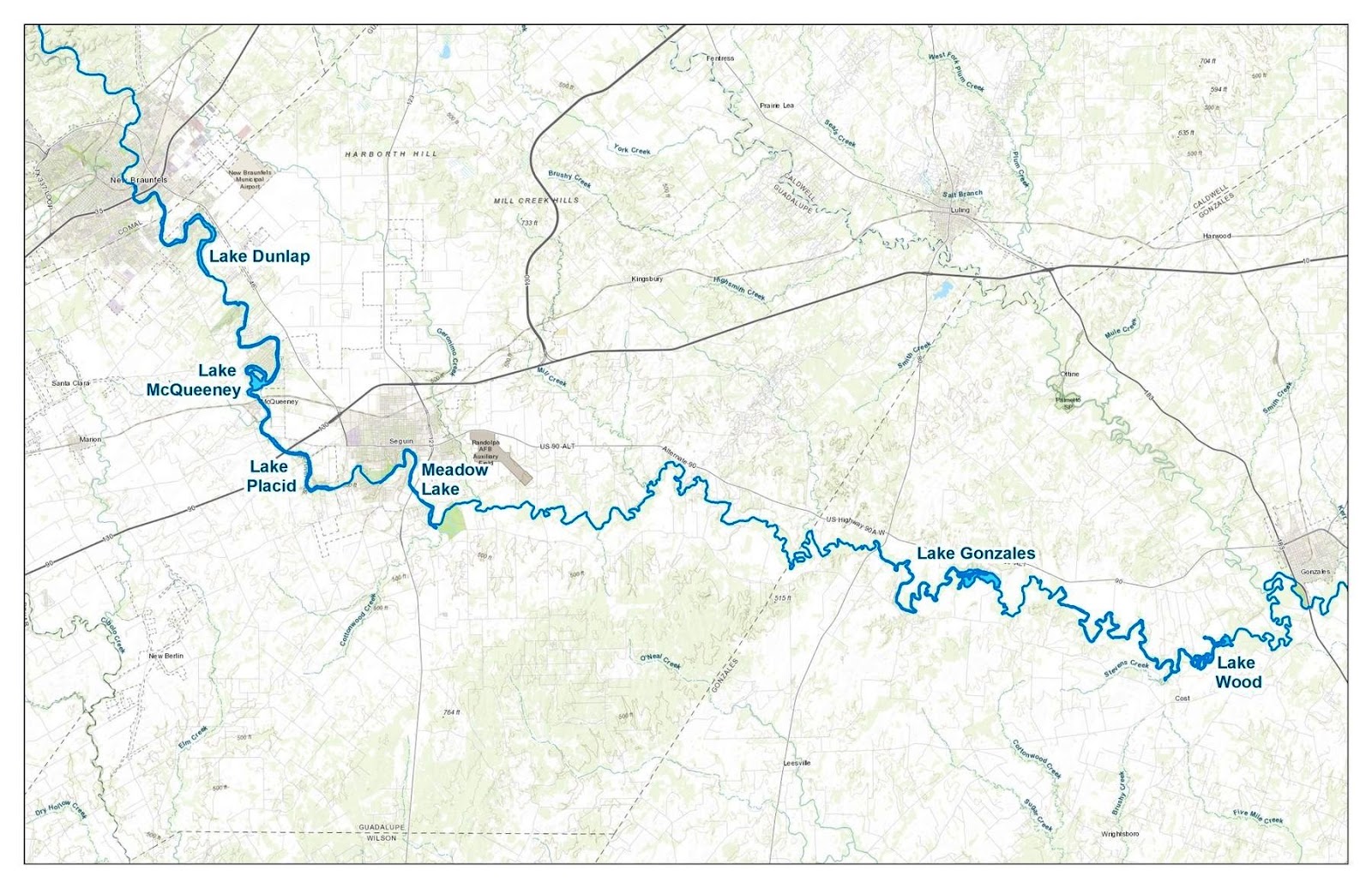
All the dams built to provide waterpower to milling operations were of modest height. However, around 1930 the government built five small dams on the Guadalupe River below New Braunfels to generate electricity. These were different, the base was made of concrete and each was equipped with generators and fitted with steel gates that could rotate open to release flood waters. This was a viable project then as the state was in between the eras of waterpower and power generated by fossil fuels.

Figure 5 Map showing location of five dams
These five dams created very small reservoirs that provided the height for generating power, but held very little water.

Figure 6 is a photo from the shoreline of Lake Gonzales showing the dam and powerhouse.


Figure 6 Lake Gonzales just above the dam

The trees on the right side of the photo are on the opposite shore of the lake, so this shows the smallness of the reservoirs. None stored much water as can be seen from the map of Figure 5, but all were equipped with electrical generating equipment. Starting from New Braunfels and going down river, there is Lake Dunlap, Lake McQueeney, Lake Placid, Lake Gonzalez and Lake Wood. These dams are now 90 years old and beginning to show signs of failure. Not total failure, but failure of the flood gates that are the upper part of the dam that is rotatable in order to be able to lower the height of the dam in case of river flooding. Lake Wood failed four years ago, and Lake Dunlap failed this past May.
This is what the Lake Wood Dam looks like from below. If you look at the facing of the concrete wall, by the powerhouse, you can see the outline of the upside-down vee shaped structure that formed the flood gate, which was never replaced after it failed.

Figure 7 Lake Wood Dam from below


The governing body of these lakes, the Guadalupe Blanco River Authority (GBRA) wants to lower the water level in all these dams because of the concern for failure of the floodgates of the other three. Today, since two of these dams have had their flood gates fail, the GBRA plan is to dewater the other three dams and inspect for safety issues. And, if truth be known, the GBRA would probably prefer to remove all the flood gates and thus decommission the dams. This is not a popular idea with those people who have homes on the shores of these reservoirs.
The electricity generated from these five dams is insignificant compared to total demand of the state; the value of the electricity generated does not cover the maintenance of the dam structure. The GBRA has little incentive to maintain the dams at their current level because, as they say, the current condition is a safety issue and the need for additional maintenance is required. The residents contend that the safety issue caused by sudden release of water is way overblown because the amount of water held by the dam’s flood gates if suddenly released is insignificant compared to normal flooding. Presently, the courts have issued an injunction which puts a hold on the emptying of the other three lakes for at least 12 months. The injunction also stipulates that the lakes will be closed to all surface activity beginning Thursday, September 19, 2019. A panel of 3 experts will be chosen; 1 from GBRA, 1 representing the plaintiffs and 1 chosen by both. The panel of 3 will have 30 days to determine what areas, if any, are safe for activity. The 30-day time period can be extended for another 30 days if needed. Professional law enforcement, acting as lake patrol, will be added to enforce the restrictions on each lake. After the failure of the Lake Placid floodgate, the water level of Lake Gonzales has been lowered two feet from normal which is where it stands today. The safety issue is more complex than described here, because one of the problems encountered by the GBRA is that after passing regulations that bar people from the dam structure area, recreational people flaunt these rules. No telling what will happen if people neglect to obey the rules set forth in the injunction.
Today, the only viable power generation on the Guadalupe River is Canyon Dam. In addition to power generation the dam is also used for flood control, recreation and storage of water which is then sold to cities and to rice farmers along the coast. Storage of water supplies for cities will dominate in the future and so, given the option, the reservoir will retain the water and not be discharged for electrical generation.
Waterpower in the area has become insignificant relative to the power consumed by the state, so it begs the question of how significant is our waterpower today compared to total demand? Just as an aside, let’s look at power generation in our state and compare it to all hydroelectric power and to the power available from the Guadalupe.
The available power from a river is easily calculated from water flow rates and the change in elevation. Obviously, when river flow rates decrease then power capability is diminished. Very roughly though, we calculate the Guadalupe River’s total potential is about 40,000 horsepower providing all the change in elevation from Kerrville to the Gulf is utilized and the water flow rate is “normal”. When that is considered, the potential power of the Guadalupe is equivalent to about one aircraft jet engine’s output when travelling at 400 mph. But even more dramatic, just one large natural gas turbine/steam turbine power generator can produce 15 times the power of the river. Thus, hydroelectric power has almost disappeared in the Lone Star State.
This graph shown as Figure 8 puts that in perspective.
Figure 8 Power sources in Texas 2017

The scale on this graph, given the size of some of the sources of power, hydroelectric power does not even get off the baseline.
We have chosen to end this article with a repurposed mill and power plant in Seguin on the Guadalupe River. The Seguin Mill was built on the Saffold Dam in the late 1800s for milling grain and ginning cotton, but then was converted by Henry Troell in 1894 to an electrical generating plant for the City of Seguin.
This transformation from a water powered mill of grains to an electrical generating station is a good example of changing times. Grain milling was probably in decline in the area and the opportunity to generate electricity prevailed.
Below is a photo of the dam and associated powerhouse where the electrical generator is located. From the photo, it appears that the horizontal underwater wheel turned the vertical shaft connected to the power unit.


Figure 9 Seguin Power Plant at Saffold Dam

This photo (Figure 9) shows the tall structure where the generator is located. It is in the tower at the upper end of the vertical shaft. Next, in Figure 10, is a picture of the generator located in the tower. It was driven by the upper end of the wheel shaft.


Figure 10 Generator at Seguin Power Plant

The limitation of waterpower, especially during low water flow, or the growing need in Seguin for electricity resulted in the addition of an auxiliary diesel engine for producing electricity. It is shown in Figure 11. This antique engine has four huge cylinders and operating at a low speed probably made a powerful sounding noise. It is still coupled to the generator, off to the right side, off the edge of the photo.


Figure 11 Busch Sulzer Diesel Engine 


Figure 12 Powerplant Texas Grill from across the river

The power plant building has been restored and now provides a pleasant setting for the Powerplant Texas Grill.

Sightings

The lack of rainfall has kept most opportunities for sightings depressed, but we did find some flowers not seen before by us when we visited the Guadalupe River dams. In other words, since the water did not come to us, we had to go to the water to see some plants not seen before.  Here in the water of the Guadalupe at Gonzales dam, we found these two plants growing in about  foot of water.  We have identified these two flowering water plants as labelled.
Figure 13 Water Hyacinth.  eichhornia crassipes

Figure 14  Mexican Primrose Willow  ludwigia octovalvis

Both these are probably hated plants because they are fast growers and invade bodies of water quite quickly.  However, there are only a  few plants that don't have at least one redeeming quality.  These two have good flowers, especially the hyacinth, plus, for all we know, these plants probably do some water purification as well.


Wow! 2024 A year of change

 Looking back over my notes of what happened with the vegetation this year brought back memories of how much of a shift we have seen from pa...