Wednesday, February 10, 2021

Birds and their preferences

 For sure, every area of the country has its birds that reside year around and birds that wander through on their way somewhere else to nest and then some in between the two-those that winter somewhere else but nest here.

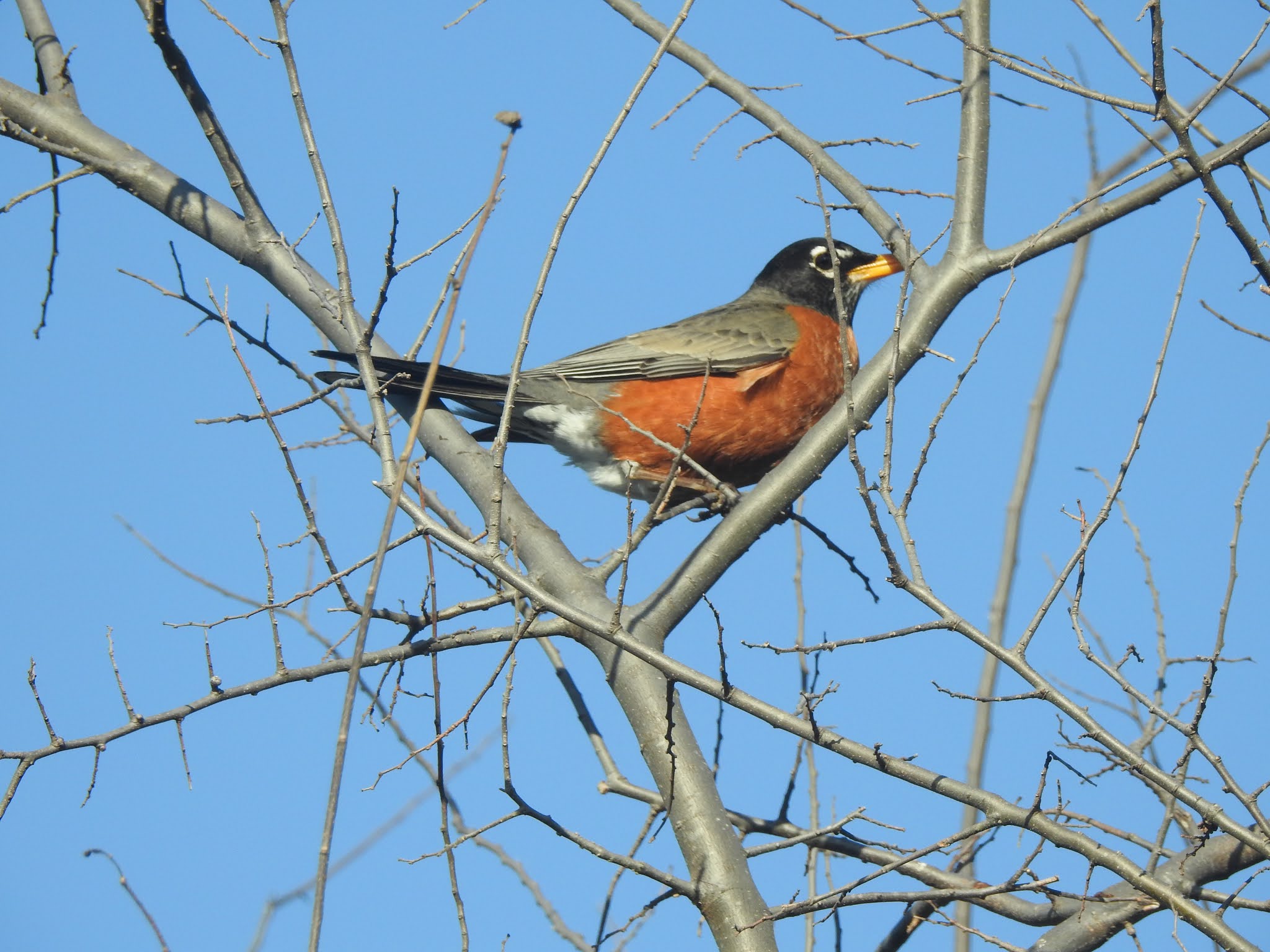
We recently had the largest, most rowdy flock of robins move through our area; their brief stay outdid every other occurrence in memory.  They were everywhere, and they stayed perhaps for ten days, then left.  Some years, the last five for sure, there were no robins to be seen here.  Their travel guide put them on a different route to their northern nesting areas, but this year our place was a featured stopover.

The interesting part of this story is the apparent preferences the birds show in their eating, nesting and social habits.

The robins are noted earthworm eaters, but we have no earthworms here, at least none so near the surface that they can tug them out in the classical robin fashion.  So,  what do they eat while ganging up on us as they did recently?  Their droppings show a lot of red berry evidence, and the only red berries we have right now in any quantity are prickly pear tuna berries that the deer have not already found.  But those berries are tucked inside the tunas and not easily obtainable by the robin, so these birds were probably feasting on such berries as possum haws.  Strange as it may be, they may find this fruit the only thing to eat in the area as they travel northward.  Bird authorities have found that migrating robins eat small berries until they exhaust the supply, then move on northward. They roost in clusters in trees at night which accounts for the pile of droppings concentrated on the ground below.

And then there is the noted Golden-cheeked warbler.  We talk a lot about how important it is to protect this bird's nesting habitat, but we actually don't sacrifice much to help this bird.  This bird seems to have two dominant preferences, one is the mature Ashe Juniper that produces stringy shreds of bark they use in nest building and the other is seclusion and privacy.  The nest is nearly always made from this stringy bark that the bird rips off the trunk of the mature Ashe Juniper.  So, even when we proclaim that we are protecting the Golden-cheeked warbler, landowners are busy eradicating their land of the Juniper and building dense housing units on the cleared land.  Hey, not so fast, remember what we proclaim about protecting the habitat of the warbler.

Here is an example in a photo credited to Amanda Aurora of a nest being monitored.  Note especially the flat strips of Ashe Juniper bark that rings the nest.

Figure 14.1 Golden-cheeked warbler nest 


We find that these birds are so reclusive that they are heard more than they are seen.  From our records here, we have heard them at least once per year, but have never seen them.  More recently, we spotted a used nest in a small oak tree.  From its construction, it is almost certain to have been that of a Golden-cheeked warbler.  
Figure 14.2 Suspect Golden-cheeked warbler nest


Compare the preference of the GC Warbler to that of, say, the Northern Cardinal or the Grackle, or better yet, the house wren.  The wren is more than likely to build its nest in the bouquet of flowers adorning your front door, so accustomed are they to being around people.  The grackle is also a standout in its ability to live among traffic and parking lots and people.  Here is a poem that won a prize for us in a local contest.  The poem describes the grackles activity in the parking lot of the local supermarket.

Scroungin' the Lot at H-E-B
I comes across this paper, see...
An' I notes this contest 'bout us birds
with all these prizes fer rhymin' words
So I sez to myself with my famous cackle
"this is right up your alley, old G.T. Grackle"
Next I fly to my tree where I keeps my PC
And that's why yer getting this email from me
Now, first all, and we all know it
You had in mind a human poet
But, what if we cut out the middleman
I win all the prizes... an'
settle some debts with my seed eatin' pals
and share the pie with my favorite gals.
If you think there is nothin' in it fer you
Not true, as I notified a crew
Of media types for an interview
Photo ops and a book signin', too.
Bring the loot to the parking lot around three
My office is in the crape myrtle tree
G.T. Grackle
641 East Hopkins
San Marcos, Texas 78666

The pie was delicious, personally delivered by the man himself, Jerry Hall.

______Sightings___________

The Christmas Bird Count has been completed by the volunteers led by Stephen Ramirez and the count was fewer than last year, but that may be true because of fewer volunteer counters.  This introduced factor of the number of spotters may be adjusted by a few of the other parameters of the count, as this year we noticed that the count also listed minutes of counting.  
No matter what, the count shows  33 species, the most prominent ones being cedar waxwings and robins along with the ever present turkey vulture.   


Thursday, February 4, 2021

A Natural Occurrence often Overlooked

 John Muir once said that everything he touched in nature was found to connect to some other part of nature.  In other words, we are living in a natural world where nearly all aspects of life, not just our own, but all life is interconnected and thus interdependent. This means we need to be careful of what we change or disrupt in nature.

This brings to mind a phenomenon that occurs continuously around the world.

Plants and animals have many things in common, but food stands out as one of primary importance.  Animals, of course, can move around and secure their food where it exists, plants on the other hand need to find food where they happen to sprout.  Plants are at a disadvantage because they can be the food of animals whereas the reverse is not so common.  In addition, plants that happen to sprout where there is no food (and water) don’t last long, do not flower and therefore make the decision not to reproduce in the particular area.   Plants that find tough conditions then become the rare species of the area----maybe even extinct.  So be it, Nature is in control for the most part unless we, the animals, interfere with the natural process in which case the outcome is usually an even more rare plant.  Unless, of course, we animals need the plant for food in which case we create the conditions (irrigation, hot houses, cultivation, insect deterrents,  etc.) that allow the plant to grow in profusion.

But, so much for plants, what about the animals that can move about and find favorable conditions.

Here is a good example of an animal that moves about for its food.  Twice per year, once in the late fall and the other in the early spring, American Robins (Turdus migratorius) move through the region here in central Texas on the way to their nesting grounds in the northern states, and while passing through they search for food .  They eat bugs, not seeds, and the bugs are classically earthworms. One old robin once said “it’s the early bird that gets the worm” and we know this is true.  The robin is noted for its travels in search of bugs and worms.  At this very moment, flocks of robins are here in central Texas on their way north.  And, they go to the far north, liking not only bugs and worms, but moisture and cool weather that create the environment for their food.  Here in central Texas, especially at this very spot, we seldom see an earth worm, but do have plenty of bugs in the wintertime—right now they appear to have found their food in the screens that cover the gutters of the roof as I can hear them pecking away at the metal screen---that helps us too as it keeps the bugs out of the rainwater collection system, water we use for our drinking water.  So, they have enough food for their short stay.  They will all be gone in a week or less. They have been here for only a few days and will soon be gone on their northward journey.  They never stay here as there too many places both south and north of this location they prefer.  In their breeding season, the summer months, its too hot here.

13.1  American Robin passing through


In our minds, this brings up the story on fish.   Whenever you see a young child fishing, you can count on the child thinking that all water has fish and the fish are equally distributed through the water.   All one should have to do is to bait the hook and cast that into the water and wait.   Depending on whether the fish have found this particular location a good place at which to eat, the wait might be a long time.

It would be an interesting study to determine how much time one needs to fish before learning that fish are to be found where there is food and not necessarily where you choose to cast your lure.  For us, before we began to be more observant of nature, it took many years of fruitless fishing to realize this point.  But the phenomenon of food as the center of concerns exists here with fish too.

Recently a video (youtube) showed a view from a tourist ship moving through the interface of arctic waters and pacific ocean waters.  Observable were many large fish at this interface feasting on the small fish that were visible to them and were flourishing at this fresh water, salt water interface.

Before we pass over it too lightly, isn’t this interface of two waters, fresh and salty a something to note in itself.

13.2 Interfacial water between Arctic and Pacific oceans (youtube)

One often wonders how the fish pass the word to other fish that this is the place to be for food.

Another learned example of the importance of fish feeding at the interface.  My friend and fishing friend David found that fishing the Mississippi River near the end of habitation is often productive for large Seatrout when you can find the interface between salt and fresh water.  If you think about this and look at a map, your natural response is that this area should have no saltwater as it is too far from the salt water of the Gulf of Mexico.

But, not so, salt water has been found near the bottom of the Mississippi River all the way to Baton Rouge.  That is made possible by two factors, one is that the bottom of the riverbed is lower in elevation than the surface of the Gulf and the other is that salt water is “heavier”, that is has a higher specific gravity than does fresh water, allowing the salt water to flow back up the river as the fresh water is flowing to the gulf.  At this interface is food, freshwater food, that the large seatrout find good to eat.

Again, animals go where there is food.  The examples are everywhere.  The backyard birdfeeder, corn for the deer, the list goes on and on.

Now comes the interesting part.

Why do cities exist, especially today?  Of course, the answer is so that people can get "stuff" and to collaborate (for both good and bad reasons).  Focusing on getting stuff, how about food.  Is it more convenient to get food in a city than it is in the countryside?  Sure is, people in rural areas have far less choice and have to travel more distant to get their food.  Imagine a city of 5 million people  and not one garden nor even one producer of beef, chicken or seafood.  People get their food when hundreds of trucks arrive daily to distribution points delivering food from processors across the nation and even from other countries.  People without an income can eat in cities and would find it difficult to procure free food in rural areas.  No doubt about it, cities are like bird feeders. Provide convenient food and people will come.  All a very natural process, but in this case heavy assistance from man himself.

______Sightings_____

Spring is still some many weeks away, but there is some signs that spring will arrive.  The birds that winter here are all in a frenzy for the mating season, the licogiums are up but not blooming, the honey bees are busy on the flowers of the rosemary, the buds have swollen on all the deciduous trees, and so on.

This nice specimen of a buck stepped in front of the lens of the camera and even posed for a second while this picture was taken, then bolted away.  Deer hunting season has closed and I think he made it for another year.

13.3 White tailed deer in Central Texas


Sunday, November 15, 2020

Alpacas off Devil's Backbone


_________12._____ Alpacas off Devil’s Backbone


Here in Central Texas the land has some extremes in canyons that are as dramatic as any part of the so-called Hill Country.  Especially dramatic is the terrain along RR 32 as it travels west on a ridge separating the Wimberley Valley from canyons to the south. This is probably the most well-known mile or so of  RR 32 as it snakes in several ess curves along what is known as Devil’s Backbone.  It’s here in the canyon to the south of RR 32 that we found Tierra Prometeda, with terrain that probably has some attraction to alpacas.  Of course, its hotter than the mountains of Peru, but this herd of some 100 animals like it because for the most part, they were all born here in Texas, plus they like the care they get from their owners Rhonda and Kern Deschner.

We became aware of this alpaca herd some two years ago when we stopped at a metal working fair located off Dreibrodt Road some twenty miles south in Guadalupe County.  At this show, Rhonda and her Farm Manager, Jenny, were showing three of the animals that were raised on the ranch off Devil's Backbone. It was first time that we were able to come within mere inches of these fine animals.

The alpaca is a member of the camelid family.  Scientists have determined that camels as we know them today, once existed in South America, and the alpaca, the vicuna and the guanaco are descendants of the camel.  The alpaca is no longer found in the wild in Peru because it is now a domesticated animal, but the vicuna is wild and remains so today.  The llama is domesticated but the llama is larger than the alpaca, does not have the quality of fleece and is used mainly as a worker, carrying loads for resident farmers.

Peru is the  native land where these animals and especially the alpaca  have been domesticated for more than 2000 years, but even so, they have not lost their native instincts, one of which is caring for their young. 


We started our visit in the mother and newborn’s corral with Jenny and met Princess Leia and her son Mandalorian, both named after Star Wars characters.  Usually the mothers birth their babies in December but Princes Leia was early by a month so this pair were alone in the corral and Mandalorian will have to wait for his peers to frolic with.

Figure 12.1-Week-old alpaca and mother

 Jenny showed us how she, but probably not we, could pick up the newly born alpaca and the mother would allow her to do so because it had occurred several times before and now Princess Leia trusted her. Despite this trust, it was apparent that she showed some signs of distress by moving closer to the newborn.  But then something interesting began to happen.  As Jenny held the small alpaca in her arms and stood by the mother, all seemed normal and calm. At this time, we were standing about ten feet away from Jenny with newly named Mandalorian and off to the side was mother alpaca.  Slowly, Jenny started to move toward us to allow us to touch the newborn, and Princess Leia also started to move, regally holding her head high and with an intense look in her eyes, all of this occurred as if in slow motion.  With Jenny nearing us, the mother alpaca slowly eased her way broadside in between us and Jenny , and here is another interesting aspect of this occurrence.  Mother alpaca was humming a continuous monotone that we were told is one of the ways they communicate concern.  All the while this was unfolding, Princess Leia made no rapid movements, kept her head high and kept her eyes on us and her new baby.  The end effect was that mother alpaca separated us from her newborn because she was unsure of the safety since we were newcomers to the scene.

We then went off to another corral where several young alpacas were gathered.  When the alpacas in this herd discovered that we were strangers, their attention shifted to us as if to say, "who are these visitors?" With just a bit of encouragement from Jenny, they slowly made their way to us and became quite friendly, one even being curious about the leather wallet I had in my back pocket.  With no hesitation, they allowed us to rub their necks as if we were their long-lost pals. While R was busy fending off the pickpocket, I was making friends with chubby-cheeked Fiorello and a couple of his buddies.


Figure 12.2 Young curious alpacas

 One aspect of the hill country terrain that the animals must like is to be able to roll in the dust, so they have been provided with special spots to roll around in some dirt bowls of dusty limestone and sand just as most of us have seen horses do with this same need to clean their coats.


Figure 12.3 Rolling in the dirt

 We talked at length with Rhonda about the business of fleece and animal production.   There is little doubt that animal sales produce the most income, with fleece sales being second. But the details of  fleece preparation was of interest to us because we were able to feel the fleece, see it in the products made from it and experience the wide range of fleece attributes that exist from one animal to another.

Shearing, as was noted before, is done in the first week of every April when the shearer arrives.  The fibers are matted, so the shearing operation produces a batch of fleece that represents one animal.  Here, Rhonda is demonstrating a pelt of fleece taken from the back of one animal. The fibers are about two inches long and zig-zagged with a diameter ranging from 10 to 20 microns.


Figure 12.4 Alpaca fleece mat

We were curious about the structure of the individual fibers that made up the mat and so Rhonda plucked a small sample of fiber from the mat and spread it out on the back of Jenny’s shirt, the only contrasting background we could find close by.  The overall length of the fibers in this photo is about 2 inches.


                                                            Figure 12.5 detail of fibers

 The mats are sold to mills that have strict grading standards that affect the price.   The fibers dye easily and thus provide opportunity for making into yarn which then can be made into clothing, rugs and whatever.


Figure 12.6   Grading of Alpaca fleece

The fiber grading chart is from Texas Hand Woven Creations doing business as Ingrid’s Custom Hand Woven, Inc., in Paint Rock, Texas and can be found on other websites like New England Alpaca Fiber Pool. Fiber grading is based on five factors;  fineness, amount of guard hair, variation in diameter of fibers, fiber length, and uniformity of fiber diameter.  The alpaca fleece is cleaned of manure and other organic matter such as grass and twigs, then sent to the processor for grading.

 The company in Paint Rock employs 8-12 who process fleeces, making yarn and weaving in an operation that is housed in three stone buildings that are each over 100 years old. In 2009 focus shifted from wool/mohair to alpaca, llama, and buffalo fibers plus some other natural fibers making rugs, placemats, floor and table runners, wall hangings and saddle pads.


Next, we advanced to the Farm Store, part of Tierra Prometida,  that is available for shopping; but since the shop has no regular hours, an appointment is a necessity.  This very compact and well-organized shop has a wide range of articles made of alpaca fleece, some of which are made in places like Peru, and some in the USA.  Here is a photo of an alpaca accent rug made by the weavers of Texas Handwoven Creations in Paint Rock, Texas.  All the colors of this 2’ by 3’ rug are natural colors.


Figure 12.7  Handwoven alpaca fleece rug


Rhonda makes some of the clothing items herself and there are cloud-soft afghans, scarves, stoles, knitted Peruvian caps and stockings as well toys.  The shop is a little Alladin’s cave of beautiful handmade delights that are hard to resist.  After mulling over the possibilities, we returned a few weeks later for the 2’x3’ rug above (to be used as a wall hanging) and a toy alpaca that will sport a red ribbon for Christmas.


_____Sightings_____


           Figure 12.7  Roadrunner on porch rail


Figure 12.8  Littleleaf sumac  ( Rhus microphylla )


Figure 12.9  Crape myrtle  ( Lagerstroemia indica ) and Shumard oak ( Quercus shumardii )

A showing of our fall colors, blowing in the November wind.


Thursday, October 15, 2020

The Elegant Bobwhite

 They arrived, they stayed awhile and then they left.

 Bobwhites, one of our favorite birds because of their flight characteristics and especially their call, have not been heard this year on the ranch.

All North American bobwhites (Corvus Virginiana) are catalogued in 23 subspecies and these subspecies are divided into 4 groups.  Three of the four groups (Masked, Grayson’s, and Black Breasted) live in central and south America and the fourth group , the one to which our local bird belongs is the Eastern Group.  In Texas, of the 23 subspecies, we have two different bobwhites, the  subspecies Texanus and the Taylori.  It takes an expert to tell all these subspecies apart as they are so similar in appearance.

Bobwhite, male and two females

The Texanus sub specie is our local bird, its range is from Central Texas south well into Mexico. The Taylori sub specie ranges from Central Texas up into the central plains of the states to the north.

The bobwhite has several habits which are unique.  They are insect and seed eaters, they group into coveys, they tend to be monogamous, and they fly with a wild beat of the wings when flushed from their roosts producing a sound that is memorable only second to the sound of a rattlesnake.

They roost on the ground, where they form a circle of birds all facing outward from the center of the circle and thus give the impression when flushed, that they all fly in different directions and for the first instant they do because of this roosting arrangement. They do this for protection as they have several natural enemies---like hawks, owls, coyotes and of course hunters.

Ranchers in Texas, particularly in the high plains and in south Texas find that leasing their land to hunting quail brings in more profit than running cattle on the same land----that’s not easy to pin down as it may be the difference between two low numbers.   Nevertheless, hunting bobwhite in Texas is a big thing and brings in a lot of associated revenue and taxes.

Bobwhites nest in the springtime and find the best spot to nest at the base of a clump of a typical Texas bunch grass, where the top of the bunch grass may be 18 to 20 inches tall providing seclusion and some shade at parts of the day.  Heavy underbrush is not their favorite habitat, grassland with some scattered brush is their preferred habitat.

The Bobwhite has been the focus of research for the last 80 years, probably due to the importance as a game bird and  a bird that could be raised for food. Squab farms are common, especially in the northern states. 

In the 1940s, researchers found that Vitamin A is an important component in the food they eat, and the source of Vitamin A for the Bobwhite is green vegetation.  Typically, 70 % of the food for a bobwhite is seed, but during breeding season, that changes to include more insects, and green vegetation to achieve their Vitamin A requirements.  In turn, Vitamin A was found to be critical to egg production and the overall health of the bird.  Low Vitamin A could lead to short life span but in most cases, the bird succumbed to predators because low Vitamin A caused low energy, poor eyesight, and a general inability to escape predation. Related to this dietary study was that landowners attempt to supply food for the bobwhite to augment natural foods had little effect on the population of the species.  Almost all the programs to help the bobwhite produced little positive results.  They apparently know the difference between natural food and artificial food.

In the 1970s, studies were conducted on the need for caloric intake at different ambient temperatures; this study found that egg production was peaked at temperatures between 70 and 77 degrees F.  Out of this study came the bonus information that showed that Bobwhites can tolerate heat, but just so much heat.  For females, that temperature is about 107 degrees F, males a few degrees higher.  Sustained temperatures above these levels and the birds succomb.

In our area, high temperatures usually mean low water levels in the soil—whatever rain we may get in the hot weather months evaporates quickly.  Bobwhites and for that matter, all the members of the quail family are known for their wild fluctuations in population correlating with rainfall. An intuitive conclusion is that high rainfall means more green vegetation as food (Vitamin A) and lower temperatures, both of which favor reproduction.

Populations of bobwhite appear to be decreasing by about 2-3 % per year from the best estimated of bird counts and harvest counts from hunting.  This decline in population has been linked to several factors, some old natural ones and some newly discovered. 

Regarding the established factors affecting population, all the known predators factor into the equation, but skunks and fire ants may be at the top of that list.  Raccoons follow as a distant third.

But there are new concerns for the health of the bobwhites; not new but seemingly found more often in recent years.  There is a parasite that is picked up by the bobwhite from eating grasshoppers.  Due to the heat and the drought, our grasshopper population has burgeoned this last year and again this year.  The parasite that is picked up is a thread worm that escapes from the bird crop and migrates to the nasal passages and eventually into the eyes.  These thread worms have been known to biologists for decades, but it appears that the infestation has grown to epidemic status in some parts of Texas.  The thread worms are destructive, destroying vision long before it kills the bird.  Hunters have reported birds that fly into obstacles upon being flushed and even birds with open eye sockets.  A medicine has been developed for adding to food supplies, but the problem is getting the birds to eat the medicated food.  The outlook for this problem is not good.

 Nest success is another problem with Bobwhites.  During average conditions of temperature and water availability, the success of the nest ranges around 28 % in most studies.  The nest sizes are large though, offsetting this low nest success level.  About 12 eggs are the normal nest size, so when the nest is successful, there are many baby quail.  Studies show that the skunk is the most probable cause of nest destruction.

If seeds are the main food for the bobwhite, what seeds are preferred?  Analysis of crops from birds across Texas show that their diet consists of a lot of different grass seeds, but there are some that are obviously preferred.   Here are a few:  Sorghum, both the naturalized plants  and those  planted for food production are a favorite of the bobwhite.  Among the grasses, such as the rescue grass, the paspalum and those grasses with seed heads like sorghum are favorites of the bobwhite.

From  all these studies of natural foods for the bobwhite, the data show that most of the favorite foods grow most predominantly in the eastern part of the state or the southern part of the state, leaving the hill country short of natural food for the bobwhite.

So, what about our brief encounter with the bobwhites?  The intuitive conclusion is that they did not find enough food and their time here was during those years when we had slightly higher than normal summer temperatures and lower rainfall.  Whether they died off or migrated to other areas is not known, but it could be presumed they did not reproduce well and the died out.

All this reminds me of my younger days of hunting ring-necked pheasants on my uncles farm in Hudsonville, Michigan.  The whole area was farming country then and most farms planted corn both for the corn and the corn plant.  The corn was saved for the chickens, and the corn plant, while still green was chopped up and put into silos for the winter feed of the cows.  But while the corn was still in the field, the pheasants not only ate the corn, but they found it easy to run down the corn rows to hide from whatever came along.  Every 20 acre field had several cock pheasants.  Then, progress came to the area and the farmers disappeared and so did the corn and so did the pheasants. It would be a challenge to find one pheasant there today.

All this shows that wild animals, and plants for that matter, live where they can thrive, and when those conditions turn negative, they leave or die.

Tuesday, September 15, 2020

Useful of Plants

 Plants can have all sorts of uses;  for ornamental value, a direct food for us or a food in the food chain, or for use to create useful material. We thought of the direct food value of plants when, at the height of the pandemic, there was talk of food shortages and we looked out over the fields at all the prickly pear cactus and decided we would not go hungry if the local supermarket went short of vegetables.

Our Hill Country crop of prickly pear cactus (Opuntia Lindheimeri) is front and center when it comes to food value.  Named after Ferdinand Lindheimer who documented the species, its common names are Lindheimer prickly pear and nopal prickly pear.  It was adopted as the Texas State Plant in 1995 and House Concurrent Resolution No. 44 describes it as “rugged, versatile, and uniquely beautiful. The prickly pear cactus has made numerous contributions to the landscape, cuisine and character of the Lone Star State and thus it is singularly qualified to represent the indomitable and proud Texas spirit.”

The plant blooms April through June with flowers of yellow, orange or red and may turn from yellow to orange as it ages.  In rare cases white flowers have been noted.

32-1 Prickly Pear cactus  Opuntia Lindheimerii  

The prickly pear cactus plant occurs naturally in the Americas but has been exported to other parts of the world. In Mexico, species of Prickly Pear cactus plant are found in large quantities in the western and central regions. It can also be found on dry hills of the east coast from Florida to Connecticut and surprisingly, it also occurs in isolated areas of southern Ontario.

All species of Opuntia have fleshy flat pads or paddles which look like large leaves but they are not leaves but modified branches and stems which serve many functions such as production of flowers, photosynthesis and water storage. Its spines are covered with tiny pointed hairs which are known as Glochids. All of which are found at the base of the major spines. The big spines look formidable, but the little glochids are the more bothersome as one touch of them puts many small spines in your skin.

This plant contains pectin, which is helpful in treating many diseases. It also  has antioxidant properties, so it is part of a healthy diet. The edible parts of Opuntia are its newly formed stems (the pads) the fruits, and flowers.

32-2 Prickly pear nopalitos

The new growth of stems (again, the pads) are cleaned of spines and sliced thin in such a manner that the cut material appears like string beans.   As they are cut a noticeable slimy substance appears and will disappear after blanching , cooking for 15 minutes and rinsing in a colander. They can then be sautéed with butter, salt, garlic and cilantro and served just as you would any vegetable.  We have tried them prepared this way in Chicharron y Nopal a recipe like pork stew.   In case you care to try this, the spines are cleaned off the pad with a sharp paring knife or a spoon held at a 90 degree angle and used in a scraping motion and about ¼ “ of the pad’s edge is removed all the way around to get rid of the remaining spines. When sliced in long strips and cut into pieces that look like green beans, they are called nopalitos. The fruit is useful as well, is tastier than the pads, and can be used in a variety of ways.  The wild animals have discovered this part of the cactus and so raccoons and deer will probably beat you to them for their dinner.  The fruit is commonly called “tuna” and forms at the base of the flower. Perhaps the most favorite use of the tuna is to make jelly, jam or candy.  The fruit is cleaned of spines, boiled to cook the fruit to a fine pulp, strained, and after adding pectin and sugar is bottled up in sterilized jars.  There are recipes for making these jams and jellies on the web. 

32-3 Prickly pear with red-ripe tunas

The time to harvest the tunas is when the tunas are dark red as they are in the picture above.  An entrepreneurial former teacher in Tucson, Arizona has made a business of using Sonoran Desert plants to make some of these products and also gives lectures to the community about the plants and their uses plus lending her support to a couple of local charities.  On BalconyContainerGardening.com you can find a recipe for Cactus Candy.  And if you don’t want to try doing it yourself see below for Cheri’s boxed specialty.

32-4  Prickly pear candy

There are many advocates for eating the prickly pear flowers in a salad, but we prefer to look at them in the field.

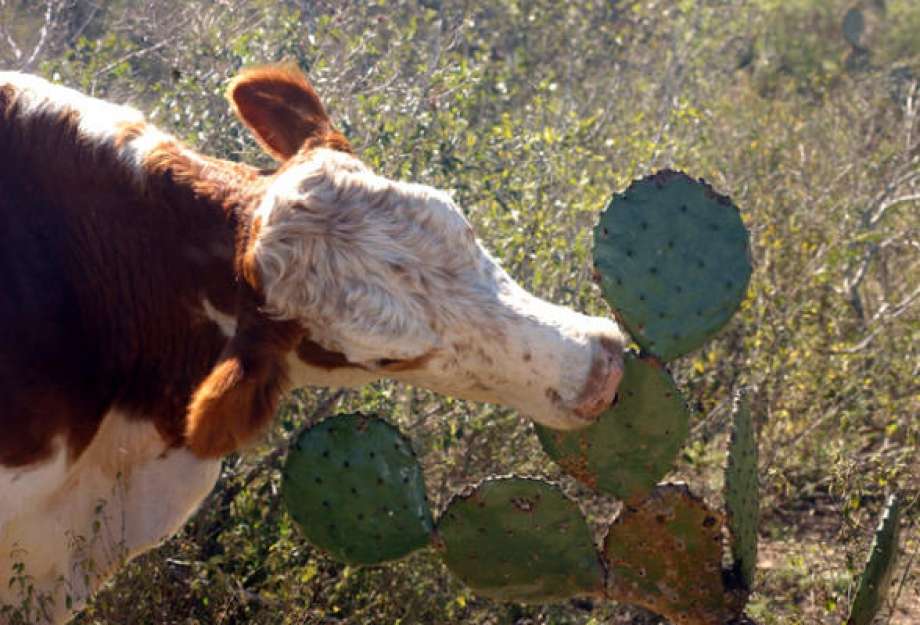
Before leaving the prickly pear there was a nagging need to follow up on how ranchers use the plant for feeding their cows during droughts.  The Internet produced several interesting posts in answer to one woman living with her family, 1 heifer, 2 dogs, 2 hogs and 1 rather nasty chicken named Bruce on 6 acres in a near desert situation with little forage.  However she wanted to use the available prickly pear plants, if possible.

And the answers flowed in.  “Yes they can be eaten but be sure they are hand-picked and the spines are all cleaned off.” 

“DH says that’s what ‘pear burners’ are for, propane torches to burn off the spines.”  

“We feed it to the cows and pigs after it’s been burned and now, we’ve begun planting thornless prickly pear.” 

“One time, Loretta (the cow) was impatient for us to burn and came in with a swollen mouth full of spines.  I called my dad (old cowboy) and he said don’t worry cows have some sort of enzyme in their body that dissolves thorns, just feed her as usual.  We did and when she was finished feeding, she had no thorns left.  So I say go ahead and burn the spines off as they will like them better, but no worries.  Cactus is very healthy for them and they will break down the fences for freshly toasted/roasted cactus.” 

“Nopale water is a favorite of my cows in high summer temps.  I’ll chop a few pieces and soak them until it gets slimy (but not fermented).  They love it.  If you add enough cactus you can use half the water and refill it again making your original batch last longer.  Also, a bit of info off subject that’s come in handy for us.  Nopale slime is a great mortar.  If you mix it into a sharp sand slurry it’ll dry harder than concrete and is water resistant.”

32-5  A cow chowing down on a toasted/roasted cactus pad

Another interesting small cactus that exists here in BWR is the Echinocereus Reichenbachii  named after German botanist H.L.G. Reichenbach and known familiarly as Lace Cactus here in the Hill Country where it grows on our limestone hills. 

32-6  Lace Cactus

This is a nice double one on a piece of limestone not too far from our house.  Three similar varieties range from the Texas Panhandle to Oklahoma, S.E. Colorado and New Mexico. They bloom in the spring and make colorful additions to the landscape.  Also as our builder pointed out, they replant easily and make nice indoor gifts planted in a small, attractive limestone rock with a generous depression for soil.

Another cactus that’s used in landscaping and is useful as well is the Twisted Leaf yucca.  It’s the most common yucca in the Hill Country and is identified by its long twisted leaves that radiate out from a central point near the ground.  After being soaked, pounded and stripped the long fibers in the leaves may be braided or twisted and used for making into ropes, baskets, mats or shoe soles.  If one is into survival skills, there are many Internet videos showing exactly how to master this art.  It was a very important plant for Ancestral Pueblo people because of its diverse uses.  The roots contain saponin that can be used as a soap substitute or shampoo.  According to legend, shampooing the hair with yucca makes the hair strands stronger and may prevent baldness.  There are shampoos available for purchase these days and DIYers are happily sharing their recipes and experiences with making it themselves.

32-7  Twisted leaf yucca

These beautiful yuccas came with the property, but it wasn’t until we added the fence that we ever saw the flowers.  Like squash blossoms, they are deer candy.  The nicest stand we’ve seen blooming locally is on a steep hill on the left as RR 12 descends down toward Wimberley.  Just after it is the antique shop on the right.  Many of the tall stems can still be seen above the foliage, but of course the flowers are long gone at this time of the year.

Continuing to stick with spiny plants we come to the Agarita (Berberis trifoliata) another common plant on our dry, rocky soil. 


32-8  Agarita bush in September without flowers or berries

This is a lovely bluish-gray-green bush that can grow to 8’x 8’.  It is evergreen with compound leaves consisting of 3 leaflets with 5 sharp points.  It blooms Feb.-Apr. with fragrant yellow flowers that are followed by red berries in June.  The bush is a favorite pollen source for bees and nesting site and haunt for birds and small mammals who eat the berries as the thorns keep cattle and deer away. 

The bright red berries also make good jelly, but because of the thorns they are not picked like other berries.  Instead a sheet is laid on the ground and the berry-laden limbs are beaten with a stick to save the jelly-maker from any lacerations.  Agarita jelly  Follow the link to see how to produce the product below.

32-9  Agarita jelly

The wood of the agarita is also useful.  A bright yellow color, it can be used to make a tan-orange dye.  According to Jan Wrede[1] “The roots contain an alkaloid that is toxic to bacteria and protozoans and has been used to treat toothache and stomach trouble.”

Lastly, we cannot leave the subject of useful plants without mentioning the Mustang grape.  We had lots of grapes this year, but once again we let the time slip by when they were a beautiful green and the size was perfect for making green-grape pie.  Later they were ripening into a nice plump purple when the heat and drought descended along with a loss of desire on our part to hassle them out of the trees, cook them up and make jam.  They do make good jam and next year’s crop will be here before you know it.  If you want to get an idea of what the process involves, you probably can’t do better than to take a look at retired electrical engineer Sawdust Willy’s tutorial. Mustang grape jelly 

Another grape we’ve purchased and planted is the Black Spanish or Lenoir variety.  We only have a couple of vines at the end of the back porch and this year (their 3rd) they made nice little clusters.  A small grape, resistant to Pierce’s disease, they are used to make wine, juice and jelly.  They have a few large seeds which only seem to intensify the mockingbirds’ enjoyment and we have enjoyed watching the mockingbirds consume them.

Since this has been a newsletter about useful plants and in many cases the food to be made from them it seems apropos to finish up with the end of the story on tatume squash.  The crop was finished by the end of August, all the squash were picked.  They felt hard to the touch, but R was sure of their viability, D was not so sure.  On the day when R took the knife to one of them, he was justified and D was happily surprised.

32-10  Tatume squash and cut "rings"

The rings were cut into small chunks and used in a friend’s recipe for Zucchini Florentine.  Sliced, cooked chicken was added and dinner was plated with the addition of half a small baguette.

32-11  Tatume/ Chicken Florentine

We are saving tatume seeds and if any of you would like to try growing the squash let us know and we’ll get you some seeds.

Sightings

32-12  Prairie Tea (Croton monanthogynus Michx)

Also known as One-seeded croton and Lemon spurge, this silver-gray-green weed is apparent everywhere in the fields at this time.  It is a favored forb of the Texas bobwhites.[2]


[1] Trees, Shrubs and Vines of the Texas Hill Country

[2] Texas Bobwhites A Guide to Their Foods and Habitat Management by John A Larson, Timothy E. Fulbright, etal.

Wow! 2024 A year of change

 Looking back over my notes of what happened with the vegetation this year brought back memories of how much of a shift we have seen from pa...