Sunday, May 9, 2021

The Tree Rings Wlll Reveal the Times

In our opinion, we have not fully recovered from the drought of this immediate area that began about 6 years ago.  The "immediate area" is important to note because in some adjacent areas, such as east of here in the blacklands, rainfall seems to have been adequate to reach underground levels.  But right here, the drought is still with us.  Yes, we have had rain, but it either arrives in runoff quantities or in small doses.  The runoffs help the rivers, and the small doses of water evaporate quickly.  This abnormal rainfall  will show up in disparate tree rings should some of our larger oaks be cut in future years.  When someone in the future were to cut a tree and look at the growth rings, they will wonder what happened in the 2015-2021 time frame as the rings will be closely spaced indicating little growth. One of our indicators of drought is Lake Bridlewood, and most residents probably noticed that it went dry this spring.  That has not happened more than once or twice to our recollection.

Droughts in Texas are common, and this year, we not only had a dry winter, but a cold one on top of all that.  The St. Valentine's Day cold spell, on top of dry conditions, hit many plants that I would call border plants quite hard.  For example, the Huisache, the Palo Verde and similar vegetation that seem to be creeping northward over many years only to now have this reminder that all is not warm and friendly up from the safety of the Valley.  I often wonder how the olive orchards that were being commercially established in northern Hays County have survived this brutal season.  Typically, olive trees survive to the south of San Antonio, but are considered risky plantings to the north.  Yesterday travelling on the road to Lockhart, we noticed entire groves of some thorny brush all black and seemingly lifeless.  These are not Mesquite, because all those seem to have survived quite well.  As the summer progresses, we intend to keep an eye on these stands and conclude how or whether they survived and the variety of plant in question.

And then there are the webworms that nearly ate all the leaves on our 15 ft. Shumardi Oak this spring, but now with some watering and the recent warm weather and rain, these planted oaks are putting out the second round of leaves.  Good for Mother Nature.  Its not an easy call to poison the webworms as they are a favorite food of the Cuckoo.  We did not spray the webworms   and all seems to be okay now, so that was a success.

The Live Oaks seem to be very hesitant to put out leaves this spring, probably due to lack of rain and the cold spring.  I am sure they will survive, but probably show some damage and appear stressed.  That means we need to provide special treatment to these trees when we can and watch for any invasion of pests.  I think  the webworms are gone, but we never know where the Oak Wilt disease is lurking.  So, if you cut limbs from the Live Oaks, seal the cut with a pruning aerolsol spray found at local stores. Otherwise, wait until winter to prune any Live Oaks.

Regarding all of our seemingly dead plantings, we are waiting to see what comes up from the roots or  out from the side of the trunks before we tear them out.  The big stand of Palo Verdes that we had growing at the culvert crossing on Steeplebrook Drive are being monitored.  Yes, we know they are considered invasive, but when its tough to grow things in this harsh environment, even invasive stuff can be tolerated knowing that Nature steps in from time to time and fixes things.  Two cases in point are the Russian thistle and the Bastard Cabbage that nearly overran us five years ago, but now is hard to find in our area.

Bluebonnets you ask?  What bluebonnets?  They need water in the fall and winter and did not get it so the seeds will probably sit in the ground until this fall and then, if they are still alive, will produce some plants.  Look for the immature plants in the fall and if they are not visible, chances are we will not have any stand of bluebonnets the next spring.

Meanwhile, the plant nurseries are doing a thriving business.

Saturday, April 3, 2021

Who ate the wieners?

  It all started with a video of a man somewhere in Canada who recorded his scene of hand feeding a hoard of about 30 raccoons their evening meal of two pounds of wieners. No, we didn't search for this video, it happened to be in the up next position after we were looking at one of our videos on our channel.

Mind you, we are not fans of feeding wild animals people food, but on the other hand, in this busy world we all need a little merriment and watching this video was amusing. Search for it on Youtube but if unsuccessful in finding it let us know and we will help locate it.

Then we decided to bait the game camera to see what would show up at our place in Central Texas.  

We know that our most frequent visitor is the raccoon, since it (maybe they) have to make a nightly raid on the bird feeder getting every last sunflower seed.

Now, 'coons don't get around much in daylight, but as soon as it gets dark, they are on the prowl and miss nothing if it smells like food.

So, adding a package of wieners to our grocery list, we came home with 8 wieners costing 69 cents.   These were not your gourmet variety, but made from all sorts of meat, and in Canada to boot.

The first night out showed that the raccoon got the wiener at 8pm.   It also showed that the fox made its appearance at 2am the next morning---way to late.  From the photo, you could tell that the fox knew what was going on with the provided dinner because it had that look of "okay, I can beat this ol' 'coon at his own game".

For the next several evenings, the wieners went out at about 5 pm and they were gone by 630 pm.  Ya see, the fox knew the 'coon was still up in the tree because it was not dark yet.

All this prompted the crafting of this rhyme to document the study.   Must get another package of wieners.

Who Ate the Wieners?


I did not know how this could be, but in colder climes apparently

Coons can hibernate like bears,  and so must eat to fatten their

Bodies ‘til spring arrives and they awake, to rustle up a new grubstake.

A kindly Canadian then set about, arranging a giant wiener handout.

Roly-poly coons came by the horde, to feast on his hot dog smorgasbord.

They were here and they were there, climbing all over him everywhere.


Well that gave an idea to my better half, an opportunity for a photograph.

First to the store for some cheap bait, then set up the camera overnight and wait.

Next morning, just as he’d figured it , there was the face of the masked bandit.

Would he be back again to sup,  on another wiener and gobble it up

Before another animal could benefit, would he again get all of it?   BUT---

The coon snoring up the tree in his bunk, wouldn’t leave it till the sun had sunk.


MEANWHILE


Someone else had seen some juice on the plate, and knew he had been too late.

He twitched his whiskers and decided then, that that would never happen again.

And he waited patiently in the woods, for the deliverer of the goods.

Soon he heard a step gravitate, in the direction of the plate.

He could see and hear no muss no fuss, as chunks of meat hit the surface.

It was still light no coons about, so he took his time and just pigged out.


Wednesday, March 3, 2021

Local History Uncovered

 Earlier posts discussed the area history of Hugo Road, Purgatory Springs, and surrounding land ownership.  Some of the information related the work of others in this field and so invited some questions, such as the origin of the name Hugo.  More recent readings suggest that there were two schools in the area, one being Purgatory Springs and the other Hugo and since these two names seem to be interchangeable, it raises the question of whether there were two schools or one school with different names.

Digging further into the matter, always striving to find original source documents, one can find no evidence of two schools in the area. However, the one school building, still standing there on one acre of land, was probably not the original school building. That does not mean that there weren't two schools, it just means that the original documentation discovered has not supported this theory.  Secondly, there has been no discovery of the basis for choosing a name for a post office.  The criterion for the name selected by the local postmaster was that it be "one word, preferably short".  Obviously, there were other criteria, probably in the judgement of the US Postal Service,  to prevent naming post offices with, shall we say, nasty words.

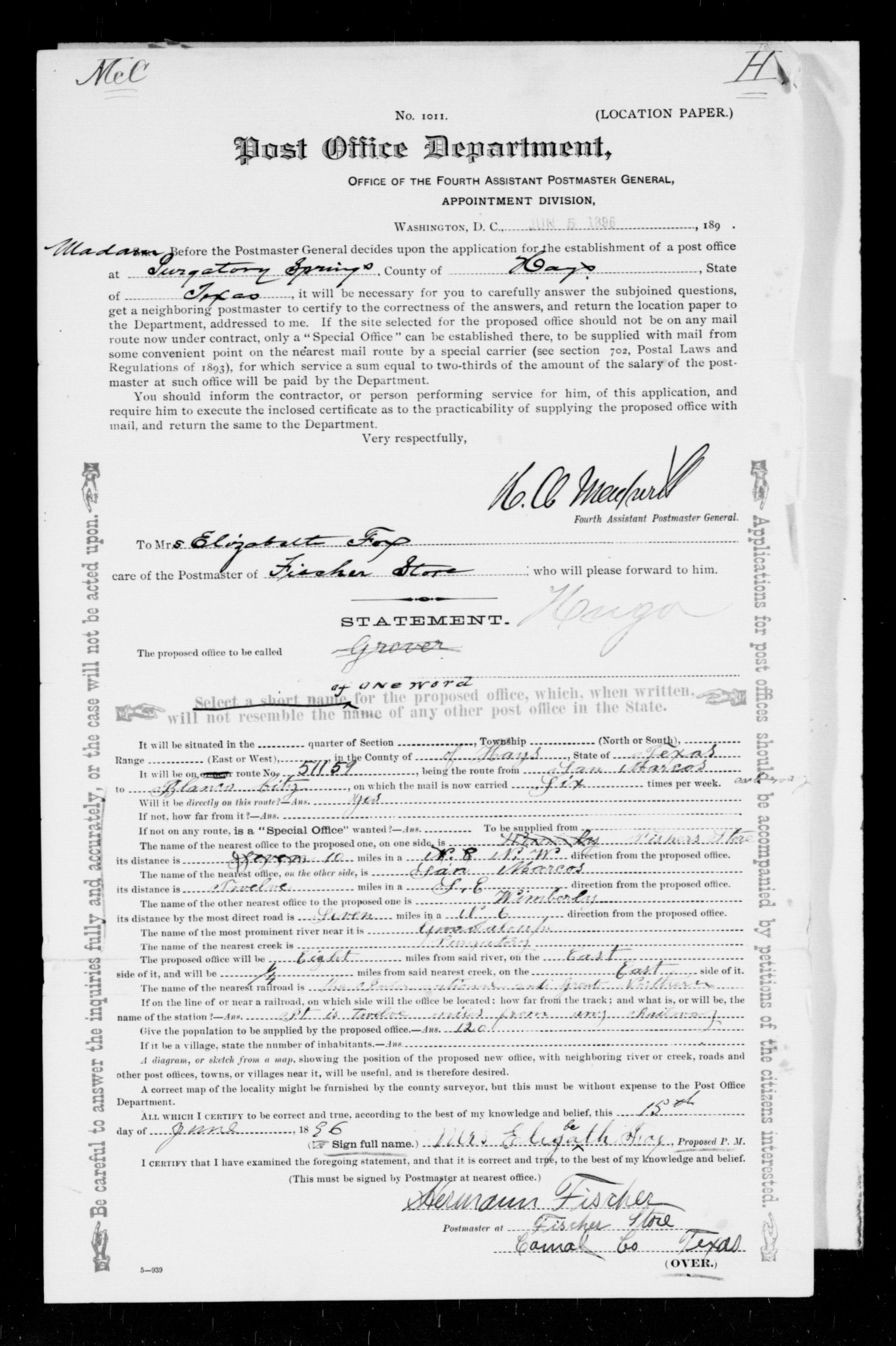
A search of the National Archives shows that the first post office to be located at the settlement of Purgatory Springs was to be named Hugo. This official document dated June 1896 makes it clear that this was to be the first post office here and not a renaming of an existing post office.  The document also shows that the name first proposed was Grover, but that is lined out and Hugo inserted. A search of\ newspapers and the census of the area did not reveal anything or anybody that would suggest a connection to the name Grover. The wording of the document also states that this is the first post office for the area, thus disputing the earlier viewpoints that there was a first post office named Purgatory Springs and then later renamed Hugo.  Apparently there was no earlier post office named Purgatory Springs.   The Hugo post office was established in 1896 with Samantha Fox as the proposed Postmaster.  The document also indicates that the site of the post office was 1/4 mile to the west of Purgatory Creek, the creek which flowed from Purgatory Springs.  The Post Office served 120 people.  The site was reportedly in a store, as is so often done, but the location of the store has not been determined.

Once the area received its post office, the settlement became known as Hugo, with the origin of the name still unknown. As was typical, the settlement adopted the name of Hugo from the name of the Post Office. Thus everything in the area was renamed including the school, the site which is known, and the cemetery, that site being known. On maps there is even a mountain named Hugo Mountain, to the north of the Highway 32 near its junction with Purgatory Road.

The origin of the name of Hugo remains speculative at this time.  Oral family history would indicate that the name was chosen in honor of an ancestral person dating back many centuries in Ireland.  A search of the newspapers of the area for the years immediately around 1896 shows many news articles in the newspapers of San Marcos and San Antonio of the death and memorials to Victor Hugo who died exactly ten years earlier in 1885.  The many news articles were in memory of the tenth anniversary of his death.  Wiki has an extensive article on the bio of Victor Hugo.

There you have it, some new facts, and a suggestion for the origin of the name of Hugo to add to the story of Hugo, Texas.  But, who was Samantha Fox?


The document can be found at:

https://s3.amazonaws.com/NARAprodstorage/lz/dc-metro/rg-028/M1126/M1126-577/M1126-577-0268.jpg


Sunday, February 21, 2021

The Polar Blast ushered in by St. Valentine


The weather forecast told it all: “unprecedented” low temperatures, snow, and wind, and for the whole week no less.  News media often use the word unprecedented because its dramatic, but for the reader the word needs a bit of grounding.  Unprecedented requires a time frame and if we make it long enough, surely the weather we were about to get has been experienced in central Texas before, but it would require going back in time for decades.  We personally experienced similar low temperatures in 1989 when living near the Gulf coast, so it was not unprecedented for us.  
Nonetheless, we had to prepare all exposed pipes to prevent breakage, especially the piping associated with the water system for the house.

All was going well the first day into the cold spell.  And then the electricity to the house was cut off. Quickly following that, the wire line phone system went dead.  Except for the bottled gas we use for cooking, the whole house depends on electricity, including the water system and the heating system. Losing electricity was doubly bad for us because much of our two pumphouses depended on 100 watt light bulbs to add just enough heat to keep the pumps from freezing and breaking. So, we waited for the power to be restored---and waited and waited.  At the time there was no information on why the power failed but one can imagine that some nearby power line was down because some freezing rain fell and that would mean  tree limbs could have broken the lines.

The low temperatures of the day for three days hung right around 5 degrees F with the highs never reaching 32 degrees F.  Everything froze and stayed frozen.  The big problem was how to keep the freezing conditions from wrecking the pumps (cast steel does not tolerate much expansion and cracks easily with expanding ice) now that we did not have the benefit of the 100 watt light bulbs.   Since we have learned repeatedly that it is not wise to get rid of a lot of old stuff, we had on hand two Coleman lanterns that still worked even though we had to search for two good sets of mantles.  So, we lit the lanterns and put them in the two pumphouses, refueling them every six hours, 24 hours a day. We were fortunate to have on hand 4 gallons of automotive regular gasoline as fuel for the lanterns.  Getting out of bed in the wee hours of the morning when the house temperature is 50 degrees, getting dressed and refueling the lanterns at ten degrees outside temperature was no enjoyable experience, but then we weren’t sleeping under a bridge or looking for food in the snow-covered woods like some of the other animals.

We coped with the toilet system by breaking the ice on the surface of the irrigation water tank and dipping pails of water out and using that water to refill the toilet tanks.  Not an easy job on slippery slopes, but doable.

The snow fell after the freezing rain ended and we found six inches of snow on the level ground.  Then two days later, another six inches fell, but neither lasted long as the humidity was low, and the ground still had some heat to melt the now.  You ask what difference the humidity makes on the evaporation of snow.  Snow crystals have vapor pressure just like water so snow and ice “dry” just like water, albeit more slowly.  For those of the northern climes, during pre-clothes dryer days, our family always hung the wash on the clothesline in the winter, just as they did in the summer and the clothes first froze, then dried.  Bits of science never hurts.

It was interesting to note the animal tracks in the snow.  The deer never seemed to mind it all, but probably took some time to learn to eat the snow for water, as all the water supplies were frozen.  Their tracks were prevalent.  Each day proved that the Grey Fox made rounds looking for food, but only at night because we never saw the animal, only the tracks. 

Probably the most miserable critter was the Roadrunner, and unfortunately we found one huddled in the sunny corner of the garage, presumed to having frozen to death, probably the first night of near zero temperatures.  When I first spotted the bird, it appeared to be warming in the sunlight, so I assumed it was still alive and would be best to let it warm up slowly while in the sunlight. This photo shows it huddled in a protective corner behind a spool of fence wire.


A few hours later I tested it for life by nudging it and found no response. 

Later, the next day I looked to see if it was still there, but it was gone.   First thinking it was dead and frozen, now I assumed it had died and was found by the fox and eaten, but the puzzle was not over yet as a wide search of the area revealed no feathers. So, I still had to presume that it was dead and served as food for some other animal.

Then I began to be concerned about all the Roadrunners and how they are able to survive these cold temperatures.  Driving out the driveway the next day we spotted two adult roadrunners looking racing along in their normal fashion, fit as a fiddle and thus we concluded that these hardy devils can survive cold weather.

That prompted a search for how Roadrunners cope with cold weather and we found that two southwestern birds, the Poor Will and the Roadrunner are capable of entering a stage of torpor where they can shut down their systems when it gets too cold and and when they run short of food.  They can exist in this very dormant state for days and survive with no ill effects.  As a result of all this information and a strong desire to think the best for our Roadrunner, we concluded it was in a state of torpor when seen by the garage where the photo was taken and lived through it all. And, better yet, maybe it was our bird that we saw the next day as we drove out the driveway.

Noticeably absent were the ever-present raccoons.  They apparently stayed in their dens wherever those happened to be located.

We probably will never know the full extent of damage to wildlife but it seems evident that it will not be significant.

The weather finally returned to normal for this time of the year, and we began to recover.  It took two days for the house to come back to 68 degrees because the electrical grid was still rationing the power, not only by rolling blackouts but by lower voltages.  We saw voltages as low as 115 when normal is about 125.  Low voltages mean any electrical device is only at partial performance levels.   We first noted this when the bread toaster worked, but never to the extent that one could see glowing radiators in the bread slots.  The heat pumps ran but were not pumping much heat and the auxiliary heating units had to make up the shortfall.

The snow is now gone, the ground is mostly bare, and we found that all the outside piping had survived thanks to wrapping everything with old towels and serapes, plus those valuable Coleman lanterns.  Oh, and another point. Sitting in the dark, even with our kerosene lamps, was not enjoyable so we rigged up a 100-watt light bulb to a DC to AC inverter and lit the lamp with the power from the storage battery.  A normal auto storage battery does not hold a lot of power as it ran the 100-watt light bulb for only a few hours, but that was enough time to get in some reading to take our minds off being cold.

All through this ordeal, our only communication link to the so-called outside world was the cellphone. But still, there was little communication on why we had lost electricity and the outlook for restoration.   When temperatures began to moderate and electricity became more reliable, then the information on the utility system began to flow from the governmental authorities.  What we know now is that very little of the transmission system of wires, transformers, and poles were affected by the storm, but the grid managed by the Texas Energy Commission lost more than a third of its electricity due to two significant events (1) the wind generators in the panhandle were shut down due to icing of the blades.  That reduced electrical generation by a whopping 23%.  We must remember, but not brag, about the fact that Texas generates more of its electricity by wind turbines than any other state. (2) some of the natural gas fired steam turbines had to be shut down due to icing of the natural gas.  This is not unusual, although most would not think that natural gas would ice up and clog the lines and injectors of gas turbines. But again, a little bit of science.  Recall that methane can form hydrates when water is present and the methane hydrates turn from gas to solid at temperatures that we encountered.

All told, had we not lost electricity, we would have easily coped with these temperatures, this amount of snow and for this duration. 

Wednesday, February 10, 2021

Birds and their preferences

 For sure, every area of the country has its birds that reside year around and birds that wander through on their way somewhere else to nest and then some in between the two-those that winter somewhere else but nest here.

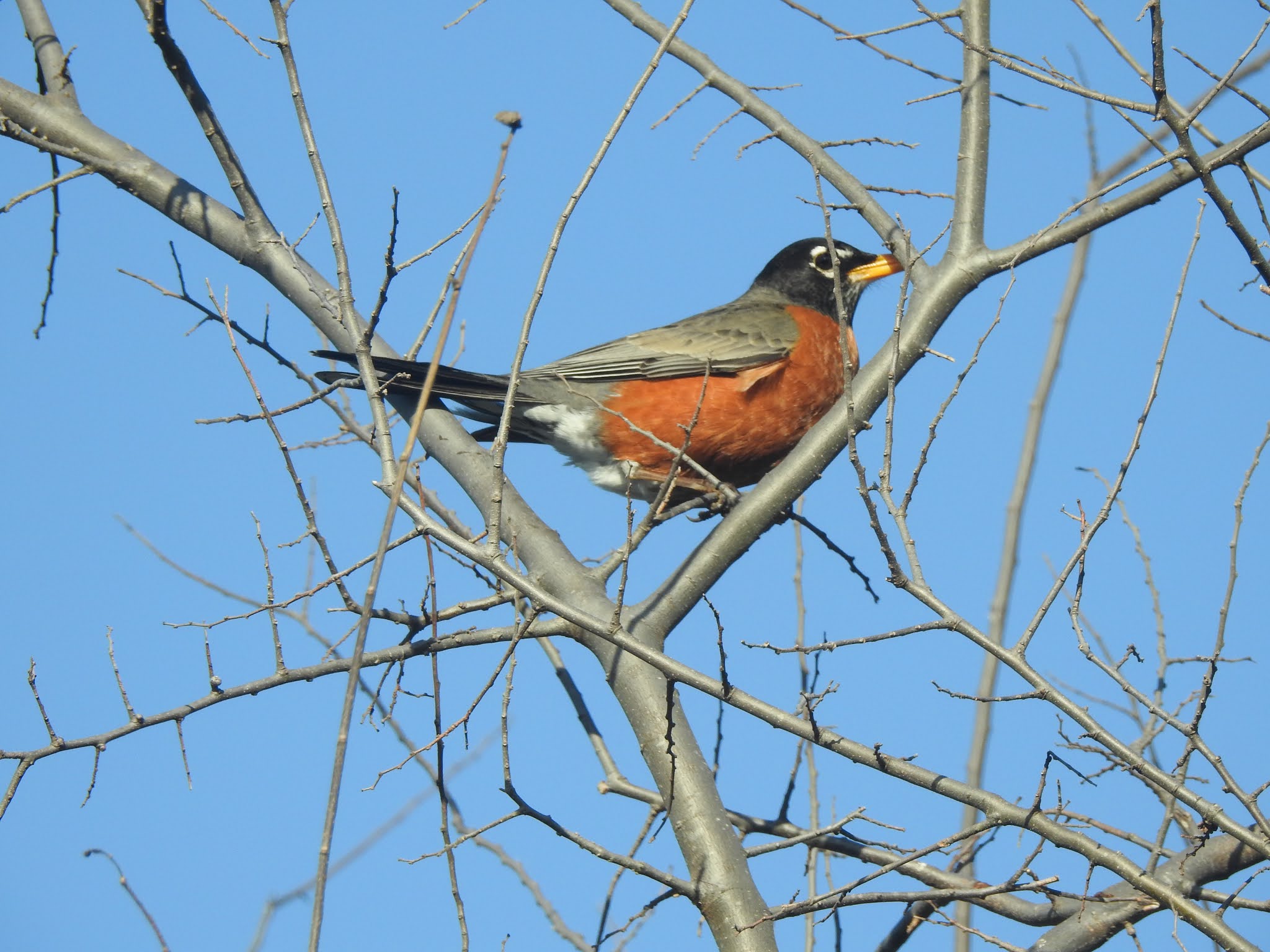
We recently had the largest, most rowdy flock of robins move through our area; their brief stay outdid every other occurrence in memory.  They were everywhere, and they stayed perhaps for ten days, then left.  Some years, the last five for sure, there were no robins to be seen here.  Their travel guide put them on a different route to their northern nesting areas, but this year our place was a featured stopover.

The interesting part of this story is the apparent preferences the birds show in their eating, nesting and social habits.

The robins are noted earthworm eaters, but we have no earthworms here, at least none so near the surface that they can tug them out in the classical robin fashion.  So,  what do they eat while ganging up on us as they did recently?  Their droppings show a lot of red berry evidence, and the only red berries we have right now in any quantity are prickly pear tuna berries that the deer have not already found.  But those berries are tucked inside the tunas and not easily obtainable by the robin, so these birds were probably feasting on such berries as possum haws.  Strange as it may be, they may find this fruit the only thing to eat in the area as they travel northward.  Bird authorities have found that migrating robins eat small berries until they exhaust the supply, then move on northward. They roost in clusters in trees at night which accounts for the pile of droppings concentrated on the ground below.

And then there is the noted Golden-cheeked warbler.  We talk a lot about how important it is to protect this bird's nesting habitat, but we actually don't sacrifice much to help this bird.  This bird seems to have two dominant preferences, one is the mature Ashe Juniper that produces stringy shreds of bark they use in nest building and the other is seclusion and privacy.  The nest is nearly always made from this stringy bark that the bird rips off the trunk of the mature Ashe Juniper.  So, even when we proclaim that we are protecting the Golden-cheeked warbler, landowners are busy eradicating their land of the Juniper and building dense housing units on the cleared land.  Hey, not so fast, remember what we proclaim about protecting the habitat of the warbler.

Here is an example in a photo credited to Amanda Aurora of a nest being monitored.  Note especially the flat strips of Ashe Juniper bark that rings the nest.

Figure 14.1 Golden-cheeked warbler nest 


We find that these birds are so reclusive that they are heard more than they are seen.  From our records here, we have heard them at least once per year, but have never seen them.  More recently, we spotted a used nest in a small oak tree.  From its construction, it is almost certain to have been that of a Golden-cheeked warbler.  
Figure 14.2 Suspect Golden-cheeked warbler nest


Compare the preference of the GC Warbler to that of, say, the Northern Cardinal or the Grackle, or better yet, the house wren.  The wren is more than likely to build its nest in the bouquet of flowers adorning your front door, so accustomed are they to being around people.  The grackle is also a standout in its ability to live among traffic and parking lots and people.  Here is a poem that won a prize for us in a local contest.  The poem describes the grackles activity in the parking lot of the local supermarket.

Scroungin' the Lot at H-E-B
I comes across this paper, see...
An' I notes this contest 'bout us birds
with all these prizes fer rhymin' words
So I sez to myself with my famous cackle
"this is right up your alley, old G.T. Grackle"
Next I fly to my tree where I keeps my PC
And that's why yer getting this email from me
Now, first all, and we all know it
You had in mind a human poet
But, what if we cut out the middleman
I win all the prizes... an'
settle some debts with my seed eatin' pals
and share the pie with my favorite gals.
If you think there is nothin' in it fer you
Not true, as I notified a crew
Of media types for an interview
Photo ops and a book signin', too.
Bring the loot to the parking lot around three
My office is in the crape myrtle tree
G.T. Grackle
641 East Hopkins
San Marcos, Texas 78666

The pie was delicious, personally delivered by the man himself, Jerry Hall.

______Sightings___________

The Christmas Bird Count has been completed by the volunteers led by Stephen Ramirez and the count was fewer than last year, but that may be true because of fewer volunteer counters.  This introduced factor of the number of spotters may be adjusted by a few of the other parameters of the count, as this year we noticed that the count also listed minutes of counting.  
No matter what, the count shows  33 species, the most prominent ones being cedar waxwings and robins along with the ever present turkey vulture.   


Thursday, February 4, 2021

A Natural Occurrence often Overlooked

 John Muir once said that everything he touched in nature was found to connect to some other part of nature.  In other words, we are living in a natural world where nearly all aspects of life, not just our own, but all life is interconnected and thus interdependent. This means we need to be careful of what we change or disrupt in nature.

This brings to mind a phenomenon that occurs continuously around the world.

Plants and animals have many things in common, but food stands out as one of primary importance.  Animals, of course, can move around and secure their food where it exists, plants on the other hand need to find food where they happen to sprout.  Plants are at a disadvantage because they can be the food of animals whereas the reverse is not so common.  In addition, plants that happen to sprout where there is no food (and water) don’t last long, do not flower and therefore make the decision not to reproduce in the particular area.   Plants that find tough conditions then become the rare species of the area----maybe even extinct.  So be it, Nature is in control for the most part unless we, the animals, interfere with the natural process in which case the outcome is usually an even more rare plant.  Unless, of course, we animals need the plant for food in which case we create the conditions (irrigation, hot houses, cultivation, insect deterrents,  etc.) that allow the plant to grow in profusion.

But, so much for plants, what about the animals that can move about and find favorable conditions.

Here is a good example of an animal that moves about for its food.  Twice per year, once in the late fall and the other in the early spring, American Robins (Turdus migratorius) move through the region here in central Texas on the way to their nesting grounds in the northern states, and while passing through they search for food .  They eat bugs, not seeds, and the bugs are classically earthworms. One old robin once said “it’s the early bird that gets the worm” and we know this is true.  The robin is noted for its travels in search of bugs and worms.  At this very moment, flocks of robins are here in central Texas on their way north.  And, they go to the far north, liking not only bugs and worms, but moisture and cool weather that create the environment for their food.  Here in central Texas, especially at this very spot, we seldom see an earth worm, but do have plenty of bugs in the wintertime—right now they appear to have found their food in the screens that cover the gutters of the roof as I can hear them pecking away at the metal screen---that helps us too as it keeps the bugs out of the rainwater collection system, water we use for our drinking water.  So, they have enough food for their short stay.  They will all be gone in a week or less. They have been here for only a few days and will soon be gone on their northward journey.  They never stay here as there too many places both south and north of this location they prefer.  In their breeding season, the summer months, its too hot here.

13.1  American Robin passing through


In our minds, this brings up the story on fish.   Whenever you see a young child fishing, you can count on the child thinking that all water has fish and the fish are equally distributed through the water.   All one should have to do is to bait the hook and cast that into the water and wait.   Depending on whether the fish have found this particular location a good place at which to eat, the wait might be a long time.

It would be an interesting study to determine how much time one needs to fish before learning that fish are to be found where there is food and not necessarily where you choose to cast your lure.  For us, before we began to be more observant of nature, it took many years of fruitless fishing to realize this point.  But the phenomenon of food as the center of concerns exists here with fish too.

Recently a video (youtube) showed a view from a tourist ship moving through the interface of arctic waters and pacific ocean waters.  Observable were many large fish at this interface feasting on the small fish that were visible to them and were flourishing at this fresh water, salt water interface.

Before we pass over it too lightly, isn’t this interface of two waters, fresh and salty a something to note in itself.

13.2 Interfacial water between Arctic and Pacific oceans (youtube)

One often wonders how the fish pass the word to other fish that this is the place to be for food.

Another learned example of the importance of fish feeding at the interface.  My friend and fishing friend David found that fishing the Mississippi River near the end of habitation is often productive for large Seatrout when you can find the interface between salt and fresh water.  If you think about this and look at a map, your natural response is that this area should have no saltwater as it is too far from the salt water of the Gulf of Mexico.

But, not so, salt water has been found near the bottom of the Mississippi River all the way to Baton Rouge.  That is made possible by two factors, one is that the bottom of the riverbed is lower in elevation than the surface of the Gulf and the other is that salt water is “heavier”, that is has a higher specific gravity than does fresh water, allowing the salt water to flow back up the river as the fresh water is flowing to the gulf.  At this interface is food, freshwater food, that the large seatrout find good to eat.

Again, animals go where there is food.  The examples are everywhere.  The backyard birdfeeder, corn for the deer, the list goes on and on.

Now comes the interesting part.

Why do cities exist, especially today?  Of course, the answer is so that people can get "stuff" and to collaborate (for both good and bad reasons).  Focusing on getting stuff, how about food.  Is it more convenient to get food in a city than it is in the countryside?  Sure is, people in rural areas have far less choice and have to travel more distant to get their food.  Imagine a city of 5 million people  and not one garden nor even one producer of beef, chicken or seafood.  People get their food when hundreds of trucks arrive daily to distribution points delivering food from processors across the nation and even from other countries.  People without an income can eat in cities and would find it difficult to procure free food in rural areas.  No doubt about it, cities are like bird feeders. Provide convenient food and people will come.  All a very natural process, but in this case heavy assistance from man himself.

______Sightings_____

Spring is still some many weeks away, but there is some signs that spring will arrive.  The birds that winter here are all in a frenzy for the mating season, the licogiums are up but not blooming, the honey bees are busy on the flowers of the rosemary, the buds have swollen on all the deciduous trees, and so on.

This nice specimen of a buck stepped in front of the lens of the camera and even posed for a second while this picture was taken, then bolted away.  Deer hunting season has closed and I think he made it for another year.

13.3 White tailed deer in Central Texas


Sunday, November 15, 2020

Alpacas off Devil's Backbone


_________12._____ Alpacas off Devil’s Backbone


Here in Central Texas the land has some extremes in canyons that are as dramatic as any part of the so-called Hill Country.  Especially dramatic is the terrain along RR 32 as it travels west on a ridge separating the Wimberley Valley from canyons to the south. This is probably the most well-known mile or so of  RR 32 as it snakes in several ess curves along what is known as Devil’s Backbone.  It’s here in the canyon to the south of RR 32 that we found Tierra Prometeda, with terrain that probably has some attraction to alpacas.  Of course, its hotter than the mountains of Peru, but this herd of some 100 animals like it because for the most part, they were all born here in Texas, plus they like the care they get from their owners Rhonda and Kern Deschner.

We became aware of this alpaca herd some two years ago when we stopped at a metal working fair located off Dreibrodt Road some twenty miles south in Guadalupe County.  At this show, Rhonda and her Farm Manager, Jenny, were showing three of the animals that were raised on the ranch off Devil's Backbone. It was first time that we were able to come within mere inches of these fine animals.

The alpaca is a member of the camelid family.  Scientists have determined that camels as we know them today, once existed in South America, and the alpaca, the vicuna and the guanaco are descendants of the camel.  The alpaca is no longer found in the wild in Peru because it is now a domesticated animal, but the vicuna is wild and remains so today.  The llama is domesticated but the llama is larger than the alpaca, does not have the quality of fleece and is used mainly as a worker, carrying loads for resident farmers.

Peru is the  native land where these animals and especially the alpaca  have been domesticated for more than 2000 years, but even so, they have not lost their native instincts, one of which is caring for their young. 


We started our visit in the mother and newborn’s corral with Jenny and met Princess Leia and her son Mandalorian, both named after Star Wars characters.  Usually the mothers birth their babies in December but Princes Leia was early by a month so this pair were alone in the corral and Mandalorian will have to wait for his peers to frolic with.

Figure 12.1-Week-old alpaca and mother

 Jenny showed us how she, but probably not we, could pick up the newly born alpaca and the mother would allow her to do so because it had occurred several times before and now Princess Leia trusted her. Despite this trust, it was apparent that she showed some signs of distress by moving closer to the newborn.  But then something interesting began to happen.  As Jenny held the small alpaca in her arms and stood by the mother, all seemed normal and calm. At this time, we were standing about ten feet away from Jenny with newly named Mandalorian and off to the side was mother alpaca.  Slowly, Jenny started to move toward us to allow us to touch the newborn, and Princess Leia also started to move, regally holding her head high and with an intense look in her eyes, all of this occurred as if in slow motion.  With Jenny nearing us, the mother alpaca slowly eased her way broadside in between us and Jenny , and here is another interesting aspect of this occurrence.  Mother alpaca was humming a continuous monotone that we were told is one of the ways they communicate concern.  All the while this was unfolding, Princess Leia made no rapid movements, kept her head high and kept her eyes on us and her new baby.  The end effect was that mother alpaca separated us from her newborn because she was unsure of the safety since we were newcomers to the scene.

We then went off to another corral where several young alpacas were gathered.  When the alpacas in this herd discovered that we were strangers, their attention shifted to us as if to say, "who are these visitors?" With just a bit of encouragement from Jenny, they slowly made their way to us and became quite friendly, one even being curious about the leather wallet I had in my back pocket.  With no hesitation, they allowed us to rub their necks as if we were their long-lost pals. While R was busy fending off the pickpocket, I was making friends with chubby-cheeked Fiorello and a couple of his buddies.


Figure 12.2 Young curious alpacas

 One aspect of the hill country terrain that the animals must like is to be able to roll in the dust, so they have been provided with special spots to roll around in some dirt bowls of dusty limestone and sand just as most of us have seen horses do with this same need to clean their coats.


Figure 12.3 Rolling in the dirt

 We talked at length with Rhonda about the business of fleece and animal production.   There is little doubt that animal sales produce the most income, with fleece sales being second. But the details of  fleece preparation was of interest to us because we were able to feel the fleece, see it in the products made from it and experience the wide range of fleece attributes that exist from one animal to another.

Shearing, as was noted before, is done in the first week of every April when the shearer arrives.  The fibers are matted, so the shearing operation produces a batch of fleece that represents one animal.  Here, Rhonda is demonstrating a pelt of fleece taken from the back of one animal. The fibers are about two inches long and zig-zagged with a diameter ranging from 10 to 20 microns.


Figure 12.4 Alpaca fleece mat

We were curious about the structure of the individual fibers that made up the mat and so Rhonda plucked a small sample of fiber from the mat and spread it out on the back of Jenny’s shirt, the only contrasting background we could find close by.  The overall length of the fibers in this photo is about 2 inches.


                                                            Figure 12.5 detail of fibers

 The mats are sold to mills that have strict grading standards that affect the price.   The fibers dye easily and thus provide opportunity for making into yarn which then can be made into clothing, rugs and whatever.


Figure 12.6   Grading of Alpaca fleece

The fiber grading chart is from Texas Hand Woven Creations doing business as Ingrid’s Custom Hand Woven, Inc., in Paint Rock, Texas and can be found on other websites like New England Alpaca Fiber Pool. Fiber grading is based on five factors;  fineness, amount of guard hair, variation in diameter of fibers, fiber length, and uniformity of fiber diameter.  The alpaca fleece is cleaned of manure and other organic matter such as grass and twigs, then sent to the processor for grading.

 The company in Paint Rock employs 8-12 who process fleeces, making yarn and weaving in an operation that is housed in three stone buildings that are each over 100 years old. In 2009 focus shifted from wool/mohair to alpaca, llama, and buffalo fibers plus some other natural fibers making rugs, placemats, floor and table runners, wall hangings and saddle pads.


Next, we advanced to the Farm Store, part of Tierra Prometida,  that is available for shopping; but since the shop has no regular hours, an appointment is a necessity.  This very compact and well-organized shop has a wide range of articles made of alpaca fleece, some of which are made in places like Peru, and some in the USA.  Here is a photo of an alpaca accent rug made by the weavers of Texas Handwoven Creations in Paint Rock, Texas.  All the colors of this 2’ by 3’ rug are natural colors.


Figure 12.7  Handwoven alpaca fleece rug


Rhonda makes some of the clothing items herself and there are cloud-soft afghans, scarves, stoles, knitted Peruvian caps and stockings as well toys.  The shop is a little Alladin’s cave of beautiful handmade delights that are hard to resist.  After mulling over the possibilities, we returned a few weeks later for the 2’x3’ rug above (to be used as a wall hanging) and a toy alpaca that will sport a red ribbon for Christmas.


_____Sightings_____


           Figure 12.7  Roadrunner on porch rail


Figure 12.8  Littleleaf sumac  ( Rhus microphylla )


Figure 12.9  Crape myrtle  ( Lagerstroemia indica ) and Shumard oak ( Quercus shumardii )

A showing of our fall colors, blowing in the November wind.


Thursday, October 15, 2020

The Elegant Bobwhite

 They arrived, they stayed awhile and then they left.

 Bobwhites, one of our favorite birds because of their flight characteristics and especially their call, have not been heard this year on the ranch.

All North American bobwhites (Corvus Virginiana) are catalogued in 23 subspecies and these subspecies are divided into 4 groups.  Three of the four groups (Masked, Grayson’s, and Black Breasted) live in central and south America and the fourth group , the one to which our local bird belongs is the Eastern Group.  In Texas, of the 23 subspecies, we have two different bobwhites, the  subspecies Texanus and the Taylori.  It takes an expert to tell all these subspecies apart as they are so similar in appearance.

Bobwhite, male and two females

The Texanus sub specie is our local bird, its range is from Central Texas south well into Mexico. The Taylori sub specie ranges from Central Texas up into the central plains of the states to the north.

The bobwhite has several habits which are unique.  They are insect and seed eaters, they group into coveys, they tend to be monogamous, and they fly with a wild beat of the wings when flushed from their roosts producing a sound that is memorable only second to the sound of a rattlesnake.

They roost on the ground, where they form a circle of birds all facing outward from the center of the circle and thus give the impression when flushed, that they all fly in different directions and for the first instant they do because of this roosting arrangement. They do this for protection as they have several natural enemies---like hawks, owls, coyotes and of course hunters.

Ranchers in Texas, particularly in the high plains and in south Texas find that leasing their land to hunting quail brings in more profit than running cattle on the same land----that’s not easy to pin down as it may be the difference between two low numbers.   Nevertheless, hunting bobwhite in Texas is a big thing and brings in a lot of associated revenue and taxes.

Bobwhites nest in the springtime and find the best spot to nest at the base of a clump of a typical Texas bunch grass, where the top of the bunch grass may be 18 to 20 inches tall providing seclusion and some shade at parts of the day.  Heavy underbrush is not their favorite habitat, grassland with some scattered brush is their preferred habitat.

The Bobwhite has been the focus of research for the last 80 years, probably due to the importance as a game bird and  a bird that could be raised for food. Squab farms are common, especially in the northern states. 

In the 1940s, researchers found that Vitamin A is an important component in the food they eat, and the source of Vitamin A for the Bobwhite is green vegetation.  Typically, 70 % of the food for a bobwhite is seed, but during breeding season, that changes to include more insects, and green vegetation to achieve their Vitamin A requirements.  In turn, Vitamin A was found to be critical to egg production and the overall health of the bird.  Low Vitamin A could lead to short life span but in most cases, the bird succumbed to predators because low Vitamin A caused low energy, poor eyesight, and a general inability to escape predation. Related to this dietary study was that landowners attempt to supply food for the bobwhite to augment natural foods had little effect on the population of the species.  Almost all the programs to help the bobwhite produced little positive results.  They apparently know the difference between natural food and artificial food.

In the 1970s, studies were conducted on the need for caloric intake at different ambient temperatures; this study found that egg production was peaked at temperatures between 70 and 77 degrees F.  Out of this study came the bonus information that showed that Bobwhites can tolerate heat, but just so much heat.  For females, that temperature is about 107 degrees F, males a few degrees higher.  Sustained temperatures above these levels and the birds succomb.

In our area, high temperatures usually mean low water levels in the soil—whatever rain we may get in the hot weather months evaporates quickly.  Bobwhites and for that matter, all the members of the quail family are known for their wild fluctuations in population correlating with rainfall. An intuitive conclusion is that high rainfall means more green vegetation as food (Vitamin A) and lower temperatures, both of which favor reproduction.

Populations of bobwhite appear to be decreasing by about 2-3 % per year from the best estimated of bird counts and harvest counts from hunting.  This decline in population has been linked to several factors, some old natural ones and some newly discovered. 

Regarding the established factors affecting population, all the known predators factor into the equation, but skunks and fire ants may be at the top of that list.  Raccoons follow as a distant third.

But there are new concerns for the health of the bobwhites; not new but seemingly found more often in recent years.  There is a parasite that is picked up by the bobwhite from eating grasshoppers.  Due to the heat and the drought, our grasshopper population has burgeoned this last year and again this year.  The parasite that is picked up is a thread worm that escapes from the bird crop and migrates to the nasal passages and eventually into the eyes.  These thread worms have been known to biologists for decades, but it appears that the infestation has grown to epidemic status in some parts of Texas.  The thread worms are destructive, destroying vision long before it kills the bird.  Hunters have reported birds that fly into obstacles upon being flushed and even birds with open eye sockets.  A medicine has been developed for adding to food supplies, but the problem is getting the birds to eat the medicated food.  The outlook for this problem is not good.

 Nest success is another problem with Bobwhites.  During average conditions of temperature and water availability, the success of the nest ranges around 28 % in most studies.  The nest sizes are large though, offsetting this low nest success level.  About 12 eggs are the normal nest size, so when the nest is successful, there are many baby quail.  Studies show that the skunk is the most probable cause of nest destruction.

If seeds are the main food for the bobwhite, what seeds are preferred?  Analysis of crops from birds across Texas show that their diet consists of a lot of different grass seeds, but there are some that are obviously preferred.   Here are a few:  Sorghum, both the naturalized plants  and those  planted for food production are a favorite of the bobwhite.  Among the grasses, such as the rescue grass, the paspalum and those grasses with seed heads like sorghum are favorites of the bobwhite.

From  all these studies of natural foods for the bobwhite, the data show that most of the favorite foods grow most predominantly in the eastern part of the state or the southern part of the state, leaving the hill country short of natural food for the bobwhite.

So, what about our brief encounter with the bobwhites?  The intuitive conclusion is that they did not find enough food and their time here was during those years when we had slightly higher than normal summer temperatures and lower rainfall.  Whether they died off or migrated to other areas is not known, but it could be presumed they did not reproduce well and the died out.

All this reminds me of my younger days of hunting ring-necked pheasants on my uncles farm in Hudsonville, Michigan.  The whole area was farming country then and most farms planted corn both for the corn and the corn plant.  The corn was saved for the chickens, and the corn plant, while still green was chopped up and put into silos for the winter feed of the cows.  But while the corn was still in the field, the pheasants not only ate the corn, but they found it easy to run down the corn rows to hide from whatever came along.  Every 20 acre field had several cock pheasants.  Then, progress came to the area and the farmers disappeared and so did the corn and so did the pheasants. It would be a challenge to find one pheasant there today.

All this shows that wild animals, and plants for that matter, live where they can thrive, and when those conditions turn negative, they leave or die.

Wow! 2024 A year of change

 Looking back over my notes of what happened with the vegetation this year brought back memories of how much of a shift we have seen from pa...