Monday, March 12, 2018

Newsletter Number 2--The Understory

Most of BWR land consists of wooded areas and open grassland.  The wooded areas are mainly live oak and ashe juniper with the low areas having a significant cedar elm population. Cedar elms like more water. The oaks and elms provide a canopy under which many small trees and shrubs thrive, not so much that they like the shade, but because there they can escape the grazers.  On the edge of wooded areas  where there is some protection and a bit of sunlight, you can find Texas persimmon, agarita, lime prickly ash, elbow bush, bee brush and several other small shrubs.
The Texas persimmon (Diospyros texana) is a good example of a small tree or shrub that prefers sun but exists where there is cover for protection. The trees are very tall and "leggy" when found under the oaks as they search for sunlight. According to Taylor,[1] it is a very valuable source of food for wildlife. Deer browse the leaves and eat the fruit that is also eaten by songbirds, quail, turkeys and smaller mammals. Birds use the trees to nest and roost while the canopy provides shade and cover for mammals. The flowers attract pollinators, such as bees. Butterfly larvae feed on the plant and the adults use it as a source of nectar.
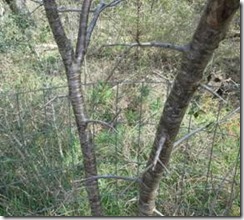
Another tree you will find in the understory here is the Mexican plum. Prunus mexicana is a member of the Rose family along with cherry and peach trees. Horizontal lines on the trunk are an identifier of this tree.
clip_image002
You might take a look in your woods or protected areas right now as the flowers are evident and do attract bees and butterflies. Wildlife enjoy the fruit and so do we when we make tart and colorful jams and jellies.[2]
Elbow bush (Foresteria angustifolia) is another woody plant you can find in the understory.  We have nicknamed it the ‘tripper upper’ as the 90 degree angled branches interlock with each other making it difficult to walk through a thicket of these plants.  Elbow bush provides deer and cattle browse and fruit for many mammals as well as quail, white-winged doves and songbirds. Bees like the flower nectar.
Agarita (Mahonia trifoliate)is a 3’-8’ shrub with stiff, holly-like leaves, yellow flowers and red berries. Its young leaves are eaten by deer and it provides berries for birds and mammals as well as nectar for bees and butterflies. Humans imbued with patience and determination use the berries to make delicious jellies and wines. In addition, the nest builders find a safe haven behind its prickly leaves and small birds, animals and plants hide in the safe shade below it. See Siemmsen authored newsletter.
Lotebush, (Ziziphus obtusifolia) is a wickedly-spined, stiff shrub and another provider of cover and protection for birds and animals while they dine on its small, black berries.
Frostweed that you see clustered under the live oaks and that spectacularly burst during our freezes this past winter was not one of our favorites until I read that it is a nectar source that attracts bees and butterflies, a redeeming quality. 
The mountain laurel is a bit of a mystery to us.  We know it will grow nearly everywhere it’s planted, but we have seen no naturally occurring specimens in the surrounding areas. We have grown it in the gulf coast gumbo soil, it is abundant in Bandera County, and we have two good examples of this plant at the entrance to Bridlewood, but we have seen no native ones.  Know of any in the wild?
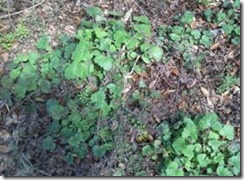
Plants that we’ve introduced that have done well in our shade and part shade are the salvias.  Cedar sage (Salvia roemariana) with its pretty geranium-like leaves and red flowers lights up shady spots and reseeds easily.
clip_image004
Just save the seed heads and scatter.  Tropical sage (Salvia coccinea) grows in part shade and reseeds itself as well.  It is more aggressive, but if you love volunteers it will make you very happy. 
Mealy blue sage (Salvia farinacea) is native in BWR and we have added more.
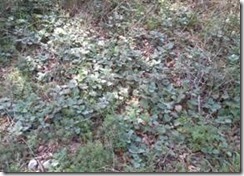
Heart-Leaf skullcap (Scutellaria ovate var. bracteata) has a deep purple flower and the plants are naturalizing beautifully in the shade of the oaks.
clip_image006
These salvias and the skullcap are all square-stemmed and belong to the mint family.
That ends our short overview of unusual flora to be found in the understory. Now is a good time to look for these plants because many are in bloom and are more easily detected. You will have to walk to find them, as they are hard to identify from the seat of a bulldozer.
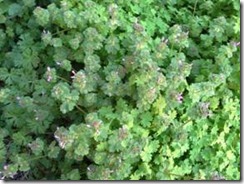
Worth mentioning just because it is an interesting little volunteer in the disturbed soil of a garden bed. Henbit (Lamium amolexicaule)[3] is an exquisite herb of the mint family with two-toned green leaves and tiny pink upright, orchid-like flowers. [4]
clip_image008
Each newsletter will feature a listing of unusual sightings of birds and mammals. The authors invite responses from readers who have sighted not-so-common species.
This month, we report that a Say’s phoebe hung around thinking it might make good use of the eastern phoebes nest under the eave. But that was not to happen as the eastern phoebe ran it out of town.
All issues of the newsletter will appear in a blog established solely for the purpose of publishing the newsletter (naturenewsletter.blogspot.com). There you can enlarge the photos for better detail and add your interactive comments to the newsletter.
R & D Tusch

[1] A Field Guide to Common South Texas Shrubs by Taylor etal
[2] A Field Guide to Texas Trees by Benny J. Simpson
[3] WIldflowers of the Texas Hill Country by Marshall Endquist p. 167
[4] Read about its medicinal and food value qualities at www.naturalmedicinalherbs.net


Sunday, February 11, 2018

Newsletter Number 1-An Introduction


Welcome to the first issue of the Bridlewood Ranches nature newsletter.  We have responded to the Board of Directors request to publish a newsletter that would inform our members of the interesting aspects of plant and animal life on the ranch and in Central Texas.  We are situated in an interesting part of Texas because we are between the blackland soil to the east and the caliche soil to the west and between the heavier rainfall of the east and the sparse rainfall of the west.  In addition to the plant and animal life, the newsletter will provide information on local organizations that offer information on these subjects.  Most importantly, please note the word interactive in the title.  Readers are encouraged to send us text and pictures that they would like to share with other readers in the newsletter and on our website.  Please send that information to dgtusch@aol.com.

Spring Lake Garden Club in San Marcos will meet on February 8 at 9:15 a.m. at McCoy’s Headquarters.  The program will be Earthkind Gardening presented by Master Gardener Marilyn Love.  Visitors are welcome, so if you are interested, you may attend this meeting at the time and place.  Call Dee for details if needed.

Wimberley Garden Club will meet on February 14 at 9:30 a.m. at the Lutheran Church of the Resurrection, 101 Spoke Hill Road.  (This road is right off RR12 between the “junction” and Wimberley) At this meeting, Darrell Vasquez, a local coffee roaster, will present information on coffee roasting and its by-products.  Both this program and the one in San Marcos should be interesting to many of us.
Our website, bridlewoodranches.org has a tab at the top of the screen labeled Natures Gallery. Clicking this tab will take you to a page describing the intent of this gallery and a way to then migrate to an offsite blog we maintain as an inventory of what animals and plants we can observe here on the ranch.  You can go to this blog directly using this internet address:  bwranches.wordpress.com.   We are always looking for input on stories and pictures of what you have observed on our 1600 acres.

For some reason, two of our plant suppliers in the area have decided to end their businesses. They are:  C & J Nursery and Reid’s Nursery, both to the east of I-35.   In the immediate area, we still have Lowes in San Marcos, and King Feed in Wimberley. If you haven’t checked out King Feed, do so as they have excellent selections of seeds, plants, trees and shrubs and Tim writes a very good, free gardening letter. It’s also fun to check out the new little chicks, quail and parakeets. Please let us know if you’ve found any other reliable plant suppliers in the area.
If you take the local Record newspaper you have no doubt seen Joe Urbach’s gardening page on Sundays.  Urbach, affiliated with the AgriLife Extension delves into his subjects deeper than most and he has a very interesting website.  He can be found at www.gardeningaustin.com.

Okay, so what is first to let us know that spring is not too far away?  Leucojums, aka snowflakes, are up with their bell-shaped white flowers with the little green dots on their scalloped edges.


The daffodils’ tall, spiky leaves are up, but no flowers yet. Quail have not yet started to sing, the rattlesnakes are still hibernating, but phoebes have made themselves heard along with chickadees. We saw a rufous-sided towhee the other day in the woods doing its usual frantic scratching around in the leaf mold looking for food. On the way in or out we always look for the American kestrels taking off from the wires on Bridlewood Ranches Dr.  These are the birds we used to call chicken hawks.
Speaking of birds and the interconnection of prey and preyed upon, do some of you remember the hordes of mice that existed here a few years ago?  It was a dramatic change and we had a terrible time keeping them out of the attic of the house.  We also saw and heard owls more frequently who obviously were happy with the mouse population explosion.  Then for some reason the mice disappeared and now we rarely see or hear any owls.
This reminds me of the odd sighting we had during the summer.  We were returning from town in the middle of the day and we heard a bird that we’d thought in the past was some sort of nightjar. It was a descending call that was quite unusual.  I got the binoculars and finally discovered the bird quite close.  He was a good-sized bird with a streaked breast, but with a long, narrow beak!  That was a surprise. Our mystery bird was a roadrunner.  I never would have guessed from the sound of its call.

It will soon be Valentine’s Day and for those of us who garden by the holidays that means it’s time to plant, fertilize and prune roses.  So Belinda’s Dream is looking at a haircut in the very near future.  She has been a wonderful, carefree, bountiful bloomer.  The Mutabilis was planted last year and is doing well. A rose with single petals, it doesn’t require pruning and its beautiful claim to fame is the changing colors of the flowers from pale yellow to white to pink.

Hope to see some of you at the garden club programs and hopefully hear from you with info, pictures or both.        

                      R & D Tusch


Wow! 2024 A year of change

 Looking back over my notes of what happened with the vegetation this year brought back memories of how much of a shift we have seen from pa...