Tuesday, June 12, 2018

Nature Newsletter No. 5-----Trees

Texas soil type and water availability vary widely across the state. Water varies a lot due to hit-or-miss rainfall and the depth of groundwater. Soil pH is acidic in the east and alkaline in the west. This range of conditions results in a wide diversity of tree life. Pines dominate in the east, and many types of oaks do well in the central area. In the far west trees can only be found in canyon bottoms or near water washes. Here in Hays County, our dominant tree is the Live Oak. Live oaks can do fairly well on our thin soils with its high alkalinity. Some of the other oaks can survive here but need lots of care to get established. Travel only as far as San Marcos where the ground water is much nearer the surface than it is here in the Ranch area and you will find a much wider range of tree species. This area and on to the east of I-35 also has dirt which is rather scarce here.
Oaks are worth spending some time reviewing because of their wide range of species. At the last survey of literature, we find there are 31 different oaks that can call Texas home. Apparently, oaks can make hybrids rather easily.
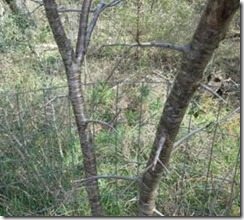
We all know a Texas Red Oak when we see it, but how about a Monterey or Mexican Oak, Quercus polymorpha. Can you spot one of those? These trees are not native to our specific area, but are native at higher elevations in the Big Bend area. That means if you want one of these fine oaks, you need to buy it at the nursery and plant it. Beyond the hedge of rosemary beloved by the bees, here is one we planted 7 years ago from a small seedling.


It’s the tree on the right, at about 8 feet tall. It was planted as a one year old with a trunk about the size of a pencil. What is unique about this oak is that it retains many of its leaves through most of the winter. That is a red oak to the left.
Another good looking oak is the Lacey Blue Oak, Quercus laceyi. When mature, the leaves actually have a bluish cast to the green. We planted two this last fall, but they need almost daily watering to stay alive in this heat and lack of rain. They do well naturally in counties to the west of here. These trees apparently like calcareous soils, and even though they are said to be drought tolerant, they do need more water than we would think a drought tolerant plant would need.
These thirty one species of oaks provide endless opportunities to study the variations. For example, in Ward County, near Monahans ---there is an oak identified as a separate species. It’s the Havard Shin Oak, Quercus havardii , that can grow to 25’ under ideal conditions. There in the sand dunes, it produces 6’ high thickets with normal to large acorns. Its sand stabilizing roots can descend 90 feet in search of water. The name Havard comes from the person credited with first identifying this tree, Valery Havard, a French a botanist and surgeon with the U.S. Medical Corps.
The Bur Oak, Quercus macrocarpa, is a fine tree, not very common here, but seen in bottom lands where there is a bit more ground water and open sky. Bur Oaks grow slowly and don’t adapt well in a forested competition with other trees. The acorns are large and since this is a tree of the white oak family, the acorns have a much lower tannin level. You can even make acorn bread with them after leaching the tannin from the acorn. Bur oaks are so valuable that I would plant the acorns rather than eat them.
There are two oak trees that one might consider to be the commonly called red oak. These two species of red oak typify the oak’s ability to hybridize. One is the Texas Oak, Quercus buckleyi, a tree that grows to about 50 feet and the other is the Shumard Oak, Quercus shumardii. This tree has leaves very similar to the Texas Oak, but the tree grows to greater heights, perhaps even 100 feet. The leaves are so similar that it takes an expert to detect the difference.
Plateau Live oaks, Quercus fusiformis, are our dominant tree species. Once considered by botanists to be a varietal form of the more familiar Old South and East Texas Quercus virginiana it now has been assigned a classification of its own due to the fact that it thrives in our dry, limestone soil.
The Cedar Elm, Ulmus crassifolia, is another good tree for this area. However, it prefers more moisture, so you will find this tree in the gullies where it gets more water than on the hilltop. A good stand of these trees runs consistently through the gully that parallels Hugo Road. From a distance, these trees can be spotted easily in the late fall because their leaves turn yellow then brown before dropping from the tree. These trees can tolerate dry conditions, but they sure do prefer the areas of more water. Below is a photo of a cedar elm planted from seed about 10 years ago.


Trees provide wood for many uses. The settlers used the wood from the cedar elm for tools such as mallets because the wood is so hard and dense. My sawyer contacts will tell you that cedar elm dulls a saw blade faster than oak or mesquite.
Surprisingly, the general area once had a lot of black walnut trees. These valuable trees went the way of the black bear and the bison with an aggressive hunt for them. The New Braunfels area once had many large black walnut trees along the river bottoms. The Germans were good at woodworking and literally cleared the area of walnut trees to make Biedermeier style furniture. You can see some of this furniture and the tools that were used over 100 years ago by visiting this museum on the north side of New Braunfels.

The museum featured on the card is at the rear of the property. Up close to the road is a collection of restored buildings from the area creating a small village. Both are worth the time to visit.
The mill where we buy wood tells us that there are still some very large walnut trees in the San Marcos area, along the San Marcos River where they can get the water they need.
Although our area has essentially no pecan trees, they are common to the east of I-35 where they actually have dirt in which to grow. Pecan trees grow to a very large diameter and last for many years, producing crops of pecans for wildlife and people. Pecan wood is valuable as a furniture wood. Sawmills rarely will cut a live tree for wood as blow-downs provide plenty of material to be sawed into useable wood. In fact, some pecan trees are so large and heavy, the saw mill is transported to the tree and reassembled to bandsaw it along its length.
Just as winter is the time to peruse seed catalogues and plan spring gardens, summer with its scorching heat is the time to plan for adding trees and shrubs to the landscape in the late fall and early winter.
Sightings
This little American green tree frog, Hyla cinera, is a common backyard species that is popular as a pet. We noticed this one on an outdoor chair in the breezeway, but overnight it found a more comfortable spot on a potted amaryllis.

We have noticed a doe now and then during the day near the house and R was sure she was either pregnant or had a fawn secreted somewhere nearby. He went to remove the loosely coiled fence he’d put around the flowering yuccas last week and there was a small fawn lying in the sun just inside the fence. R came to the house to get me and we both wondered how to get her outside the fence and out of the sun. She stirred, saw us, jumped up and threw herself against the fence trying to get away. Lordy, lordy, what a todo! We talked quietly to her and she calmed down a bit. Then she found and wormed her way through the narrow opening that she’d entered. We left her peering at us from behind a tree. She obviously wasn’t going to tell Mom that she’d wandered away from the safe, shady spot she’d been left. Now if she could just find it.
A pair of Summer Tanagers, Piranga ruba and a juvenile showed up the other day. I saw the female first; a greenish–yellow back with gold below. Later the bright red male appeared; the size of a cardinal with a heavy beak but missing the crest and black mask. The juvenile male came to a tragic end against a kitchen window and we found him later on the back porch. He had a red head and splotched red breast.
The Yellow-billed Cuckoo, Coccyus americanus, is one of my favorite birds. And I’m always glad to hear him chortling in the treetops when he returns from winter quarters. The word is that their numbers are diminishing throughout much of their range in the U.S. If you see one consider yourself lucky as they are secretive and stick to the tops of large trees.
The Common Poorwill, Phalaenoptilus nuttallii is another bird that is usually heard but not seen. The smallest of our nightjars, its song is also shorter ( poor-will-ip, the ip only heard close up) than its relatives, the Chuck-wills–widow and the Whip-poor-will. We hear him calling from a leafy spot where he lies hidden in the woods.
Follow up bird note: Our bluebirds have fledged and the backyard is lit up with additional flashes of bright blue.
Check out the following great local site for excellent pictures of birds, butterflies and new trails. The Hays Master Naturalist website has it all in their June newsletter. See it at: haysmn.org.

The bathing birds. All the birds come to the bird baths for drinks, but three species we’ve noticed go a step further. The Cardinals, Painted buntings and Lesser gold finches plow into the water with purpose and splash around with abandon.


From right to left: a male Painted Bunting on the rim of the birdbath, under him in the water is the olive-colored female, also in the water is a titmouse flailing around and above it on the rim is a male Lesser goldfinch. The little brown bird to his left on the inside of the rim is too indistinct for me to identify.
The following two insects were observed on a hall window in the morning obviously taking a break from their positions in the cicada chorus.

Homoptera cicadidae has locally emerged from his underground root feeding to procreate and die. The males are singing their high-pitched song to attract females. This courtship went on all day.
Books
I was alerted to an interesting book on trees by a March article in the Smithsonian Magazine titled “Do Trees Talk to Each Other?” by Richard Grant. Grant’s article is in essence an interview of a German forest manager, Peter Wohlleben, who lives with his wife in a cabin near Hummel. His book The Hidden Life of Trees: What They Feel, How They Communicate has become a best seller in Germany and 11 other countries including the U.S. and Canada. Other scientists are becoming more involved in this study; for and against the idea. For those interested, Mr. Wohlleben’s book is available at the Wimberley Village Library.
R & D Tusch




Tuesday, May 8, 2018

Nature Newsletter No. 4—Wildflowers

April showers bring May flowers, so our May flowers are a bit on the short side due to scant rains so far this spring. Nevertheless, this newsletter is devoted to the wildflowers that are not commonly in the news. The reader probably does not need to hear more about Bluebonnets except that they are biennial and need to be planted in the summer the same time that the plants snap their seeds from the pod. If planted late in the fall, the seeds should be scarified, but if planted in the late spring, the hard outer coat will be taken care of by the harsh summer weather and ready to germinate in the late fall on schedule. You can always tell if there will be bluebonnets next year by looking for the small plants in the late fall and winter. No plants at that time, the show next spring will not be good.
Some wildflowers are valued for their beauty, some are viewed as pests and invasive but still may be attractive in the field. This newsletter will cover both.
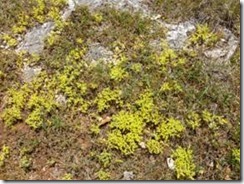
We’ll start with Yellow Stonecrop-Sedum nuttallianum, a plant we don’t remember seeing around here before but evident this year. The plant is a very small, fleshy, succulent herb that settles itself beautifully on and around stones in our rocky soil. You probably have some on your property. If not, it can easily be seen on the right side of the road as you enter BWR in front of the Verato’s property. Coincidently I saw some plants for sale at the H-E-B in Wimberley.
clip_image002
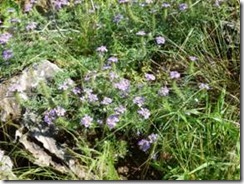
A few years back the fields were full of Prairie verbena- Verbena bipinnatifida, but since then for some reason we just have scanty patches of it.
clip_image004
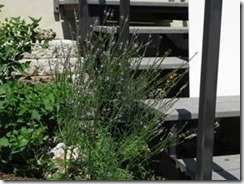
In this same family, we feel lucky to have a few examples of Texas Vervain- Verbena halei, shown below.clip_image006
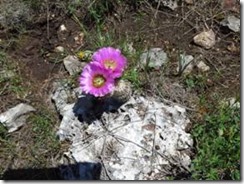
We’re all familiar with the prickly pear cactus and with all the flowers being produced, It looks like a good year for making jelly. However, there seem to be fewer Lace Cactus- Echinocercus reichenbachii or they’re blooming in short spurts, the hot pink visible one day and gone the next. Today (5-5-18) we saw around a half a dozen across from the Shuler’s, where the cows have a trail to the west. Below is a nice double bloomer.
clip_image008
Queen’s Delight- Stillingia texana is an interesting plant and as far as we know this is only one of a few on our property. It’s quite handsome with its yellow “candles” which are just now coming into bloom.
clip_image010
Marshall Enquist describes Three-Seeded Mercury- Aclaypha Lindheimeri as “being found in weedy habitats” which may be the reason it feels so at home here. I used it recently in a flower arrangement and its curved shape, color and lasting ability were very impressive.
clip_image012
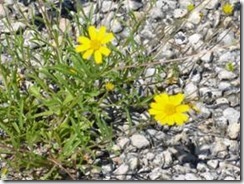
One of the many yellow spring flowers Slender-Leaf Hymenoxys- Hymenoxys linearifolia is a sturdy little annual plant with yellow daisy-like leaves. There are many of them along the roadsides in BWR this year.
clip_image014

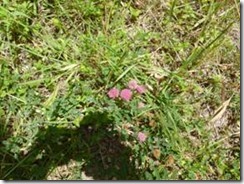
According to author Enquist, children are easily fascinated by the Sensitive Briar-Schrankia sp). They enjoy touching the leaves and watching them immediately fold up. This perennial with interesting round pink flowers has a sprawling habit and produces seed pods.
clip_image016

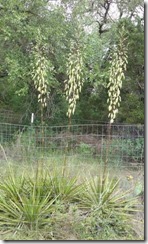
We have four Twisted Leaf Yuccas- Yucca Rupicola along the driveway and they made it to the bloom stage this year because of the wire cage. Cattle and deer like the flower buds. We want the seeds.
clip_image018
These twisted leaf yuccas are rather common, but the flower stalks are not so common as the wildlife and cattle eat them without hesitation.
We’ll end the wildflower section of the newsletter with three thistle types, two are aggressive aliens introduced from Europe and the third is our own Texas native.
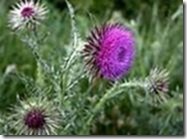
Musk Thistle-Carduus nutans is a large plant, 2-6’ with 2 ¼ to 3 ½” pink flowers. This plant was introduced from Europe many years ago for its use in gardens. The best way to identify these thistles is by inspecting the flower head. Here’s the musk thistle flower.
clip_image020Note the prickly leaves bracketing the flower.
It can be a tough plant to chop down when it is mature, but do chop it down (before it goes to seed).
Malta Star Thistle-Centaurea melitensis is another thistle from Europe and this one is a really bad guy, as it is very prickly and aggressive. Note here that the base of the flower head is all spines.
clip_image021 We chopped a few out of our land this week. Do you remember a few years back when there were so many that it was impossible to eradicate them all? Such is the case with wild plants. They flourish one year and then disappear for a few years—you think they are gone and then here they are again. The seeds can lay dormant in the ground for years. As we were told by one of the people at King’s Feed, since the flood customers are reporting plants they’ve never seen before in the area.
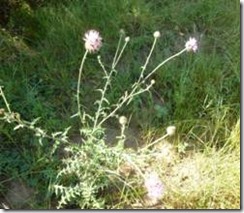
The Texas Thistle-Cirsium texanum is native and not very aggressive. Additionally, it provides seeds for the birds. It exists throughout the hill country. The seeds are especially savored by the goldfinches and the other day we saw a Lesser goldfinch clutching a stem blowing frantically in the wind picking at the seeds that were left as the rest of the seed head disintegrated and swirled around him.
clip_image023
It’s well worth it to get to know the difference between these thistles. Chop out the alien ones and save the Texas thistle for the birds.
Sightings
Sightings this month are that the painted bunting arrived May 5th, right on time and the quail are talking to each other. It seems like the quail population might be down a bit this year based on the calls heard. We even heard an owl this morning. We saw only one snake so far and it was a small speckled king snake-lampropeltis getula. The range of the speckled king snake is east Texas, so its presence is a bit unusual here in central Texas.
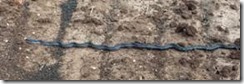
David F. sighted this Western Rat Snake-pantheropic obsoletus which posed nicely for a photo.
clip_image025
Rat snakes are common, but they can be hard to identify because they vary so much in color and in markings. This black snake variety of the Western Rat Snake wasn’t shown in our books but after getting the name from TX snakes I.D.com it was then found easily on the internet. Now I am sure it’s the mottled brown version that I saw at our old place in Medina. The snake was crawling along in front of the double stall garage and it was almost the length of a door! Rat snakes are capable of climbing trees and into the rafters of old barns looking for their prey. They are very beneficial, so take care of them.
Books of Interest
Roemer’s Texas 1845-1847 by Dr. Ferdinand Roemer. Roemer is known as the Father of
Texas Geology. He was also a well known botanist and Catclaw Acacia- Acacia Roemeriana is one of the plants named after him. This is a fascinating look at Texas with emphasis on the German immigrations to New Braunfels and Fredericksburg.
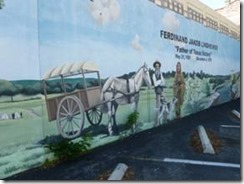
A Life among the Texas Flora Ferdinand Lindheimer’s Letters to George Englemann by Minetta Altgelt Goyne. Lindheimer, known as the Father of Texas Botany, led a very interesting life as he traveled this area of Texas in search of botanical specimens to send to Asa Gray in St. Louis. His home on the banks of the Comal River in New Braunfels has been preserved and may be visited. And, the Sophienburg Museum is a wonderful little gem of early New Braunfels history. Following is a mural seen from the parking lot of the most well known bakery in New Braunfels.
clip_image027

R & D Tusch


Saturday, April 14, 2018

Newsletter Number 3 --- Grasses

Grasses are of great importance to the open areas. They provide economic value, aesthetic value and are extremely valuable for erosion control. In Texas, we have at least 560 species of grasses and in just the Hill Country, there are over 280 species. Of these 280 species, 65 have been introduced, mostly intentionally. Many are now viewed as invasive pests because they do not offer intended benefits and tend to push out native species. Perhaps the most common and widespread introduced grass is King Ranch (KR) Bluestem Bothriochola ischaemum (L) Keng. Native to Asia and Central Europe, it was introduced with a cattle grazing purpose on poor soils and droughty conditions. Ranchers liked it because they said “it could grow on a pane of glass”. In Texas it has now become one of our state’s most undesirable weedy grass species.
Texas botanists often talk about the big four native grasses of the plains, and therefore of Texas. These four are little bluestem, big bluestem, indian grass, and switchgrass. All are bunch grasses and tend to grow tall. Tall enough so that the early settlers wrote that the grasses were up above the stirrups as they rode horses through the fields.
In our area, there are no large stands of any of these grasses, which makes it more of an interesting challenge to identify what we do have on our own acres here in BWR. Two books we have found useful in our search are Grasses of the Texas Hill Country by Brian Loflin & Shirley Loflin and Grasses of South Texas by James H. Everitt etal.[1] Gould’s book is also a good source.
We continue on the subject of grasses with, Texas winter grass Nassella leucotricha [2], a cool season perennial native, as it has already flowered and is busy making those barbed and needle sharp seeds that catch in one’s socks.


Now that the seeds are developing the barbed seeds,  the grass will be irritating as cattle feed but birds will eat the seeds and can use the grass for nesting. Texas winter grass is the grass that gives us the early green color in the pastures in late winter.


Texas winter grass with its silvery seed heads.

Plains lovegrass Eragrostis intermedia Hitchc. This is a warm season perennial native bunchgrass. See the books for descriptions, economic value and uses. Note that this grass because of its delicate appearance can be used in the landscape with wildflowers and other native grasses.
Sideoats grama Bouteloua curtipendula (Michx) Torr. A warm season perennial native, this grass is a real winner in the cattle and animal forage area and its seeds are eaten by wild turkeys and Bobwhite quail. The dotted skipper and green skipper butterflies use it as a larval host and it is another choice for a wildflower garden.
Little bluestem Schizachyrium scoparium (Michx) Nash. Has not grown much so far this time of the year, but you can spot the colonies now because the growth from last year is brown and still standing.


In our travels, the most extensive stand of little bluestem we have spotted was about two acres not shared with other grasses.
Texas native bunch grasses spread mostly by seed, but some spread by runners (stolons) or even by rhizomes. For the grasses that depend on seed production, it’s appropriate to rotate grazing areas allowing the native grasses to develop seed for reproduction of new plants. It takes a long time for native grasses to come back from near extinction because of the competition from other grasses and, of course, weeds.
Yellow indiangrass Sorgastrum nutans (L.) Nash has large seed heads and presents a very dominant stand. Indiangrass is a large plant, easily reaching 4 feet in height and, with a large seed plume. It is native and perennial reproducing from seeds and rhizomes. Its leaves are broad and very noticeable. Like the little bluestem, it is a warm season grass and the growth from last year hangs around until early summer when it rots and falls to the ground. Here is a small stand of Indian grass, what’s left from last year’s growth.


Springtime is when we all talk about wildflowers---that is, those wildflowers that we can see. But grasses develop flowers as well, because these flowers develop into seed heads just like most other plants. So, the next time you look out on a field of green grass that is getting near the seed stage, just make the observation that these flowers are beautiful too, in spite of their minute size and general lack of color.
Shortspike windmillgrass Chloris subdolichostachya. It is a warm season native perennial reproducing by seeds and tillers. As it rates only poor to fair for grazing cattle and wildlife the only attribute it seems to have going for it is its interesting windmill aspect with 5-11 horizontal “branches” that are fastened closely together at the top of the stem and form a whorl.
Rescuegrass Bromus catharticus
Rescuegrass is an annual cool season introduced pasture plant that received its moniker because, according to the Loflins, it has many times come to the rescue of ranchers following drought or hard winters. This is what it looks like in our field on the 9th of April.


It is a lovely green now and will turn to straw yellow when it’s ripe. It is relatively good forage for livestock and fair for wildlife. It also provides seeds, forage and nesting material for birds and small mammals.
Virginia wildrye Elemus virginicus A 2’ to 4’ cool season native perennial grass, blooms as early as March and makes seed April through June. It provides good livestock forage, fair wildlife forage and forage for birds and small mammals. It reproduces by seeds and tillers.
Bermudagrass Cynodon dactylon A 4”-12” warm season perennial, it was introduced from Africa probably via Bermuda. Looking down on its 3-6 splayed, digitate spikes, it looks like the track a bird’s foot would make. It is a common lawn and pasture grass that is excellent for cattle but poor for wildlife. However it should be noted that it is sometimes susceptible to a fungal growth producing tryptophan rendering it toxic to livestock. It provides seeds, nesting and denning for birds and small mammals. Butterfly aficionados will be delighted to learn that it is host to fiery skipper, umber skipper, Julia’s skipper, obscure skipper, gemmed satyr, Carolina satyr, southern skipperling, sachem and whirlabout butterfly larvae. It reproduces year round from seeds, tillers, stolons and rhizomes. In gardens, it is a pest.
Common sandbur Cenchrus spinifex A warm season native perennial that has no redeeming qualities and has made itself a pesky weed throughout Texas.
Showy chloris Cloris virgata A warm season annual native that varies in size up to 3’ is also called feather fingergrass and feathertop rhodesgrass. Its 2” seedheads above blue-green stems and leaves make it a showy plant for the garden as long it is prevented from becoming weedy. Cattle find it edible and birds and small mammals consume its seeds.
Silky bluestem Dichanthium sericeum Silky bluestem is a 20”-40” warm season perennial introduced as a forage grass from Australia where it is known as Queensland bluegrass. It flowers May through September and is identified in the field by blue-green leaves and branches topped with straw colored spikelets that have long awns (heavy hair-like projections) that are covered with fine silky white hairs. Its foliage is food for some butterfly caterpillars.
Silver bluestem Bothriochloa laguroides ssp. Torreyana Silver bluestem is a 18”-48” warm season native perennial bunchgrass usually growing from tillers. It is only fair forage for livestock and poor for wildlife. However, it produces seed and forage for birds and small mammals. The Loflins cite that warblers and other migratory birds perch on the seedheads and pick out seeds while American Indians used the stems as toothpicks. Also called silver beardgrass, they are easily seen in the field after their into 4”-8” silvery cotton-like seedheads mature.
Sightings
Sightings are what we have observed that are a little out of the ordinary and may be of wide interest. We have a few this month and would like to hear of your sightings.
First, there is the Hummingbird moth. This is a moth, not a bird, that probes flowers. Just as a hummingbird would, it flies and darts around probing flowers for nectar.. There are several species, but this one we photographed was a Commom clearwing Hemaris thysbe.


We spotted three False gromwell Omosmodium bejariense wildflowers;[3] one on the property edge of Siemmsen’s land, the other two on the roadside of the Miller property, up by the big majestic oak.
This plant is not common in our area.


The Antelope horn milkweed Asclepias asperula is making a good showing this year all along Bridlewood Ranches Drive.
It has an unusual flower head so it should be easy to spot. It’s obvious that the cattle do not like it, nor do the deer. But the butterflies find it a valuable food source and egg laying site. So, please don’t mow them until they have gone to seed and all the seed has been dispersed by the wind.
Interesting article on this plant. Click here Antelope
Antelope

The tiny 3”-5” bright pink Golden-eye phlox Phlox Roemeriana is still to be seen in some places along Hugo Road and on the right side going into BWR not far from the entrance.


Hugo Road is a good place to look for wildflowers as their only enemies on this county road are an occasional yard mower and the county mowers later in the season. County mowers are instructed not to mow down the bluebonnets, but that protection doesn’t extend to most all the other wildflowers.
Eastern bluebird Sialia sialis. After building over 200 bluebird houses, Robert finally has a resident pair in one of his boxes.


Herbertia Adolphia drumondii a lovely, small, three-petaled blue/purple flower of the iris family is now gracing some of our fields in BWR. Don’t miss getting a close look at its delicate beauty.
It won’t be found in Everitt’s Hill Country book, but is present in Geyata Ajilvsgi’s book Wildflowers of Texas. Perhaps this is because, as Ms. Ajilvsgi says,” Herbertia is endemic to the southern portion of Texas and is usually abundant where found, forming large areas of almost solid blue”. These can be seen in the fields along Bridlewood Ranches Drive.


Cattle egret Bubulcus Ibis One last sighting. This afternoon ( 4-12-18) on our way back home, we saw two cattle egrets on the Vinson’s property standing on the ground by the two horses.
R & D Tusch

[1] Both of these books are available at the Wimberley Village Library.
[2] Also known as speargrass and Texas needlegrass.
[3] A good wildflower book for this area is Wildflowers of the Texas Hill Country by Marshall Enquist.


Monday, March 12, 2018

Newsletter Number 2--The Understory

Most of BWR land consists of wooded areas and open grassland.  The wooded areas are mainly live oak and ashe juniper with the low areas having a significant cedar elm population. Cedar elms like more water. The oaks and elms provide a canopy under which many small trees and shrubs thrive, not so much that they like the shade, but because there they can escape the grazers.  On the edge of wooded areas  where there is some protection and a bit of sunlight, you can find Texas persimmon, agarita, lime prickly ash, elbow bush, bee brush and several other small shrubs.
The Texas persimmon (Diospyros texana) is a good example of a small tree or shrub that prefers sun but exists where there is cover for protection. The trees are very tall and "leggy" when found under the oaks as they search for sunlight. According to Taylor,[1] it is a very valuable source of food for wildlife. Deer browse the leaves and eat the fruit that is also eaten by songbirds, quail, turkeys and smaller mammals. Birds use the trees to nest and roost while the canopy provides shade and cover for mammals. The flowers attract pollinators, such as bees. Butterfly larvae feed on the plant and the adults use it as a source of nectar.
Another tree you will find in the understory here is the Mexican plum. Prunus mexicana is a member of the Rose family along with cherry and peach trees. Horizontal lines on the trunk are an identifier of this tree.
clip_image002
You might take a look in your woods or protected areas right now as the flowers are evident and do attract bees and butterflies. Wildlife enjoy the fruit and so do we when we make tart and colorful jams and jellies.[2]
Elbow bush (Foresteria angustifolia) is another woody plant you can find in the understory.  We have nicknamed it the ‘tripper upper’ as the 90 degree angled branches interlock with each other making it difficult to walk through a thicket of these plants.  Elbow bush provides deer and cattle browse and fruit for many mammals as well as quail, white-winged doves and songbirds. Bees like the flower nectar.
Agarita (Mahonia trifoliate)is a 3’-8’ shrub with stiff, holly-like leaves, yellow flowers and red berries. Its young leaves are eaten by deer and it provides berries for birds and mammals as well as nectar for bees and butterflies. Humans imbued with patience and determination use the berries to make delicious jellies and wines. In addition, the nest builders find a safe haven behind its prickly leaves and small birds, animals and plants hide in the safe shade below it. See Siemmsen authored newsletter.
Lotebush, (Ziziphus obtusifolia) is a wickedly-spined, stiff shrub and another provider of cover and protection for birds and animals while they dine on its small, black berries.
Frostweed that you see clustered under the live oaks and that spectacularly burst during our freezes this past winter was not one of our favorites until I read that it is a nectar source that attracts bees and butterflies, a redeeming quality. 
The mountain laurel is a bit of a mystery to us.  We know it will grow nearly everywhere it’s planted, but we have seen no naturally occurring specimens in the surrounding areas. We have grown it in the gulf coast gumbo soil, it is abundant in Bandera County, and we have two good examples of this plant at the entrance to Bridlewood, but we have seen no native ones.  Know of any in the wild?
Plants that we’ve introduced that have done well in our shade and part shade are the salvias.  Cedar sage (Salvia roemariana) with its pretty geranium-like leaves and red flowers lights up shady spots and reseeds easily.
clip_image004
Just save the seed heads and scatter.  Tropical sage (Salvia coccinea) grows in part shade and reseeds itself as well.  It is more aggressive, but if you love volunteers it will make you very happy. 
Mealy blue sage (Salvia farinacea) is native in BWR and we have added more.
Heart-Leaf skullcap (Scutellaria ovate var. bracteata) has a deep purple flower and the plants are naturalizing beautifully in the shade of the oaks.
clip_image006
These salvias and the skullcap are all square-stemmed and belong to the mint family.
That ends our short overview of unusual flora to be found in the understory. Now is a good time to look for these plants because many are in bloom and are more easily detected. You will have to walk to find them, as they are hard to identify from the seat of a bulldozer.
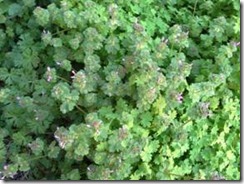
Worth mentioning just because it is an interesting little volunteer in the disturbed soil of a garden bed. Henbit (Lamium amolexicaule)[3] is an exquisite herb of the mint family with two-toned green leaves and tiny pink upright, orchid-like flowers. [4]
clip_image008
Each newsletter will feature a listing of unusual sightings of birds and mammals. The authors invite responses from readers who have sighted not-so-common species.
This month, we report that a Say’s phoebe hung around thinking it might make good use of the eastern phoebes nest under the eave. But that was not to happen as the eastern phoebe ran it out of town.
All issues of the newsletter will appear in a blog established solely for the purpose of publishing the newsletter (naturenewsletter.blogspot.com). There you can enlarge the photos for better detail and add your interactive comments to the newsletter.
R & D Tusch

[1] A Field Guide to Common South Texas Shrubs by Taylor etal
[2] A Field Guide to Texas Trees by Benny J. Simpson
[3] WIldflowers of the Texas Hill Country by Marshall Endquist p. 167
[4] Read about its medicinal and food value qualities at www.naturalmedicinalherbs.net


Sunday, February 11, 2018

Newsletter Number 1-An Introduction


Welcome to the first issue of the Bridlewood Ranches nature newsletter.  We have responded to the Board of Directors request to publish a newsletter that would inform our members of the interesting aspects of plant and animal life on the ranch and in Central Texas.  We are situated in an interesting part of Texas because we are between the blackland soil to the east and the caliche soil to the west and between the heavier rainfall of the east and the sparse rainfall of the west.  In addition to the plant and animal life, the newsletter will provide information on local organizations that offer information on these subjects.  Most importantly, please note the word interactive in the title.  Readers are encouraged to send us text and pictures that they would like to share with other readers in the newsletter and on our website.  Please send that information to dgtusch@aol.com.

Spring Lake Garden Club in San Marcos will meet on February 8 at 9:15 a.m. at McCoy’s Headquarters.  The program will be Earthkind Gardening presented by Master Gardener Marilyn Love.  Visitors are welcome, so if you are interested, you may attend this meeting at the time and place.  Call Dee for details if needed.

Wimberley Garden Club will meet on February 14 at 9:30 a.m. at the Lutheran Church of the Resurrection, 101 Spoke Hill Road.  (This road is right off RR12 between the “junction” and Wimberley) At this meeting, Darrell Vasquez, a local coffee roaster, will present information on coffee roasting and its by-products.  Both this program and the one in San Marcos should be interesting to many of us.
Our website, bridlewoodranches.org has a tab at the top of the screen labeled Natures Gallery. Clicking this tab will take you to a page describing the intent of this gallery and a way to then migrate to an offsite blog we maintain as an inventory of what animals and plants we can observe here on the ranch.  You can go to this blog directly using this internet address:  bwranches.wordpress.com.   We are always looking for input on stories and pictures of what you have observed on our 1600 acres.

For some reason, two of our plant suppliers in the area have decided to end their businesses. They are:  C & J Nursery and Reid’s Nursery, both to the east of I-35.   In the immediate area, we still have Lowes in San Marcos, and King Feed in Wimberley. If you haven’t checked out King Feed, do so as they have excellent selections of seeds, plants, trees and shrubs and Tim writes a very good, free gardening letter. It’s also fun to check out the new little chicks, quail and parakeets. Please let us know if you’ve found any other reliable plant suppliers in the area.
If you take the local Record newspaper you have no doubt seen Joe Urbach’s gardening page on Sundays.  Urbach, affiliated with the AgriLife Extension delves into his subjects deeper than most and he has a very interesting website.  He can be found at www.gardeningaustin.com.

Okay, so what is first to let us know that spring is not too far away?  Leucojums, aka snowflakes, are up with their bell-shaped white flowers with the little green dots on their scalloped edges.


The daffodils’ tall, spiky leaves are up, but no flowers yet. Quail have not yet started to sing, the rattlesnakes are still hibernating, but phoebes have made themselves heard along with chickadees. We saw a rufous-sided towhee the other day in the woods doing its usual frantic scratching around in the leaf mold looking for food. On the way in or out we always look for the American kestrels taking off from the wires on Bridlewood Ranches Dr.  These are the birds we used to call chicken hawks.
Speaking of birds and the interconnection of prey and preyed upon, do some of you remember the hordes of mice that existed here a few years ago?  It was a dramatic change and we had a terrible time keeping them out of the attic of the house.  We also saw and heard owls more frequently who obviously were happy with the mouse population explosion.  Then for some reason the mice disappeared and now we rarely see or hear any owls.
This reminds me of the odd sighting we had during the summer.  We were returning from town in the middle of the day and we heard a bird that we’d thought in the past was some sort of nightjar. It was a descending call that was quite unusual.  I got the binoculars and finally discovered the bird quite close.  He was a good-sized bird with a streaked breast, but with a long, narrow beak!  That was a surprise. Our mystery bird was a roadrunner.  I never would have guessed from the sound of its call.

It will soon be Valentine’s Day and for those of us who garden by the holidays that means it’s time to plant, fertilize and prune roses.  So Belinda’s Dream is looking at a haircut in the very near future.  She has been a wonderful, carefree, bountiful bloomer.  The Mutabilis was planted last year and is doing well. A rose with single petals, it doesn’t require pruning and its beautiful claim to fame is the changing colors of the flowers from pale yellow to white to pink.

Hope to see some of you at the garden club programs and hopefully hear from you with info, pictures or both.        

                      R & D Tusch


Wow! 2024 A year of change

 Looking back over my notes of what happened with the vegetation this year brought back memories of how much of a shift we have seen from pa...