Friday, September 13, 2019

Newsletter No. 20---Cotton


Cotton has been grown in Texas for 274 years since it was reported by Spanish missionaries in San Antonio in 1745.[1]  The several thousand pounds produced annually were then spun and woven on site.  And in 1813 nitrocellulose or gun cotton was used in explosives.  Anglo-Americans took up cotton cultivation in 1821 and the state reported production of 58,073 bales each weighing 500 pounds. 

Figure 1   Family Picking Cotton
Ferdinand Roemer[2] in 1846 tells of staying with a wealthy slave-owning planter who resided east of Caldwell.  He found it remarkable that in spite of his wealth, the family lived in a simple log home and ate very simply.  “And …though otherwise in agreement with his English cousin does not share with him the love for a comfortable and cozy home.”  The owner told him that he was planning to abandon the farm in spite of its prime location and buy farther down on the Brazos River because it cost him about $500 a year to get his cotton to the market in Houston.  Roemer noted that “The scarcity of easy communication …, is so general in most parts of Texas that it proves an obstacle in the development of the country”.

As everyone knows, Eli Whitney invented the cotton gin in 1794 in Georgia and patented it for use on short-staple cotton grown inland.  The long-staple cotton grown along the coast could easily be parted from its seeds, but the short-staple contained sticky, green seeds that were a problem to extricate.
Figure 2 Whitney's early cotton gin


A small gin could be hand cranked; larger versions could be harnessed to a horse or driven by waterpower. According to Whitney, “One man with a horse will do more than 50 men with the old hand cranked machines.”[3]

However, he and his partner made little money from the gins they produced as the farmers resented having to go to his gins and pay what they considered an exorbitant amount.  They began to pirate his gin designs, labeled them new and lawsuits against them were tied up in the courts for years.  Instead, Whitney later became rich by making and selling gin replacement parts and by becoming the father of mass production.  In 1798 he figured out how to manufacture muskets by machine, so the parts were interchangeable.  His work with the cotton gin also created the technology with which the North won the Civil War.

 The 1850s-60s saw a sharp increase in cotton production because of the removal of the Indians and opening of new land.  By 1852 Texas was number 8 of the top 10 cotton producing states.  The 1859 cotton census recorded 431,645 bales each weighing 500 pounds.  The number decreased during the Civil War, but by 1869 had moved up to 350,628 bales.  Railroads were built and stimulated the industry by making it easier to get the cotton to markets, so in 1879 some 2,178,435 acres produced 805,284 bales.  It continued to rise, and the 1900 crop was more than 3.5 million bales from 7,178,915 acres.

Locally, Edward Burleson bought a large tract of land in 1844[4] that included the headwaters of the San Marcos River.  He constructed the first dam on the river and the water from the spring powered his grist and sawmills.  After his death in 1851, the “Mill Tract” property supported many different businesses including a cotton gin. There is an historical sign in front of the Salt Grass Restaurant on Sessom Street.


Figure 3 the Burleson Mill Tract

In the 1850s the William Thompson family moved from Louisiana with their slaves to plantations in Hays and Caldwell counties.  With slave labor a mill was built on the San Marcos River which powered a cotton gin and lumber operation.  This area is known as Thompson’s Island and there is an historical marker near the intersection of Cape Road and River Road at:  Geo: 29.8674 -97.9315.

Figure 4  Thompsons Island, San Marcos River

Until the Civil War people in the area were mostly rural subsistence farmers according to Freeman Center.  At about the time of the Civil War the population in Hays County was a little over 1,000 people, one third of them Black slaves.  Cattle ranching was the main economic activity with corn the chief food crop along with small commercial crops of cotton. 

In 1868 Alexander Parkes created an interesting and unusual cotton byproduct by combining nitrocellulose (gun cotton) and camphor. Known by other names as well, it was registered as Celluloid in 1870.  Widely used in the 1800s and early 1900s, it was fashioned into pins, buttons, fountain pens, dolls and many other plastic-like items.

After the Civil War cotton production was aided by the growing web of railroads across the cotton producing areas.  And in 1872 the Blackland Prairies of Central Texas hosted thousands of immigrants from the Deep South and Europe.  Some bought small farms, but many worked as tenant farmers or sharecroppers for owners of as many as 6,000 acres.

 The tenants lived in houses furnished by the owner, but supplied their own draft animals, tools and seed for which they received two-thirds of the profit from the ginned cotton with one-third going to the owner.

The sharecroppers, with a different arrangement from tenant farmers, furnished only their labor while the landowner provided the houses, animals, tools and seed. The profit was split between both parties.

Both tenants and sharecroppers were expected to trade for all their needs at the landowner’s store where an account was kept of the purchases.  At the end of the season after they settled up, the laborers usually had little cash left over.  This socially enforced crop-lien system began after the Civil War and lasted until the 1930s causing debt peonage or economic slavery.

In 1873 an immigrant from Germany, Henry Schumacher, of Navasota, built another machine very important to the cotton industry.  Using the description from an old encyclopedia, he erected one of the first oil works that produced cottonseed oil, meal and cake.  This machine could process about 1500 tons of seed a year. Cotton seed oil was an instant success. Cotton seed oil is now used widely in the food industry. Schumacher was honored for his contributions to the cottonseed oil industry about 1883 with a dinner at the White House given by President Chester A. Arthur.  The first mill burned in 1910 but was rebuilt with all modern machinery and ran until 1954.[5]
Figure 5  Zedler's Mill in Luling, Texas

Built in 1874 on the San Marcos River, Zedler’s Mill is the same age as Luling and had been in the same family for more than 100 years.  The water-powered mill was used to saw lumber, grind corn, mill cotton and was the town’s first electric generator.[6] 

Zedler’s Mill is now a museum that is continually being enhanced.  We last visited it a few weeks ago in August and more displays had been added to the cotton, corn grinding and tool areas.  It sits on lovely grounds on Magnolia Street and is free and open to the public.  Access directions and hours on the Web.

Figure 6  Old Cotton Compress on rotating table in Zedler’s Mill.

The cotton bale on the left has been compressed, tied and is ready to be removed as more cotton comes down the chute on the right side to fill the compress. Once compressed and bound it would have been rotated out like the previous bale.

In 1884, Robert S. Munger of Mexia[7] revolutionized the “plantation method of ginning” by devising the faster, automated “system ginning” that we use today. Huge cotton compresses that reduced 500 lb. bales to about half their ginned size were built along railroad rights-of-way in many towns for convenient shipping.  This allowed farmers in interior cotton growing areas to sell their ginned cotton directly to buyers who shipped it directly to the mills.  Cotton could be sold on the world market via telegraphed contracts.  In addition to cotton fibers, cottonseed oil, and cattle feed from hulls, nitrocellulose to be made into celluloid was shipped as well.

The Lockhart Gin Co. that sits by the railroad tracks on Brazos Street could have been an example of that type of gin. In business for 113 years it began ginning this year’s crop of cotton on August 26.

In 1908 five local farmers purchased a site at 120 W. Grove Street in San Marcos (Geo: 29.8743,       -97.9411) and built the Farmer’s Union Gin Co.  It was established under the leadership of Oscar Calvin Smith.  It was the first industrial–sized plant in town and was vital to the town’s cotton industry.  The original gin house burned down and was replaced by the brick house in 1911, which remained in operation until 1966. 

Figure 7  Farmer’s Union Gin Company

Figure 8  Austin Cotton Yard by Will Beauchamp about 1910

During the 1890s the boll weevil made its way up from Mexico and was first discovered near Corpus Christi.  It wasn’t long before damage was noted in all the southern cotton-growing states.   Farmers used calcium arsenate dust to fight back and along with help from the USDA and Texas at A & M, demonstration farms and experiment stations worked the problem.

WWI stimulated cotton production, but afterward prices slumped, times were changing and sharecroppers, tenants and returning veterans began moving to the cities to work in factories.  Mechanization had begun to dominate the farms.[8]   “The landlords are saying… they wanted to farm all their lands with tractors…in Hall County Texas alone there will be moving from the farms here 420 tenant farmers with the average of 5 persons to the family it simply means that 2,100 men, women and children will be driven…from the only occupation which they have ever known.  Whither will they go?”   

Other economic factors were the federal government’s control program under the AAA (Agriculture Adjustment Act) which curtailed farm product, reduced export surpluses and raised prices.  Also affecting the industry were an increase in foreign production, new synthetic fibers, the tariff, the lack of a lint-processing industry in Texas and, WW II which brought a shortage of labor and disrupted commerce.

After the war another facet of the cotton industry came to the fore locally when in 1949 cottonseed companies, including the legendary Harper Seed Farm of Martindale, supplied a large percent of the pedigreed cottonseed produced in Texas.

Figure 9  Harper Seed Co., Martindale, Texas

The seed company and gin are still on site but are no longer in business.

Figure 10  Martindale gin on the San Marcos River

On Friday, August 23, we went to Lockhart and noticed several fields of cotton that looked close to being ready to strip.  Cotton farming goes on year-round in Texas starting with planting in January in the Rio Grande Valley.  And for the second year in a row Wesley Vanderpool delivered the first bale of cotton in the United States to the Willacy Co-op in Sebastian, Texas on Friday, June 21, 2019. The first bale of cotton has come from the Rio Grande Valley for the past 66 years.

South Texas including the Hill Country and Big Bend harvests cotton in late summer and early fall.  Rolling Plains (Central) and East Texas harvest in October and November. The High Plains, (Wichita Falls, Amarillo} with the highest concentration harvest in December and early January near the planting time in the Valley.


Figure 11 Production in bales.
As can be seen in the above map, the High Plains area centered near Lubbock now grows most of the cotton in the state.  And the town of Spearman up toward the border of Oklahoma on Hwy 207 is home to the largest cotton gin in the U.S. and soon to be of the world.

Figure 12  2018 Cotton production in the U.S.
The huge irrigated fields of the Panhandle are conducive to the use of huge machinery; stripper/balers or stripper/lint trailers that dump into compressor/module makers that are picked up by trucks that can haul the 8’x8’x32’ cotton modules.

Figure 13  Cotton stripper/baler

Figure 14  Module hauler

This photo was taken in the yard of the Lockhart Gin Co.  The truck backs up to the leading edge of the cotton module in the field and a moving cog belt on the truck’s floor is engaged that hauls the module into the truck which then heads for the gin.

Figure 15  Lockhart Gin Company

We spoke to Roland at the gin and had been invited back for a tour later when they weren’t so busy getting the season started.  We returned on September 6 to see what we could see.  Following are some pictures R took of the proceedings.

Figure 16  Roland arrives from the field with 2 mini modules: 8"x8"x16'.

The moving track inside the truck is engaged and the module moves out onto the gin’s belt.  Each mini module weighs about 20,000 pounds. The truck carries two of these mini modules.

Figure 17  The modules are on their way into the gin.

First, they are torn apart and enter air conveying systems to dryers and cleaners where all the field trash is separated from the lint.  Then the cleaned lint is conveyed to the Cherokee 174 gin stand where the lint is torn free from the seeds.  It is then blown on to an additional cleaner and then on to the compress where the lint is compressed into 500-pound bales, strapped and wrapped bales.  From beginning to end the farmer’s number is marked on his cotton with a serial number and barcode.  A sample is taken of his cotton which is sent to Corpus Christi where it is graded.  This is how the farmer finds out how much he can charge for his cotton.

Figure 18  500-pound bales of wrapped cotton exiting the gin.

A forklift fitted with a bale lifter moves the bales from the platform to the barn.  The barn is shown below.
Figure 19  Sal is leaving the barn for Taylor loaded with 100 five hundred-pound bales of cotton.

At the intersections of the Missouri Pacific and Missouri, Kansas and Texas lines and State Highway 95 and U.S. Highway 79 Taylor, Texas has been the shipping point for Central Texas cotton since the early 1900s.  In just a little over 2 hours, Sal will be back for another load of cotton.

And thus begins another year of cotton production in Texas. 


_____Sightings

Native plants that get all the raves this time of the year are the ones that can produce flowers with our droughty conditions.   Here are five:
Figure 20   Skeleton Plant

Figure 21  Silver Leafed Nightshade


Figure 22    Lindheimer’s Senna


Figure 23   Retama

Figure 24  Zexmenia

Despite their willingness to bloom in this dry period, they all would prefer a bit more water.


[1] Texas State Historical Association’s (THSA) “Cotton Culture”.
[2] Roemer’s Texas 1845 to 1847 by Dr. Ferdinand Roemer
[3] National Archives, Educator Resourses.
[4] Texas State University Archives
[5] Texas Historical Marker
[6] F.N. Day Trips column by Gerald E. Mcleod, Apr. 14, 2006 The Austin Chronicle.
[7] THSA Cotton Culture
[8] Jerry Pytlak-The New International Vol. 5 No. * Aug. 1939 pp. 247-250.

Tuesday, August 13, 2019

Newsletter No. 19----Longhorn Cattle


Longhorn cattle have a long and colorful history.  Most breeds of cattle were developed for a particular trait, like for milk production or meat quality.  Not so with the Texas Longhorn, they evolved along chance lines from a long history and what resulted is a unique animal with some very basic instincts.

The Texas Longhorn evolved in North America from descendants of cattle brought into the Americas by the Spanish in the late 1400s and early 1500s However, the Longhorns did not descend directly from Iberian stock. Rather, the first cattle to be imported to the Americas by the early Spanish explorers were from the Canary Islands or Hispaniola. These cattle, it is said, were descended from the auroch, an animal now extinct.  So, the closest relatives of Texas Longhorns among existing European breeds are Portuguese cattle breeds such as the Alentejana and the Mertolenga.

These early imports of Iberian Peninsula cattle soon became feral in northern Mexico.  At the time, northern Mexico  included lands that became the Republic of Texas in 1836, then part of the United States in 1845.

Since the early ranches in Northern Mexico were not fenced, the Longhorn was free to roam and roam they did for the next two hundred years.   From this environment, they became feral, and from this roaming, they became Texas Longhorn Cattle.

Over a couple hundred years, these wild herds underwent intense natural selection; the only cattle that could survive were highly disease resistant, could live on harsh range conditions (through droughts, floods, heat, and cold), and could defend themselves and their calves against predators.

In the early 1800s, wild cattle, mostly Longhorns, were found throughout much of Texas. Keep in mind that this was a time when the human population of Texas was scant, so the first settlers to arrive and establish ranches were curious about these wild cattle.  Most settlers, especially those coming from the eastern part of the country, probably never saw cattle with horns this large.

During the California Gold Rush of the late 1840s and early 1850s, there was great demand for beef in California, and cattle began to be driven from Texas by the tens of thousands to meet the demand. This practice was interrupted by the U.S. Civil War, as well as the end of the California gold rush. Texans who returned to Texas after the Civil War had few sources of income, but there were lots of wild cattle in Texas.  In fact, the population of wild Texas cattle greatly outnumbered the available cattle in the eastern USA. The Civil War demand for meat and the lack of attention to farming at the time depleted the eastern stock of Herefords and other domesticated breeds. 
Figure 1__Drovers with their long horned cattle

Texans saw the opportunity to make a living by rounding up the cattle and driving them up to the rail heads in Kansas, where they were shipped to the east coast cities to satisfy a growing demand for beef in the northern states. Many famous cattle trails were established, such as the Chisholm Trail and the Goodnight-Loving Trail, and many millions of cattle (then called "Texas cattle") were driven up these trails for shipment east.[1]

The harvesting of “Texas cattle” was a big operation after the Civil War. It is estimated that nearly 4 million Texas cattle were rounded up from the brush country and sold in northern markets.

This at first satisfied the demand for meat, but then the critics of the Texas Longhorn began to complain about the quality and amount of useable meat.  One reporter[2] at the stock pens wrote “the cattle were barely able to cast a shadow and would probably not weigh anything if it weren’t for their horns, which were only useful to keep them from crawling through the fences”. 

During the late 1800s, large ranches began to be established in Texas. Fences were built, cattle were captured and contained, and the days of free-ranging cattle came to an end. Although these ranches originally stocked Texas Longhorns, most soon turned to importing "improved" European breeds of cattle. The European breeds produced more fat than did Texas Longhorns, and tallow was the primary driving force behind cattle prices at the time. However, several ranchers kept herds of the original Texas cattle, either for nostalgia or because they appreciated the abilities and native instincts of these cattle.

By the 1920s, the longhorned cattle were rare enough that the United States government assembled a herd of Texas cattle at the Wichita Wildlife Refuge in southwestern Oklahoma to preserve them from extinction. About six private herds were also maintained during the first half of the 1900s.  Most modern Texas Longhorns can be traced back to seven "families" of longhorns: the Wichita Refuge, Butler, Marks, Peeler, Phillips, Wright, and Yates lines.
Figure 2.. The Longhorn herd at L. B. J. National Historical Park near Johnson City. 


The cross breeding and the harvesting nearly made the Longhorn extinct, but not quite.  Ranchers began to see the advantages of the Longhorn in the harsh environment of Texas.  The animals could live on scant water, poor grass and were naturally tickproof.  In other words, these beasts could literally take care of themselves.

In 1964, the Texas Longhorn Breeders Association of America was founded, and a registration process was established. Thus, Texas Longhorns became a registered breed. Today, Texas Longhorns are bred and valued for many different reasons. Their naturally lean meat is now considered an advantage, and the ability of Texas Longhorns to thrive on natural range conditions without the use of antibiotics, added hormones, or the use of feedlots. This makes them a favorite for lean beef, range-fed beef, and organic beef markets. They are also widely raised for their beautiful colors and horns, and by people who appreciate the history and qualities of the breed. Texas Longhorn bulls are often used as service sires on other breeds of cattle, because the crosses produce fewer birthing difficulties and calves that grow quickly and have few health problems. Traits that stand out in Texas Longhorns are their natural disease resistance, great longevity, high reproductive rate, ease in birthing, ability to thrive under harsh range conditions, and an ability to defend themselves against predators. Longhorn cows are known to “calfsit” a bunch of calves while their mothers continue to feed.  You can see this when there are several calves lying in the grass with only one or two cows with them.

Texas Longhorns are gentle cattle and are among the easiest of breeds to handle and control. Their gentle disposition and striking looks make them favorites as riding steers, and their general health and adaptability make them ideal for small ranches. 


Figure 3__Longhorn steers in 4th of July parade

Texas Longhorns that interact regularly with people are easy to handle; as with any breed, however, cattle that rarely see humans can grow wild and wary.

Of course, caution is required among Texas Longhorns because of the long horns. These cattle never attack or harm a human on purpose, they can and do use their horns to manipulate objects and to scratch their bodies, so reasonable care should be exercised around the cattle to avoid accidental contact with the horns. Texas Longhorns will also defend their calves against dogs or any predators.

Naturally, the horns of the Longhorns attract a lot of attention, the same way that deer hunters look for the record rack.There are at least two common ways to measure horns. The tip-to-tip measurement is the easiest to reproduce: it is simply the straight-line measure from one horn tip to the other. The "total horn" method attempts to measure the horns along their curve, to get a measure of the total length of the horns. This measurement is much harder to replicate accurately, but it is the best method of the total horn length. The tip-to-tip measurement assigns longer values to straight, lateral horns than to upwardly curving horns of the same total length.

Every year, the Horn Showcase competition is conducted by the Texas Longhorn Breeders Association of America. This competition obviously does not include all the living Texas Longhorns, but owners of prized animals enter their longest horned cattle in the competition and so the winners are at least among the longest-horned Texas Longhorns.

Here are some typical measurements from the 2006 competition:

The Texas Longhorn cow with the widest horns (tip-to-tip measurement) was Day's Feisty Fannie, at 82 inches.

The Texas Longhorn cow with horns of most length (total horn measurement) was Sunrise Hope, at 97 3/8 inches.

Steers tend to have longer horns at maturity, and at the 2006 Competition the Texas Longhorn steer with the longest horns (total horn measurement) was Gibraltar at 126 1/2".  Heck that’s only ten feet.

In Bridlewood, the Millers and the Shallenbergers manage a herd of Longhorns which grows to about 100 head. Then, at roundup time the herd is reduced so that they can start the process all over again. They provide an update on the herd at our meetings so that we can stay informed about the calves and the status of the herd.

·        Longhorn calves can be any color, not necessarily the color of their parents, but the dominant colors are russet and white.

·        Calves can be a bit erratic and frisky, so when they are near the road, drive carefully, because they can behave like the proverbial chicken that runs across the road at the last minute.

·        Cattle are experts at finding holes in fences, so walking the fence line is a good thing to do, especially in the winter.

Following are some photos that we pulled from our files.    Many are our favorites and even get special names, even though their owners have their own names for the same animal.


Figure 4___Cow and yearling—current time


Figure 5___Peaches—file  photo

This is Peaches with a 9 foot horn spread.

We don’t have a photo of Fudge, but Fudge was an elderly cow, nigh onto 23 years of age and died this spring.   She was getting feeble and could not move with the herd.

This last year the older bull disappeared and no one knows where he might be.  He could have died in some remote spot on the ranch; or he might have escaped through the fence, but that is unlikely as the fence was patrolled after his disappearance and no fence hole was found. Supposedly we might have sophisticated rustlers who would cut the fence, drive him out and then mend the fence.  Nevertheless when walking your own land, keep an eye peeled for some white bones.


------SIGHTINGS-----


Figure 6__Leaves and flowers of Wafer Ash

The flowers of this Wafer Ash, Ptelea trifoliata are almost impossible to see in the photo, but if you zoom in on the photo the wafers become apparent.  We discovered this not-so-rare tree growing on the side of Cedar Road in Kyle (look at this road as the extension of Limekiln Road which is on this side of the Blanco River).  This fall, we will collect some seeds to see if we can grow this tree.  The seed pod is a flat wafer about the size of a half dollar with one seed in the center.

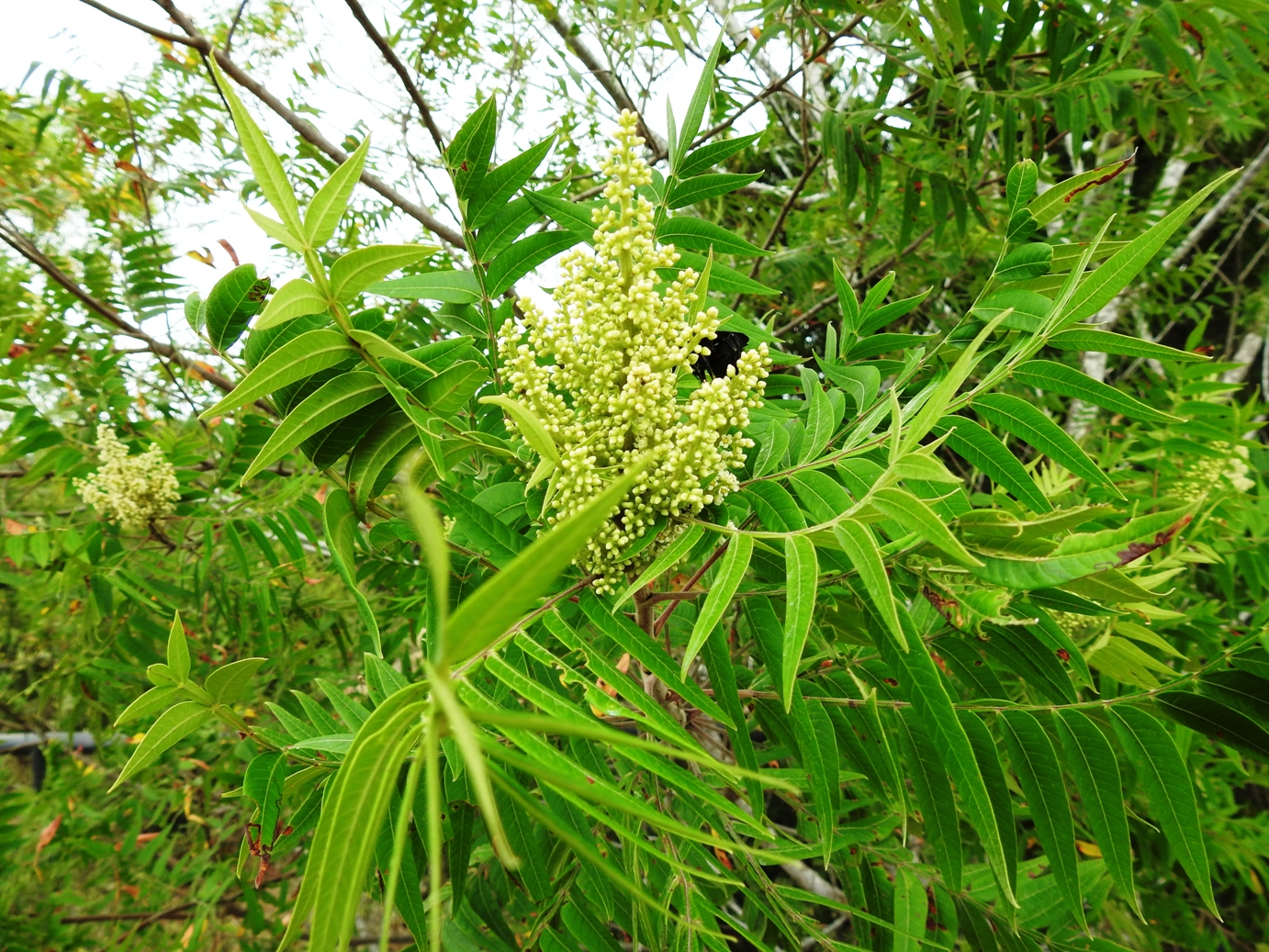
It is really dry now from the lack of rain, but there is one shrubby tree that really likes dry weather. It’s the Prairie Flame-leaf Sumac, Rhus lanceolata that you find scattered throughout the ranch.  Some of the more mature plants are blooming right now.  The yellow jackets like the flowers and the quail like the seeds that the flowers produce.  This photo was taken in front of our place along the front fence line.


Figure 7__Flower head of the Prairie Flame-leaf Sumac

The black part of the image is the yellow jacket having lunch.
Since all flowers are made up of a lot of water, they become scarce during droughty times. Although common, this plant is quite unusual.


R & D Tusch


[1] There is an excellent Chisholm Trail Museum in Cuero.
[2]The Passing of the Longhorn by  Havins, The Southwestern Historical Quarterly July 1952.


Wow! 2024 A year of change

 Looking back over my notes of what happened with the vegetation this year brought back memories of how much of a shift we have seen from pa...