Wednesday, July 15, 2020

Bugs

 Bugs must be high on the list of “deplorables” maintained by most people, but heck, there is some redeeming value in everything in nature.  We doubt though that bugs will displace snakes on this list of deplorables.  However, as Beck and Garrett[1] would say “it’s fascinating to learn why so many different types of creepy, crawly creatures were put here to aggravate us, help us, and to offer great beauty”.

Because bugs are so valuable to the cycle of nature, it would be appropriate to remind ourselves how some of them interact with their fellow bugs and with other organisms.  Bugs also interact with nonliving things, like our gate controllers and other mechanical and electrical devices which is not one of their redeeming features.

Realize that not all these creepy crawly things are bugs.   Some are bugs, but some are beetles, insects, and even others to be named.  “Bugs” is certainly a good catchall term though, so we will often just use that term. 

Entomologists will tell us that the biomass of insects on earth is at least ten times the biomass of humans.  That’s not hard to believe considering that bugs are everywhere, and humans are scattered. Probably, bugs are more populous in areas where humans are scarce.  We have a way of getting rid of bugs and that may be to our own detriment.

Bugs are important in the food chain of so many other creatures.  Take birds for example.  More than 90% of all small birds must feed insects to their newly hatched young as food---even though the bird may be a seed eater when it matures.  We have often watched cardinals feeding cracked sunflower seeds to their immature offspring as if they were teaching them how to forage on seeds when they had been reared on insects. 

Here is a phoebe with a worm that will go straight to the nest for one of the lucky nestlings.

Figure 30.1   Eastern Phoebe

The link between birds and insects for food is just the tip of the iceberg.  Insects need a good environment to survive to become food for birds, and that environment usually means edible plants.  Although we think of a good garden plant as one which is insect proof, we might want to live with plants that are hosts to insects and live with the damage to the plant that we like.  Here is
a good example of that point:  In our garden we have a fennel plant purchased years ago to be able to harvest the bulb for use in cooking.  But we never got around to using the bulb in the kitchen and so the plant just keeps getting more robust each year.  Here it is this year, doing its thing and now putting out seed heads.

Figure 30.2    Fennel plant

All the upper part of the plant are the long stems and seed heads, the lower part is a filmy foliage that smells and tastes like anise.  Soon, the black swallowtail butterfly will find this plant, lay eggs on the stems.  What follows next is that the eggs hatch into larvae to start the life cycle of the swallowtail---that is if the birds don’t find them first.  They usually do find them first.  Here is a photo of the bush with many caterpillar “bugs” all over it and if they are not harvested by the birds, all the foliage will be gone in a week.  This may bother gardeners, but we find it more fascinating to watch this unfold and then to buy the fennel bulbs in the store when we need them.

Here the caterpillars are at work stripping the foliage as their food.

Figure 30.3 Black Swallowtail Larvae

If you are interested to see them in action, go to this YouTube short video we have uploaded. 

https://www.youtube.com/watch?v=yLmteb-inxs

Here is another example of plant to insect connection, this time in the opposite direction as the common petunia plays host to no insects--or so it would appear.  Two years ago, we planted a few seeds of Laura Bush petunias and had a good showing of flowers.   The plants went to seed in the raised beds and the cycle repeated itself again this year when now we are overwhelmed with petunias.  But careful observation reveals that no bugs will go anywhere near the petunias, not bees, not leaf chewing insects, none.  Even the hummingbirds shun them despite all these blooms.  Deer even turn up their noses on these plants.

Figure 30.4 Laura Bush Petunia

We poked around in the literature and found that petunias are not native to the Americas, having been imported from Africa.  So, apparently these plants don’t fit in very well to our ecosystem.  This lack of interconnectivity between plants and insects raises the question in many botanists and entomologists about the definition of an “alien” plant.  Some proclaim that the definition of an alien plant should not be based on whether it is introduced from outside the country but should be based on its compatibility with other forms of life in the area, specifically insect and lower animal life.

The Mud Dauber ( family of Sphecidae) is an interesting wasp of which there are many species.  Mud daubers build mud houses under some structure that provides protection from rain, lay their eggs in the cocoon- like mud houses  then pack them with spiders that they have  paralyzed.  They paralyze the spider by stinging it, then they haul it to the nest and jam it into the mud house and seal it up. When the eggs hatch, the newborn feed on the spider’s living tissue, before breaking out of the mud nest and voila, more mud daubers.  The wasps rarely sting humans preferring to move on if their nests are damaged.

Recently we watched a mud dauber hauling a  paralyzed spider across the porch, up the stone wall and pack it into a crevasse where there was a mud house.  And it did all this walking backwards knowing exactly where to deliver the live body.  We are always impressed with the memory of the mud dauber and other wasps.  They seem to sit and wait for the garage door to be opened in the morning so that they can continue to build their nests inside the garage.

When we lived farther to the east, and especially in Louisiana, we found that old timers painted the ceilings of their porches sky blue.  They never had mud dauber nests on their porch ceilings, because, apparently, the mud dauber thought it was open sky and the mud nest would not be protected from rain.  We don’t have a lot of black widow spiders, but these spiders are their favorite food.  That could be why the black widow spider is not common.

Fire Ants (solenopsis) and Chiggers (trombiculidae) are two nasty insects that have one good trait, but first, the bad one.  Both fire ants and chiggers cause skin problems when they bite.  Fire ants bother everyone, but chiggers seem to affect just some people.  When it is dry, fire ants house their egg hatchery underground, but when it rains and the ground is soaked, they move their egg hatchery above ground in the ant mounds familiar to us.  Chiggers seem to be everywhere in the dry grass in the hot months of the year.  The good trait is that a principle food of the fire ant is the chigger, so we don’t interfere with that relationship as it’s to our advantage. Fire ants first arrived in the USA in the 1920s from Brazil and have since spread across most of the southern states where climate is favorable for their growth in numbers.

Figure 30.5  Range of the common fire ant

Now, some hundred years later, these ants are well established and have outnumbered native ants five to one. Mari Sica tells us that moth balls are a good deterrent to fire ants that may be prone to take up residence in your electrical devices like gate controllers.

Cochineal is an interesting and useful bug.  Most probably you have never seen a cochineal but if you have observed the white furry looking stuff on the prickly pear cactus, you were getting close to seeing the cochineal bug.  The white fuzzy stuff is the secretion from the cochineal, probably serves as a protection.  What makes the cochineal interesting is that it produces a brilliant red substance that has been used for centuries as a dye.  Even today, cochineal red is used in food coloring and dyeing of textiles.   A little goes a long way, but it takes a lot of bugs to harvest just a little bit of dye—in fact, it takes more than 70,000 bugs to make a pound of dye.  See for yourself, the next time you happen to notice the white stuff on a prickly pear, scrape it off and crush it to see the brilliant red dye of this bug.

June Bugs are those hard-shelled beetles that are attracted to the lights in your house in the morning, hitting the windows making a noticeable sound.  The larvae of these beetles are the common occurring white grub found in garden soils some two or so inches below the surface.  Come late April or May, these larvae develop into the beetle, thus completing the life cycle.  These beetles are seldom harmful, but a dense infestation might be a problem in lawns.  Apparently, this beetle is nationwide, as those in  the northern states call them June Beetles, but here in Texas we more often refer to them as May beetles.

Not a bug, but Galls are an interesting plant reaction to a sting from certain insects of the wasp family. Galls take on all sorts of different forms depending on the tree and depending on the insect that created it.  The most common gall here is oak apple gall. observed on oak trees.  Below is one example.

Figure 30.6[2]  Oak apple or oak gall on an oak leaf

Galls are used by the insect as a micro habitat because inside the gall is a concentration of plant nutrients that the stinging insect uses for food for its brood.  What a unique plant/insect interaction:  Insect stings the plant and the plant builds the insect a nest. And the galls are not harmful to the host plant.

Web worms are the nemesis of pecan growers but can be controlled by letting wasps do their job.  The web is a problem for the wasps though as the wasps have difficulty accessing the worms. The web worm is a caterpillar that forms the web and then eats all the leaves within the web.  The worm is the larvae of a white moth.  These moths emerge in the early summer, depositing eggs on the underside of the pecan leaf and the larvae then eat the leaves. Beck tells the story of a pecan  farmer who learned that wasps know when the web is broken open for their feast of the worms. When the farmer first knocked the web apart, it took the wasps about two hours to discover the opened web.  The next time he did that the wasps responded in 15 minutes.  Now all he must do is to walk out the door with a stick toward the nest and the wasps come flying.

The nests are obvious even from a distance.

Figure 30.7  Webworm web

The natural control of this pest is by allowing the wasps, birds, and assassin bugs to do their work.  It has been shown that where extensive chemical control of wasps has occurred, web worms are more common. Over and over, we encounter the good that the family of wasps do to control other insects.

 Also, the Cuckoo, a bird we have here in Central Texas feasts on these web worms.   The Cuckoo is not often seen but we always hear their call off in the higher reaches of the live oaks nearby.  Listen for their call, it is a clucking sound.

The Dung Beetle is both legendary and industrious.  This is the dark colored beetle that collects cow and horse manure, rolls it into a ball and then buries the balls in a nest underground.  The beetle then lays eggs on the stored balls of manure as food for the larvae that hatches.  Many have seen these beetles, head down, pushing the ball of dung toward the spot they have chosen to bury the ball. Whatever obstacle they encounter in their path while pushing this ball, they seem to find a way to overcome it.  Children often have fun watching the beetle encounter a stick, stone or other obstacle and work their way around it.

Dr. Fincher of the USDA Lab at TAMU College Station has spent most of his career studying this beetle.  He finds four main benefits:  (1) the removal of livestock waste allowing grass to grow (2) the enrichment of soil where the dung balls are buried (3) breaking the life cycle of livestock parasites that show up in the manure and (4) removing the breeding medium for flying insects that harm cattle, horses, and us.

This celebrated beetle carries a lot of history.  It is the beetle that the Egyptians worshipped as shown by their tomb records.  The tomb of King Tutankhamen contained a pendant showing the Sun God Scarab beetle Ra rolling a ball symbolizing the movement of the sun across the sky.

Spiders are scary because the Tarantula is large, the Brown Recluse is dangerous, and the Black Widow is dangerous too.  But the Argiope is not dangerous and does make  a web with an intricate zigzag stitch across the center.  Every year we have one or two that make their fly trap and then sit and wait for their food to arrive.  We observed one that was waiting for dinner to arrive, but its web was filled with crape myrtle flower petals.  Here is what this spider looks like.

Figure 30.8  Argirope

The zigzag-stitched web is a giveaway feature of this spider.

Despite the Tarantula being large and hairy, it is relatively safe to handle, even though we would not be the first to volunteer to do that. 

The Black Widow is poisonous and does bite readily.  It is found in out of the way places where its dark and moist.  I have found most of them in nested empty garden pots that were stored in the shade.

The Brown Recluse is worrisome as its bite results in the destruction of tissue around the bite and unless treated, can become a threat to the whole bite area

Now with all this, we hope you can enjoy the bugs just a little more.

_____________Sightings____________

One of our neighbors has reported seeing Vermilion Flycatchers hanging around their house. These birds do summer here but are not common, so that was a good sighting.  Of our three red birds, Cardinals, Tanagers and Vermilion Flycatchers, the flycatcher is the smallest of the three, has a thin black mask and a bit of brown on the back.

A new first here with the successful nesting of a batch of purple martins.  We built and erected a purple martin house five years ago, and this was the first year the birds stayed to nest.  Here are two of the new generation sitting on the top of the house:

Figure  30.9  Purple Martins

Consistently, we have a few pairs of Painted Buntings nesting nearby.  They arrive in mid-May and leave by late summer.  In the last few weeks, this male has taken a liking to sitting in the top of a hackberry tree and serenading all those who will listen.

Figure 30.10  Male Painted Bunting

Last year we came upon some seeds for Tatumi squash and so we planted it this spring.  It germinated slowly, then took off rapidly, making lots of blossoms, but still no fruit.  Then the fruit started to show up.  It’s a good vegetable, it can be used like a summer squash or a winter squash and we think the experiment was a success.  One squash however was rather indecisive and developed half in and half outside the deer fence.  we finally had to cut it out of the fence.


Figure 30.11  Tatumi Squash

Tatumi tried travelin’ through the fence

And never did he figger he’d grow bigger.  Alas….


When the squashes are immature, they are green when fully mature they are pumpkin colored like these.  Yell if you want seeds for next year.


[1] Texas Bug Book Authors

[2] Photo courtesy of Wikimedia Commons (Andou)

Monday, June 15, 2020

Keeping Time

 Stephen Hawkins wrote an interesting book titled “A Brief History of Time”.  So as not to be confusing, this newsletter will be called “ A Brief History of Time Keeping. And then, because so much of the history of time keeping is visibly on display at the Southwest Museum of Clocks and Watches, located in Lockhart, the newsletter will end by providing a brief tour of the museum.[1]

Before we get to the Museum, it is interesting to know more about the history of keeping track of time.

Various devices have been used to measure and keep track of time. The current system of dividing up the day into twenty-four segments dates to the Sumerians about 4000 years ago.

During this era, the middle eastern people used large obelisks to track the movement of the sun along with other devices to measure time.  Most of these were the water outflow type, along the same principle as the sand flowing through an hourglass.  The use of the obelisk was the idea that generated the sundial, the nifty garden decoration with the brass plate and the slanted gnomon.  The gnomon is a Latin word that means the pointer of a sundial.  Beware of sundials with gnomons at an odd angle, as sundials are only reasonably accurate when the gnomon is aligned with the Earth’s axis.

None of these ancient devices for keeping track of time were called clocks----that word came with the development of the mechanical clock, and one that could ring a bell.  In Medieval times, the word used was clocca which is translated into the English word of clock.  There are other spellings depending on the language, but they all are phonetically similar. Examples would be clokke, clocke, cloque, etc.  Another word that comes into our vocabulary is horology, stemming from the Latin word horologium[dt1] .  We will run into that word a bit later.

One invention that made mechanical clocks possible was the escapement wheel mechanism. The whole idea of the escapement made possible a clock that could display time on its face, by regulating the rotation of a shaft fitted with gears.  Escapements are a study unto themselves.  The principle of the escapement is shown by this schematic display:

Figure 30.1  basic escapement mechanism

The gray pendulum swings back and forth alternately releasing a gear tooth on one side and engaging a tooth on the other side.  Thus, with the swing of the pendulum, the shaft (black dot in the center of the toothed wheel) could be turned at regulated speed. The tic toc of old clocks is the escapement mechanism in operation.  Yet needed was a way to adjust the rate of this tic toc operation.  This was accomplished by use of a balance wheel and spring, or with the center of mass of a pendulum.  Either of these gave the first mechanical clocks their ability to be calibrated accurately with a measured beat.  Then, there is the need for power to make all this run.   Waterpower was used early, but metal springs able to be “wound up” and weights on chains are what made the early clocks suitable for use in homes and buildings possible in the 1600s.

Ever striving for accuracy, the pendulum clock was the most accurate up until the 1930s when quartz crystal oscillators were invented. But then, with the atomic age came the atomic clock based on the oscillating frequency of the Cesium atom referenced to zero degrees Kelvin.  The atomic clock is an extremely accurate time standard, providing clock time around the whole world.  The Cesium clock in Colorado provides an output that can be seen at https://time.gov/.  Today, this time is called Coordinated Universal Time across the entire world.

Accurate time is so commonplace now that few of us think about how precise time plays a role in our lives.  All nations are tuned into the atomic based clock now, but a few hundred years ago, coordinating time between places on the globe was a big challenge, especially when accurate time was needed to determine positions on the sea with a sextant.  There was a time not many decades ago that it was not only difficult to keep accurate time on land,  but also have the device transportable for use  at sea.  The only portable clocks way back then were more than a few cubic feet in size and very vulnerable to weather conditions.  Navigation at sea or on land was highly dependent on the accuracy of the clock.  Mapping, GPS location, transportation control, even the theory of relativity depends on accurate time.

Europe has an interesting history of clocks in public settings, all using old methods of keeping time and all having interesting features beyond telling the time of day.

We took the following picture when we were in Rouen, France in 1981. 

Figure 30.2  The Gros Horloge

The Gros Horloge is an astronomical clock with mechanisms and dials for indicating various astronomical phenomena such as phases of the moon and movement of the planets.  The mechanism is one of the oldest in France having been begun by Jourdain del Leche and completed by Jean de Felain in 1389 who became the first governor of the clock.  It is installed in a Renaissance arch crossing the Rue Gros-Horloge and in 1527 was moved from its original installation in the belfry to its present position so the citizens of Rouen could better see their most popular monument. 

Remembering the beauty and great age of the clock, another question remained to be answered.  Edge was asked, “What is the oldest astronomical clock in the world?”  Built in 1410 the Prague Clock has been keeping time for over 610 years.  The Gros Horloge appears to be older, but a little more digging uncovered the fact that even though it is in excellent condition, it has been powered by electricity since the 1920s., whereas the Prague clock is still keeping time with its original weights, gears, and teeth.  It is also composed of more moving parts, including statues.

Figure 30.3  The Prague Clock

Mounted on the south side of the Old Town Hall in the Old Town Square of the city of Prague the following features can be noted:  the Astronomical Dial that focuses on and records the universe of the Earth and Sun, the Zodiacal Ring that constantly moves the signs of the zodiac.  The third and fourth features bring into play moving sculptures.  The third feature is a portrayal of life and death and the sins that are to be avoided. When the skeleton rings a bell three figures shake their heads; they are not ready to die.   


              Figure 30.4  The Skeleton and Vanity


Figure 30.5  The Usury and Lust

Vanity tries to impress Death with his beauty, the Usury tries to buy him off with a sack of gold and Lust tries to entertain him.  When they rotate offstage, the twelve apostles begin to move in front of two windows at the top of the structure and when the rooster appears, the show is over until the next time.  A marvelous piece of engineering for the times.

All of this and more is featured in the Museum of Clocks and Watches, located in  Lockhart, Texas on the Square facing the historic Caldwell County Courthouse.  Built in 1894 in the popular Second Empire style of “Muldoon Blue” sandstone from Fayette, County, the courthouse’s mansard roofs and high central clock tower dominate the Square in French traditional grandeur.

Figure 30.6  Caldwell County Courthouse

And because of this special refurbished courthouse and its clock tower it began to have a special appeal to one man in particular, Mr. Gene Galbraith.  .  Gene was a music teacher and chorale director until he retired in 1991.  Always interested in watches and clocks, he apprenticed with McGuire’s Clocks in Austin for five years then went to work at Old Timer Clocks in Austin.  He became an expert well known and respected horologist and was Vice-President of Southwestern Chapter of the National Association of Watch and Clock Collectors when the idea of a museum came to him.  One night (all brilliant thinking comes at night) he envisioned a museum to be a repository for clocks and watches that would preserve history and provide a learning opportunity for young people.  The museum was formed in 2007 and after much organization, recruiting members, and finding donors, took up its first residence in September of that year in the Brock Building.  Built just 4 years after the courthouse in 1898, its corner entrance proclaimed it the original home of the Lockhart National Bank.  

The museum is ranked high among clock and watch museums of the entire USA. It has been featured in many publications and is well known throughout the community of clocks and watches experts.

Figure 30.7 The first location of the Southwest Museum of Clocks & Watches in Lockhart

Because the museum proved to be so popular and received so many excellent donations and loans of clocks and watches, it wasn’t too long before larger accommodations were needed.  Just down the street at 109 the old JC Penney building became available.


 Figure 30.8  Now at 109 E. San Antonio Street

This beautiful old building with its newly added interior galleries has the space to highlight the clocks of England, Germany, France, and America.

Figure 30.10  Entrance to the museum

Just to the left of the entrance is the lovely little museum shop full of interesting donated watch and clock items for sale.


Figure 30.11  Inside of two of the many galleries


Figure 30.12  Galbraith with The Great Clock Organ

One of the highlights of the museum, The Great Clock Organ stands 9’2” tall and was hand crafted of flame and burl mahogany in 1850’s Empire style. The organ has 72 wooden flute pipes and a weight-driven  bellows supplies air to lambskin valves.  The sliding wood cylinder has a choice of 10 different refrains that play as it rotates independently from the clock.  The statues you can see behind the glass, move when the music plays and this  amazing piece of furniture also  includes a desk with drawers for supplies.

Gene operates the museum with his associates, but those dedicated people do more than docent work in the museum.  One cornerstone effort is the restoration of the classic clocks of the county courthouses.  Gene is the go-to man for this restoration work---but it takes money to restore these old clocks to a condition where they will run for a long time.   Counties where clocks are needing  repair first have to appropriate the funds and then Gene’s team goes to work

These clocks  are the ones that are located high in the tower at many courthouses---many of which stopped operating because of lack of maintenance, but the interest in these magnificent clocks, as the classic county courthouses are being restored,  has placed a call on Gene to get them back into running order. Most of these clocks that have stopped keeping time have failed due to lack of maintenance and harsh conditions in the tower.

The classic courthouse clock has a face on four sides, so the clock not only needs to keep accurate time,  but must operate mechanisms to activate the minute and hourly hands, plus strike a bell on the hour---and manage the hands on all four sides of the clock tower.

At last count, Texas has some 50 county courthouses with tower clocks.  When we lived in Bandera County for a time we were impressed with the rehabilitation of the outside of its courthouse, but we were disappointed in the tower clock because it never showed the correct time.  Only recently did we learn that the hour and minute hands (that show 4:08) are painted on the clock faces.   The person who did the painting of the clock faces must have been an expert in trompe l’oeil because they look extremely realistic.

The Cooke County Commissioners in Gainesville, Texas .asked the museum to assess the condition of their Courthouse Clock as part of the courthouse’s restoration project.  It was found to be in  poor condition and needed a complete restoration.  Late in 2010 the museum’s proposal was approved by the Texas Historical Commission. The giant clock was installed in pieces in the early 1900s by hoisting the components up to the clock tower.  Now to repair it, Gene and his crew had to disassemble the clock and use a block and tackle to lower each of the components down seven stories-- a two-day job. After many hours of rebuilding and refurbishing this old clock, it was now in a restored condition and put on display in the museum until it was ready to be re-installed in the tower in time for the November 2012 rededication and 100- year anniversary of the courthouse.


Figure 30.13  Gene working on the Cooke County clock

In this photo of Gene at work with the E. Howard Clock in the tower at Gainesville in Cooke County, follow with your eye the vertical shaft which is turned by the clock mechanism.  This vertical shaft runs a set of gears which transforms the rotation of the vertical shaft into the rotation of four horizontal shafts, one for each of the four sides of the clock face.

Figure 30.14  Cooke County Courthouse

The clock is keeping perfect time today as it reigns supreme over the restored Beaux Arts-style courthouse with some Prairie features of Louis Sullivan seen in the ornamental plaster and stained glass.  Another historical Texas monument saved for the future by the citizens of Texas.

_____________Sightings______________

No quail, and not much new to report except we did spot some colorful creatures (homo sapiens) floating on the Guadalupe River at Horseshoe Bend in Canyon the other day.


[1] Open on Saturdays 10 AM-4PM or by appointment by calling (512) 658-3853.  Admission is free, and donations are gladly accepted.


 [dt1]

Friday, May 15, 2020

The Bastrop Fire 2011

Prior to 2011, there was a large area of Loblolly Pines growing in an unlikely spot in Central Texas.  Unlikely because in travelling from the vast forests of east Texas and Louisiana  westward, one finds miles and miles of rolling prairie until just before entering the Hill Country where there are these large, towering pines.  Centuries old, this pine forest is called The Lost Pines. The “lost” name was applied because this forest was a remnant, disjunct section of pines that was separated from their species in East Texas by about 100 miles. This 100,000-acre forest became disconnected from the same species of tree of the well- known Piney Woods of East Texas during the most recent glacial period of the Pleistocene era.  Interestingly, from the botanical detail of the two stands of Loblolly Pine, it may be that the Piney Woods tree is an offshoot survivor of the Lost Pines trees.  That might be true, but what is evident is that the soil is key to the existence of these pines in the Bastrop area.  The soil is red sandstone, and the pines liked it such that they stayed after the last glacial age ended.  Some recent studies show, however, that the Bastrop pines are slowly giving up their residency in this area of Texas.  Left alone, they may slowly disappear in another couple thousand years.

Early botanists noticed this pine forest as unusual. It was mentioned nearly 174 years ago in June of 1846 by Ferdinand Roemer[1] as he and a friend were travelling from LaGrange to Bastrop.  As he approached the area, he noted the sandy, gravelly soil with pieces of petrified wood,  and made note of the Loblolly Pine and Post Oaks.  To quote from his journal: “Just opposite La Grange, the peculiar sterile, salacious soil appeared red in which in addition to red rubble stones, larger and smaller pieces of silicified wood occurred very frequently.  Only post oak (Quercus obtusiloba) and yellow pine (Pinus taeda L.) grow on the long stretches of gravel and sand of Central Texas.

Both species of trees have the peculiarity of excluding all other trees where they grow whereas other deciduous forests of North America are composed of a variety of trees.

In distinct contrast, to the prevailing uniformity of the vegetation and sterility of the soil, stood the forested bottoms of  several brooks flowing into the Colorado River through which our way led.  In this deep black soil, the bottom vegetation grew as luxuriantly as is the case along the larger rivers such as the Brazos. The huge Poplar trees on which the grapes and other vines climbed, were again conspicuous.”

Logging of these big pines in the 1800s reduced the population of trees by about ten percent for the wood required to build homes and commercial buildings. Then, a large area was protected by the two state parks established nearly a hundred years ago. Bastrop State Park and Buescher State Park have always been popular places for recreation.

Fires have always been a threat in pine forests and that came into play when on an extremely hot and windy day, the sparks from a downed power line in two locations ignited the brush and tree debris and an out-of-control ground fire was started.  Quickly, the ground fire became hot enough and so intense that the fire got up into the treetops and began to consume the whole area. The fire of September and October 2011 lasted for weeks and threatened the whole area.


To understand how this fire went from a ground fire to a forest destroying fire, it’s important to understand pine rosin.  Normally, fire control experts who manage controlled burns will easily agree that pines of this size, some of them 2 feet in diameter, can withstand intense fire around their base.  But, let that fire get into dense underbrush and grow to such a size that it reaches the green needles of the tops of the pines and its sure death to the tree.

We experienced this problem with Ashe Juniper in Bandera County when a fire got out of control some miles south of our property and burned a swath for miles before being extinguished.  The risk of a small fire getting out of control depends on heat and dryness.  When the foliage of evergreens such as juniper or these Loblolly Pines experience ambient temperatures above about 110 degrees F, the rosin in the needles can burst into flames from even the smallest ignition sources.  That was the problem in Bandera and it appears the same risk factor situation that existed in the Bastrop area when this fire got out of control.  That is, the fire reached into the needle foliage of the upper part of the tree and then raced from tree to tree until it essentially ran out of trees.

34,000 acres, nearly half of this grand old forest in Bastrop County, were ruined; 1,660 homes were destroyed; 2 people perished and 12 were injured.  Both state parks were damaged.  That was 9 years ago, and the appearance of the area still shows what a terror this fire must have been.

Figure 28.1 Burned area. (NASA photo marked)

At first, the speculation was that carelessly tended open fires were the cause of the fire, but weeks later in probing the starting areas, it was concluded that in two places, power lines were broken by the wind and fell to ground causing sparks.  We always generate a lot of worry about pipeline hazards, but never worry about power line failures, but now that has changed.

The fire was observable for miles, traffic was detoured, and emergency crews arrived from all over the state and even from other states.

As is the case with all intense fires like this, the fire created its own windy condition, adding to the normal windy condition at the time.  This made firefighting difficult and  remarkably ineffective.

     Figure 28.2 Flames reached high

From Figure 28.2 it should seem obvious that the flames during the height of the fire were way above the tops of the trees, making it easy for the fire to run high off the ground consuming all the forest in its path.

                                        Figure 28.3  Aerial view of scorched area

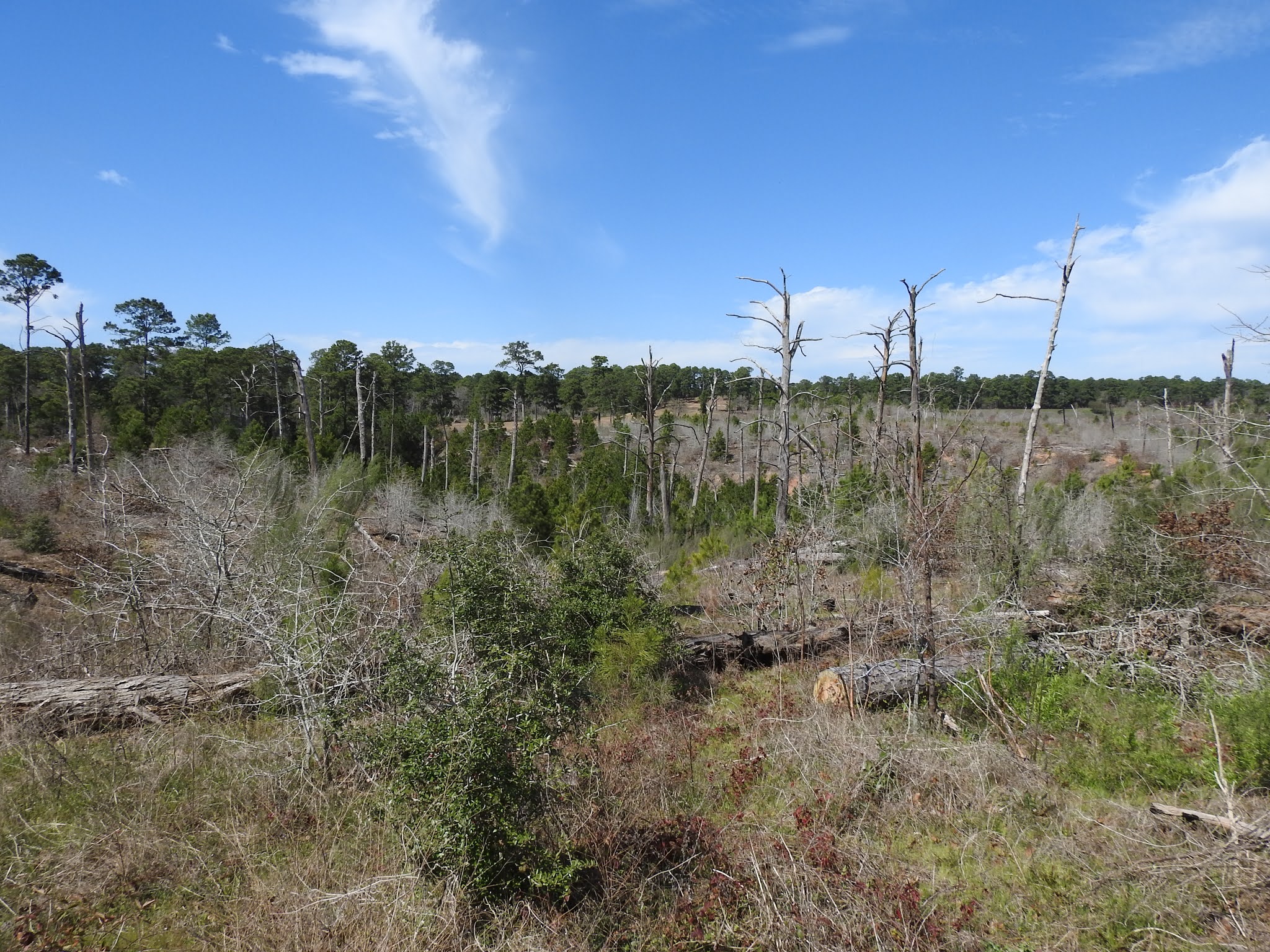
Figure 28.3 is an aerial view of the burned swath through the forest. It was a very windy day and quite easy to imagine the wind-driven fire raging through this area.  The topography is not all flat as it looks on the right in the picture but is in many places hilly and cut with many ravines. In some areas of the burned part, there are towering hulks of the dead trees.   However, for most of the area, the trees that died have been cut down, and, we think used for good purposes, as the felled tree if not hauled away would be visible and they were not.

We visited the area this past winter to see how well the forest was recovering from the fire.  Here is what we found.

Figure 28.4 The first stop on our tour


It was also a warm day and the redolent breeze carried the fragrance of pine needles. In the distance under the new growth of replanted loblollies a rust-colored carpet of old needles could be seen.

Figure 28.5  New growth appearing


Figure 28.6  Example of the Loblolly Pine bark

Before moving on to see the rest of Bastrop Park, we we took Road 1B to check out the Pioneer Village Cabin Area.  The trees in this immediate area were not affected.  These cabins were all constructed and built by the CCC in the 1930s using the pine logs of the area.  Here is just one of about twenty cabins in this village and several of them were occupied on the day of our visit.  The tree at the left of the cabin is typical of the mature trees in this forest. 

                            Figure 28.7  CCC built cabin in Bastrop Park

    Figure 28.8 Much of the forest didn’t survive

There are still grim reminders of the devastation and visitors are warned to stay away from standing dead trees because they may topple over.  Continuing on Road 1A on our way to the Overlook, we noticed a few spots of what looked like possible prescribed fires along the sides of the roads. 

In an unrelated incident to the fire, that same year on Memorial Day, heavy rains caused the already full Bastrop State Park 10 acre lake dam to fail and the flooded Copperas Creek surged down the ravine on a wild tear to the Colorado River.  Its waters damaged roads, trails and the golf course.  The Texas State Legislature has appropriated 8.4 million dollars for repairs but it is all taking time.  Arriving at the overlook situated on a prominent knob, we took pictures across the ravine shown in the foreground of Figures 9 and 10.   The ten-acre lake once filled this ravine.  Presently there is no water.  

Figure 28.9  Barracks with the telephoto lens.

Figure 28.9 also shows new pine growth that is emerging all over the burned area.  The appearance of the new pine growth shows that seedlings began to emerge right after the fire, because most of the young pines are 8 years old based on their growth sections. There is some on-purpose reforestation occurring in certain areas.

Figure 28.10  Barracks and other buildings with the regular lens.

It will be interesting to observe how this area recovers in the next twenty years because there appears to be competition from the hardwoods.  For this pine forest to recover to its original condition, the pines will have to dominate the hardwoods and even drive them out.  Presently the score is even in most of the recovering areas.

The Bastrop County Complex Fire was the most devastating wildfire in Texas’ history and in searching the Internet for ideas to prevent recurring fires, we came upon an article by FEMA that outlined some steps to protect residents.  One action the county is taking, according to Mike Fisher, Bastrop County’s Office of Emergency Management Coordinator, is fuel reduction.  Ridding the understory of dead trees, fallen trees and unwanted understory growth by mulching as opposed to prescribed burning is nontraditional and labor intensive, but Fisher says it’s one that‘s unique and not   been used before as far as he can tell.

 The county received a grant from FEMA’s Hazard Mitigation Grant Program (HMGP) to fund the program.  Almost 4,000 acres were targeted and placed into north and south zones.  The zones were studied to determine where large tracts of wild land (with a history of destructive fires and high- density understory fuel) met smaller tracts of developed land and subdivisions or houses located on small, medium and large lots (with varying degrees of fire resistivity and defensible space).  FEMA contributed over $1.2 million of the $1.6 million cost of the north project and $1.6 million of the $2.1 million cost of the south project .  The HMGP grant had a two-year performance period.  Four skid steer tractors were purchased with these grant funds and will be used to clear the understory.  Also, another idea to clear 1000 feet each side of 1441 was proposed. 

Using the skid steers, low-impact machines with a mulching head on the front, the county designed a mechanical thinning process.  Operators grind up the understory and remove undesirable tree species growing under the tree canopy.  On a wildfire outbreak the fire stays on the ground and does not go into the trees.


 Figure 28.11 Skid Steer Mulching Equipment

Fisher found few skilled contractors available to work the machines so county employees learned how to operate the equipment and will proceed with the task of clearing.

The project sparked excitement, curiosity, and some reservations among residents in most of the private acreage targeted for mitigation.  Fisher found “getting the residents buy-in the most challenging part of the project,” but “believes what the county is doing is a good measure to take.”


To get another professional opinion on what has happened since 2011, we contacted Kari Hines, Firewise Coordinator Mitigation and Prevention Department Texas A & M Forest Service in LaGrange.  Kari said that in late 2015 or early 2016 was when the crews began the mulching project and the first phase was accomplished in Tahitian Village.  There were two human-caused fires in 2016, that she knew about, in areas that were treated that the local fire department was able to put out more quickly and safely because of the work that was done.  Work was done almost completely on private property, with the agreement signed by the landowners that they would be responsible for maintaining the low fuel condition after the work was done.  Future phases of this work included mulching on the Boy Scout Camp and private property along 1441 and further south, in and around some developed neighborhoods between Bastrop and Rosanky.  Today, one can see in Tahitian Village and on 1441 which owners allowed mulching, and which didn’t by the density of the understory vegetation.  Depending on maintenance, the yaupon has grown back quite well in some areas.  Owners could decide how the mulching was to be carried out so there is often a mosaic pattern to the work completed on their properties.

Kari went on to describe other efforts on public lands by Texas Parks and Wildlife, Texas A&M Forest Service, Texas Military Division (Camp Swift) and other large- scale landowners including and expanding their forest floor fuel reduction projects.  These were projects that had been in place before the 2011 fire and were accomplished by hand with chain saws, mulching equipment, or prescribed fire.  The Bastrop Complex showed land managers how important  proper land management is as it was obvious that stands of trees that had prescribed fire in Bastrop State Park had much less severe damage than adjacent stands where prescribed fire had not been applied in years.

With our membership in Firewise we are reminded of the dangers of the growth of ladder fuels around our homes.  Our website features a Firewise newsletter on the effectiveness of fire damage prevention.  To maintain our rating of a Firewise Community, we complete a report annually and submit it to the Forest Service.  So, when you are out and about, survey your property, especially the area close to buildings and if you do any clearing on your property that can’t be seen from the road, please let us know so we can include it in the report.


                   ____________Sightings

§   This month the main sighting has been rain.  Wiley’s data posted on the website from his official rain gauge showed that we received 4.5 inches on Tuesday the 12th. 

§    We have not seen the Poor Will nor the Cuckoo but have heard these two annual residents already.  These are two birds that are usually never seen but often heard calling.

§    What is somewhat disappointing is that we have heard nothing of the Bobwhite Quail.  We hope that someone has heard them indicating that these birds are still here.   There is no telling what damage to wildlife and plant life has occurred because of the drought of last summer.


R &D Tusch


[1] Roemer’s Texas 1845-1847 by Dr. Ferdinand Roemer


Wow! 2024 A year of change

 Looking back over my notes of what happened with the vegetation this year brought back memories of how much of a shift we have seen from pa...