Thursday, January 27, 2022

The Mountain Lion

 We have spent many hours in the outdoors in Michigan, New England States, Louisiana, Arkansas, and Texas and throughout all those years and places we have spotted a mountain lion on two occasions, In Northwest Arkansas in the 1980s and by Lake Amistad in Texas in the 1990s.  Both were good spottings up rather close, maybe 100 feet away.  The Arkansas spotting was a mother lion moving her litter with a newborn cub in her mouth.  She spotted us, stood and looked at us for about 20 seconds, and then moved on casually to her destination.  The other spotting occurred as we were walking on an old ranch road near Lake Amistad.  The road was walkable with high brush on both sides so all we could see was the road ahead.  As we rounded a bend, ahead of us was a lion casually walking in the same direction.  Since its senses are extremely keen, it probably knew we were present but did not show that it knew we were there.  Finally, the lion ducked into the tall brush alongside the road, and we never saw it again. As many might think, no, we did not tremble with fear when we encountered these two lions. 

Yes, the mountain lion is a predator, but so is man.  It's understandable that if a lion has adopted the habit of repeatably killing livestock, it should be hunted and killed but the media and the TPWD have created such a negative attitude toward the lion, an attitude of fear, that even those who have no experience of any predation are eager to kill it.   We should work to change that attitude.

Now the range of the lion in Texas is concentrated mostly in the remote areas of the Big Bend.  It is occasionally spotted in the rest of the state but not very often. The map below shows the counties where the mountain lion has been spotted, but the spottings more than likely fall short.  It's almost certain that the mountain lion exists in all Texas counties west of the 100th meridian---maybe in all counties of low population in all of the state.

The map below shows the spotting data:

Figure 24.1 Range of the Mountain Lion

The Mountain Lion has a long history of residence in North America, and for those who have never seen a mountain lion here is a photo of one that matches those we have seen.  Some photos show the lion as a gray color, but I believe all are of the tan color unless the color of the fur changes with the winter season.


Figure 24.2 Mountain Lion

For those who have seen a bobcat, the mountain lion is larger than the bobcat and more elusive.  The bobcat of course is easily identified as its tail is very short.

According to the website maintained by THE MOUNTAIN LION FOUNDATION, the lion has a range running all the way from Canada through the western USA and into Chile.  The lion has maintained that longitudinal range since records have been collected, but the latitudinal range has been shortened dramatically to that west of the Mississippi by extermination and habitat destruction.  There is a species of lion that lives in the Everglades.

Western states exhibit varying degrees of attitudes about the lion.  For example, South Dakota is considering all-out destruction of the lion whereas Colorado is considering a ban on hunting the lion.

Texas for all of its notoriety of being a safe home for many forms of wildlife has an open season on lions with the thrust of this led by Texas Parks and Wildlife.

Try visiting Mountainlion.org for more information.   Help save this great animal by not killing it for the sake of the kill.

Mountain lions are many names, including cougar, puma, catamount, painter, panther, and many more. They are the most wide-ranging cat species in the world and are found as far north as Canada and as far south as Chile.

Solitary cats, 

Wednesday, December 22, 2021

A Struggle for Existence

We find it enlightening to reread material written by naturalists in the middle 1800s as they began to study evolution and the origin of species.  Most commonly read are the two books written by Charles Darwin:  Origin of Species and Voyage of the Beagle.  There were many others studying the science of plant and animal development during this time and Darwin made good use of their studies in crafting his theories.

In these two books, especially in the Origin of Species, he makes the point that every generation produces variations in the makeup of the species--all due to natural causes.  The variations are too small to be observed in just one generation, but these changes, accumulated over time result in either more adaptability to the environment or less.  In other words, if the variation makes survival more likely, they make it, otherwise...  Some make it some do not.  The process can lead to overpopulation or to extinction.

These old writings make the reader realize that we live in an ever-changing world of living things and the change is happening right before our eyes.  But we don't notice the change as our span of observation is our lifetime and these genetic changes occur over a much greater time period.

This constant change sets up the contest for survival of the fittest and the struggle for existence.

Hundreds of years ago, the native Live Oaks of the gulf coastal region grew only in the heavy soil and warmer conditions along the coast.  Oaks are known for their ability to readily produce variation and some variations adapted to the soil and conditions of the Hill Country.  Because of these adaptabilities of the Oak species, we have the Plateau Live Oak that lives here but not on the coast. 

It may seem to us that the Plateau Live Oak is well established, but we ask, is it really?

Let's take the reseeding of the Plateau Live Oak, as just one of the factors that determine its existence.  Our variety of Live Oak (Quercus Fusiforma) received a kick it the rear end last year in February when we had that severe cold downdraft from the polar region.  Many of the oaks had trouble leafing out on time and from my observation, they did not produce many acorns that year.  Without acorns we get no new oaks.  During normal winters and springs, the oaks produce a good crop of acorns.  When I first began experimenting with live oak propagation, I collected handfuls of acorns at random and spread them out over the grassy fields expecting to see a forest of new trees develop.  How many did I see?  None.

Then I started testing the acorns to determine if they were alive and found that in a typical handful, I might find one that was alive, all others having had their cores eaten out by worms while still on the tree.   The little hole in the acorn that shows up later after the acorn has fallen to the ground is the telltale sign that the acorn is dead.  The worm consumes the heart of the acorn, develops and escapes it leaving a hole in the acorn.

So then, I only planted known live acorns in the grassy fields where I monitored them with a marker.  How many did I get?  None.   In disbelief, I started to inspect the planting site and found that the acorn did sprout but deer or some other animal found the new leaves so tasty that the sprout was consumed and without starter leaves, the new plant died for lack of nourishment.

Extrapolating the grazing process, it becomes apparent that this is the cause of most of our live oaks having Y-shaped trunks, where the grazer has nipped off the leader but left enough to allow the plant to live and to ultimately form two trunks in the absence of the leading stem.

So now to have more live oaks, I plant live acorns in pots and when they come up and live in a pot for a year, then they are transplanted with screen guards to prevent grazing.  It's the only way.  So, if you were to depart (we all do sooner or later) and come back in a hundred years, the botany of the area would look just like it does today, open grasslands and mottes of oaks, but perhaps with filled in areas of Ashe Juniper.  What gives Ashe Juniper the edge to expand its territory?  New sprouts are not attractive to browsing animals, perhaps due to their prickly exterior.  And even if the new sprouts are browsed, if the browser does not get every bit of green, the new seedling continues to grow.  Ashe Junipers are like that. That browsing also leads to the Ashe Juniper growing up without a main trunk and looking much like a shrub.

Live Oak acorns have other factors in their struggle to create the next generation of trees.  Live acorns are a prime source of food for squirrels, turkeys and hogs.

And there is Oak Wilt, a disease that can decimate whole stands of live oaks.

In summary, about the only way for a Live Oak to reproduce naturally in our immediate environment is to germinate in the brush among the mature trees.  The predators find it not worth their effort to probe the brush where the new sprout is hiding.  Acorns from live oaks standing in the open have no chance to produce seedlings.  This situation is one of the causes of our oaks forming mottes as commonly occur here.

I would like to see the data on the odds of a single tree producing a single successful descendant--it must be very low.  As Darwin has pointed out, there is a struggle for existence.

Thursday, November 18, 2021

Rock Pile Kits

 The title sounds like something you would buy at a toy store, but in this case, it refers to the three gray fox kits that were raised in the rock pile in our back yard; the rock pile we preserved as a feature to attract the wild animal and plant life of the area.
Well, the gray fox found a great place to raise her three kits in the top of the pile where there apparently is a cave of sorts that all three kits could call home for a while. As is the usual arrangement, the mother fox lived close by but not in the den with the kits.
We did not notice this activity right away, but one day looking out the back window, we spotted a small fox that appeared briefly and then disappeared into the pile.   We kept the camera handy to catch the activity in the future.
Here is what we caught.
Kit Gray fox on the rock pile


After about three weeks, the three small foxes decided that they would vacate the rock pile and join mother.  We observed this ceremony when mother fox visited and as she left, all three went with her, single file to the back woods.
Over the next several months, we saw the small foxes when they would occasionally visit their early homestead, but then as time went by, and they grew to adult size, they stopped coming by, hopefully now out on their own.
A fantastic animal.


Thursday, October 21, 2021

Porcupines and Other Observations

 Whoa, what was that animal recently observed running up the driveway?  It was too far away to easily identify it but it ran with a side to side gait, not very fast, and was the size of a fat house cat.  So, at the time I concluded it was a fat house cat.  Since the coyotes have returned to the neighborhood, the feral cat population seems to be down, but maybe this one was more clever to evade the coyotes.

Then a few days later, on the road at the entrance to the driveway, what do we see but the same animal--this time close enough so that it was obvious, it was a porcupine.

(Photo courtesy of istockimages)

We are familiar with porcupines, having some experience with them in Bandera County, and and greater experience with this animal in Michigan.  The territory of the porcupine ranges throughout the world in one form or another, but here in the USA the territory of the Porcupine ranges from Alaska through the lower forty eight states with the exception of the great plains (no trees) and the southeastern part of the country in general.  The range map shows the territory more clearly.

Range map of the American Porcupine

Over many years, the range of the porcupine in Texas has been moving slowly eastward.  It may take decades and then maybe never, for the porcupine to habit all of Texas.
There are a lot of stories that circulate around regarding the porcupine, one of which is that they have the ability to "shoot" their quills out like arrows from a bow.  Not so, but these quills are anchored quite loosely in their skin, so if a predator attempts to bite the porcupine, the quill being barbed on its tip, is then lodged in the predator's mouth.  Dogs have to learn this danger, but coyotes seem to know it instinctively.  I have seen dogs with their mouths full of porcupine quills.
Another story about porcupines is one from Michigan during WWII.   At that time, Michigan was issuing new license plates for cars and trucks on an annual schedule.  Aluminum and steel were in short supply, so someone in the government decided that fiberboard plates, made from wood chips, would suffice for a year.  In the city, the plates did last the year, but for those vehicles parked in the wooded areas, the porcupine ate the license plates right down to the mounting bolts.   They like wood and are strict herbivores.
Some think hedgehogs (think Europe) and porcupines are the same animal, but that is not the case.  The hedgehog does have quills but their quills are not barbed.  Furthermore, the hedgehog is an omnivore.  Yes, they look similar, but are not the same, only distantly related.  For those interested in the Scientific name of our native porcupine it is Erethizon dorsatum.

Other Observations
Taking a backward glance at the St. Valentine's day polar vortex that gave us that very cold week in February, it appears as if our earlier observations were correct in that the Palo Verdes are coming back from the roots, the Huisache has been told to move back south of San Antonio and the same goes for the orchardman's olive trees.
It will be an interesting observation to note how many years it takes the Huisache to move back to Hays County to the extent that it had established itself---- it maybe many years.  Perhaps shrubby trees read too many reports on global warming and decided to make the move north only to be disappointed.
Similar story goes for olive trees.  I once wanted several olive trees for the yard, but every nursery I contacted was south of San Antonio and thought, since I lived in the Hill Country, that I was being foolhardy, but I wanted olive trees for the decorative effect, plus the olives are good in some drinks.  Despite this discouragement from the south-of-San Antonio nurseries , several olive "ranches" developed up in the northern part of Hays County about 6 years ago.  Why they started this big investment when they probably received the same advice I received was a mystery to me at the time.  Think tourism.  The world is not short of olive oil, but olive oil does fit into the specialty market as do the wines of the Hill Country, so olive orchards were planted for their tourism appeal.  That tourism area, if you hadn't noticed lies to the north of a latitudinal line beginning in northern Hays County.  South of this line, outdoor tourism is essentially nonexistent.  So, the olive trees are gone, and I would doubt that replanting is in progress.
We noted the first (to us) flock of Canada Geese flying in formation on the coattails of the cold front that went through a few days ago. Seems earlier than usual.
Then another strange observation.  A fawn, new enough to still have a strong showing of spots showed up with its mother.  I don't keep good track of this information, but it sure does seem late in the year for a fawn with spots.
Spotted fawn on the left (through blinds)

I considered that it may have been an Axis deer as they have spots into maturity, but they are rare here and besides, my experience is that a Whitetail would usually run them off, especially if there is food around.
Time will tell if we see it again and its five feet tall and has spots, eh?


Sunday, September 19, 2021

Who is boss among the wildlife?

 We decided to run a two week experiment about 30 days ago by providing food of four varieties at a specific time each evening.  The invitees were to be any that showed up. We chose 5-7 pm because we are usually at home then and can provide observation and data gathering each day.

The foods we chose were (a) sweet feed, which is probably ground up meal mixed with molasses (b) fruit scraps from our use of apples and pears (c) sunflower seeds and (d) small bits of 69 cent wieners as a meat. Oh, yes, and fresh water in the birdbath was included.  With this well balanced diet, we sat and waited.

The attendance was ragged at first, but within a week it settled into a routine that allowed us to make some observations.

The regular attendees were three deer (one six- point buck, one spike horn, one doe), one immature gray fox, a squirrel, countless Red Cardinals and a few titmice. The mockingbird, known in Texas as the junkyard dog of the bird world, was nowhere around as it hangs out on the other side of the house, since they and the cardinal are not particularly good bedfellows. Uninvited attendees were the zillions of fire ants. By the way, the ants this year are particularly invasive, more than any other year in our recollection. 

 At first, when we simply placed the wiener pieces on the sidewalk, the fox would bat the pieces along the concrete with its front foot to rid the meat of the ants, but still after eating, had to fight off the ants from its mouth with the side of its front paw.  So one observation is that the immature fox already knows all about fire ants and how to deal with them.

With the variety of food placed in separately located piles, all was peace and quiet for awhile.  The fox went for the meat, the deer for the sweet feed and the birds and squirrels for the sunflower seeds.  By now we had learned to place the meat scraps in a bowl situated in a pan of water; the water acting like a moat, to keep the ants off the food.  

The deer and the fox both liked the fruit scraps.  The deer were protective of the fruit scraps and the fox was well aware of that, warily eyeing the fruit and the closeness of the deer.  But deer don't gobble their food and they would occasionally wander off by a few yards giving the fox the chance to move in on the fruit scraps.

When the deer saw the need to ward off competitors, they got aggressive, battling their foes, which include other deer, by standing on their rear legs and waving their front hooves menacingly .  But as to the fox, all the deer needed to do was to look at the fox, move a few feet toward it and that was enough for the fox to move away. The fox seemed to have little fear of the does, but the buck with those antlers, well that was something to avoid.

Then we placed the fruit scraps in the same pan as the sweet feed.  The deer dominated this situation, but the fox took every opportunity to quickly run to the pan and grab a piece of fruit should the deer be looking the other way. The fox had to be quick and decisive to pull this off.

The deer were constantly concerned about their security (that's good, we should keep it that way).  For example, when the squirrel would jump from the tree branch to the bird feeder, shaking the limb wildly, the deer would jump away in alarm. Not the fox, the fox always seemed as if it had its security under control.  Interestingly, the squirrel was never observed on the ground at the same time the fox was around. That would indicate that the fox would attack the squirrel if it was caught out of the tree. That's somewhat surprising to us as the squirrel can get nasty when handled and it can use those front teeth to do battle.  But, we have learned that the fox and wild cats kill squirrels quickly by taking them in their mouth and shaking them rapidly, thus breaking their neck.

The deer never stopped being wary, but the fox dropped into a casual mode after eating, sometimes sitting on the sidewalk like a dog would sit, looking around and doing some necessary scratching. They are a beautiful animal.

The bird feeder is two sided, so if the squirrel was on one side, the cardinals were on the other side, not enjoying each others company, but being tolerant of one another.  The mockingbird would not act the same way, as it would incessantly harass the squirrel to the point where it would leave.  The cardinals are more complacent.

When finished eating, the deer would drink from the birdbath (it has to be refilled daily) and the fox would jump up on the rim and takes its fill of water before ambling off.

After a few weeks of this all the participants show up minutes after the food is put out.  They must all be parked up in the woods a few yards away waiting for noise I must make in setting up the days experiment.

One side observation is that none of these wild animals will eat man-made breakfast cereal---corn based, oat based, no matter, they will not eat it. They sniff it and walk away. Do they sense something we don't sense?  At cereal's $5 per pound cost, perhaps we would be better off eating sweet feed at 20 cents per pound.  

When night arrives, the cleanup crew appears.  The cleanup crew is always one or more raccoons, but they must be disappointed because all that is left is the odor of what was there earlier--except for the cereal which they don't like any more than all the others.

We ended the experiment by tapering off the food and then stopping it since we do not want to domesticate these fine wild animals.  

Friday, August 20, 2021

Marion, Texas---a favorite


Marion was established as a depot on the Galveston, Harrisburg, and San Antonio Railway in 1877.  It was named by the owner of the railway, Pierce, in honor of his daughter Marion.

Looking at the map of the state as it may have existed in most of the early 1900s, Marion was situated on a major east/west roadway between San Antonio and Harrisburg and later paralleled by the railroad.  Because this route was the major connection between what is now Houston and San Antonio, it became the most significant depot in Texas by the year 1877.  The railroad dropped off tonnage of imports from other Gulf Coast ports for distribution to all south-central Texas.  The commercial activity of the area in the early history was cotton farming, cattle raising and the mercantile business for a wide-ranging area of south-central Texas.  So, the Marion depot was the loading spot for local baled cotton and live cattle.


The cotton was ginned in the area through two ginning companies, baled and shipped out.  Cotton farming was big business for countless small farms in an era before large scale operations.  Even though there were only two gins nearby to Marion, Guadalupe County had at least ten gins in operation. And, necessarily, all the cotton gins were situated along the Guadalupe River, the only source of natural power.  Few know this, but Stagecoach Road, west of the Guadalupe River and southeast of Marion ends at the site of the old Erskine Ferry at the river.  Then just south of the ferry site, there was a six-foot-high dam on the river to create the elevation needed for a millrace to power a mill and a cotton gin.  Today, looking at nearly any detailed map of this spot, it is apparent that the resort called Son’s Island is an island created by the millrace from the dam.  Very close inspection might reveal some artifacts of this old mill and ferry site, but in general, it’s all gone.

Cotton flowed out, and money flowed in, so the town of Marion supported a substantial bank.


The Marion State Bank in the early 1900s

Ranching and cotton farming required a reliable supply of hardware, feed and other supplies required to repair machinery, and make life more enjoyable.   All this was provided by the Krueger Store. 

The Krueger Store was typical of the mercantile stores of the era, as they sold nearly everything a person would need from clothing to ranch and farm supplies and even canned goods for food.


Interior of Krueger Store 1900s

Taking a close look at this photo, it is apparent that there is an ample supply of toasted corn flakes, and a significant inventory of canned goods on the shelves behind the clerks.  Keep in mind this was the era when clerks attended to customers from behind a counter and fetched many of the requested items for customers.  Self-serve had not been implemented yet.

Marion slowly increased in population to about 500 people around the time of WWII and added population steadily to about 1000 as its stable level.

So, Marion thrived because of just a few key ingredients.  Cotton farming, ranching, mercantile business, and the attendant shipping and banking component necessary for conduction of this business.  The geographical scope of this business activity was significant, covering a wide-ranging area all served by the frequent visits from the Galveston, Harrisburg and San Antonio Railroad.

Life in this farming and ranching country is well described in a book titled Stagecoach Road, written by an area resident and updated by Steve Mardock. We have several copies. It’s an historical novel and contains many important facts of the area and of the times.  Stagecoach Road parallels the San Antonio Road that passes through Marion, lying about 3 miles south.  It was an important road in the early days, because it led to the ferry crossing across the Guadalupe River allowing easier access to Seguin long before any of the bridges were built.

In the late 1900s, changes in nearly all aspects of life in rural Texas changed and these changes affected Marion.

The changes of most significance were:

·         Cotton farming went industrial, with big farms, mechanization, and improved access to transportation.  This change removed a significant amount of cotton farming from the area around Marion and placed it in the northern part of the state.

·         Cars and trucks began to appear in great numbers replacing local traffic of the railroad and that of wagons.  Now it was easier to get to San Antonio than ever before.

·         The Interstate highway system was built and it bypassed Marion, thus making a rapid transit connection even better between Houston and San Antonio.

·         The demographics of the population made a slight shift due to the children of the long-established inhabitants moving to large cities for better paying (and easier) jobs, somewhat replaced by those moving from the larger cities to fill the need to live a rural lifestyle.  This change however was not large and for that reason the area has maintained a character unique to its history.

Adaptation of the town continued.  The Marion State Bank, established in 1906 moved from its original location to a new location on the main street, modernizing their facility and their services.  Way back in 2006 it celebrated 100 years of service and is still operating with its conservative practices.

The Krueger Store was replaced in 1973 with the Helping Hands Store which probably stocks and sells more items than any of the so-called big box stores.  Its enlightening to wander the aisles and note all the merchandise available here.  Also, the people who run the operation treat each customer as if they knew them forever.  We walked in after not having been to the store for a year or so and asked “where’s the cat?” since we were impressed on how the cat was apparently a fixture of the store.  The person simply said that the cat was upstairs as it had not been feeling well lately.  She answered the question without the usual hesitation to answer an off-the-wall question from a stranger.

So, today, there are the commercial mainstays consisting of the Marion State Bank, the Helping Hand Hardware, the Penshorn Meat Market, the Gg's Corner Café and the Coffee House, now locating in a ground level floor of the old bank building.

The meat market and the Corner Café and the others mentioned are “all American” establishments that take pride in what they have to offer.

However, the activity at the depot is gone and gone probably for good. While we were there recently, a Southern Pacific freight train blasted through the town pulling at least 100 cars, all headed in the direction of San Antonio.  The crew in the four-engine locomotive waved as they went on through the gate closed crossings.   Then, not more than an hour later, another freight train sped through, going the same direction, both heading for now what is the center of commerce, the big cities.

But Marion is doing just fine, in fact is doing so well that it does not seem to have the urge to be more robust by tapping into cheap tourism.

Thursday, July 22, 2021

Living With Nature

 Living and learning with nature is much more educational than trying to transform it into something parklike.  But, our sense of being orderly  is often in conflict with our sense of the randomness of nature.  But if we're lucky enough to be starting out with a piece of property with a real bit of woods, some grass and shrubs it's worth our while to carefully observe the natural system and determine who else might have taken up residence here.  As John Muir wrote so famously,  "Everything I touch, I find it is connected to something else."

Its good that we humans have a sense of orderliness otherwise our cities would be a mess and unfit for living. Hmmm, many already are. Cities have had their ups and downs regarding order and control, but city priorities have largely eliminated nature from the city. It is difficult to find a city park that is still natural. Is there a chance that some children have never seen a weed or a tree or even a snake?

Most of our population in the US has a history of migrating from  rural areas to cities, leaving behind the rawness of nature and becoming accustomed to the artificial aspects of the city.  Orderliness of the city here refers to the absence of nature and certainly does not apply to the orderliness of social behavior because for the most part, we humans are more socially ordered in the countryside than we are in the city.  But that is a whole different subject where we have no expertise.

Because of social disorder in the cities that is occurring now, there is an indication of a reverse migration of people from the city to areas more rural---small towns and even more sparse areas of larger acreage. When that happens, there is an urge, not sure why, but there is an urge to bring city style orderliness to the countryside.  Big mistake. 

A substantial amount of work is required to modify the surroundings and perhaps even more to then  maintain that orderliness.  I chat on occasions with an old rancher who still uses his property to raise goats and cattle both of which seem to do a good job of managing nature yet not in a very orderly way at least not orderly in the city sense.  He once said that function is more important than style, just as in politics, content is more important than style. The most common comment he gets from those around him is that he should modify his gate as it is "not very attractive".  His response is that gate's function is to keep the cattle and the goats inside his property and it serves that function very well.   His gate could use a bit of remodeling I  would be the first to admit, but there is a limit to making everything look better and while not adding to its purpose.

Living in the midst of the clutter of nature has some benefits. The unmown grass prevents erosion and produces seeds for the next growing season, piles of rock provide homes for wildlife, and on this point, we looked out over the backyard and spotted a mother fox playing with her three kits on top of the stone pile, a stone pile of about 5 feet high and 20 feet long.  Soon, she decided enough playtime for the moment and sent a signal for them to go back into their den.  We could not see the den opening, but they disappeared into the pile and she strode off.  Where else can one get this type of experience?  Surely not on a screen.  In truth, saving the visual sight in ones memory is much more valuable than saving it on your photo file. The list of benefits could go on to great lengths, but listing them might destroy the thrill of discovery.  It gets down to being an astute observer.

The whole idea is to live with Nature and not destroy it in a quest to make the surroundings safe, secure, neat and tidy. Man's junk is not attractive, but nature's "junk" is surprisingly attractive and useful.  I would guess that it depends on whether you are a good observer.

Wednesday, June 2, 2021

The Struggle of the Live Oaks

 Probably most people travelling from the Gulf Coast of Texas to the Hill Country and beyond notice all the Live Oaks but they probably don't know that the Live Oaks in the Hill Country are not the same as those along the Gulf Coast, and for that matter all the way from the Texas Gulf Coast to the Atlantic states up to Virginia.  Digging even deeper into the variations of the Live Oaks, the classical live oak of the Gulf Coast that thrives in the heavy soils all the way to Virginia only exists in the eastern part of the Texas Gulf Coast.  Texas has five forms of the Live Oak, one of which is the Quercus Virginiana, and the other are modifications, if you will, of the Q.Virginiana and they are all Quercus Fusiformis.  The Latin name of the four variations comes from the observation that a distinguishing factor between the Q. Virginiana and the other four Q. Fusiformis is the long, slender acorn of the Fusiformis

In summary these five are in the Live Oak Complex

  • Live Oak (Q. Virginiana)
  • Escarpment Live Oak  (Q. Fusiformis)
  • Q. Virginiana x Q. Fusiformis
  • Q. Minima x Q. Fusiformis   (small zone of growth along the sandy coast of Texas)
  • Q. Oleoides x Q. Fusiformis  ( small area of growth along the lower sandy coast of Texas)
From this list, the classic live oak is Quercus Virginiana with its range from just west of Galveston Bay in the coastat counties, all the way to the Carolinas.  The Live Oaks of our immediate area run from the Balcones fault line northwestward for about a hundred miles. This is the Quercus Fusiformis.  Then to make things even more complex, there is a hybrid that grows in the area between the Fault Line and the range of the Live Oak of the coastal area.  So, if driving from the Houston area to the hill country, you would pass through the territory of the Q. Virginiana x Fusiformis.  The fact that the Balcones fault line separates the Fusiformis from the Virginiana x Fusiformis would suggest that the abrupt change in soil is the dominant determining factor.  Temperature and rainfall may also be a factor as well.

Which brings us to the dilemma of the St. Valentines Day polar blast and the very slow recovery of the Live Oaks in our area.  Our observations indicate that some of the oaks are having more trouble leafing out than others.  It just so happens that the boundary between the Q. Virginiana and the Q. Fusiformis runs right along the Balcones escarpment, with the Virginiana x Fusiformis being happy and contented with conditions south of us and the Q. Fusiforma content with the conditions north of this line.

But the line between the two variations can move with time and temperature.  Of course the line of tolerance on temperature is fuzzy and it depends on the amount of time that the tree experiences at low temperatures.  For example, in the Dallas area, where the Live Oak had been planted extensively, it was nearly completely obliterated in the freeze of 1983 when the temperature was below freezing for 12 consecutive days.

Knowing that there is variation in everything in nature, the speedy recovery of some of our Live Oaks compared to that of others right next to them would suggest that at this boundary line between Live Oak varieties is vague and we may have two kinds of Live Oaks in our local forest.  If we see some of our Live Oaks die, it may simply be that they were q. Virginiana x Q Fusiformis.   Time will tell, but so far, we have spotted only two trees that look in really bad shape.  
Another factor causing the decidedly slow leafing out of our live oaks may be caused by abnormal sap withdrawal to the root system from this very cold February and cold spring to boot.  We all know that deciduous trees only leaf out when the sap flows up from the roots and that timing is related to moisture and temperature.   Who knows, the Live Oak may be right on the edge of being a deciduous tree.  But then we wouldn't want to call it a live oak.

As to the pesky but very attractive Huisache, it appears that the few that we had are dead from the freeze.  Note all the dead Huisache along the roadside of  Old RR12 just after leaving Wonder World Drive at the LaCima entrance.  A warming trend brought them up this far from the southern part of Texas and a cooling trend sends them back home.

The same goes for the Palo Verde mentioned in the previous month blog post.  It now appears that all the Palo Verdes trunk and limb structurer is dead but the plant is coming back from the roots.

We haven't searched out the fate of the Olive orchards, but it is likely that these trees are gone.

Sunday, May 9, 2021

The Tree Rings Wlll Reveal the Times

In our opinion, we have not fully recovered from the drought of this immediate area that began about 6 years ago.  The "immediate area" is important to note because in some adjacent areas, such as east of here in the blacklands, rainfall seems to have been adequate to reach underground levels.  But right here, the drought is still with us.  Yes, we have had rain, but it either arrives in runoff quantities or in small doses.  The runoffs help the rivers, and the small doses of water evaporate quickly.  This abnormal rainfall  will show up in disparate tree rings should some of our larger oaks be cut in future years.  When someone in the future were to cut a tree and look at the growth rings, they will wonder what happened in the 2015-2021 time frame as the rings will be closely spaced indicating little growth. One of our indicators of drought is Lake Bridlewood, and most residents probably noticed that it went dry this spring.  That has not happened more than once or twice to our recollection.

Droughts in Texas are common, and this year, we not only had a dry winter, but a cold one on top of all that.  The St. Valentine's Day cold spell, on top of dry conditions, hit many plants that I would call border plants quite hard.  For example, the Huisache, the Palo Verde and similar vegetation that seem to be creeping northward over many years only to now have this reminder that all is not warm and friendly up from the safety of the Valley.  I often wonder how the olive orchards that were being commercially established in northern Hays County have survived this brutal season.  Typically, olive trees survive to the south of San Antonio, but are considered risky plantings to the north.  Yesterday travelling on the road to Lockhart, we noticed entire groves of some thorny brush all black and seemingly lifeless.  These are not Mesquite, because all those seem to have survived quite well.  As the summer progresses, we intend to keep an eye on these stands and conclude how or whether they survived and the variety of plant in question.

And then there are the webworms that nearly ate all the leaves on our 15 ft. Shumardi Oak this spring, but now with some watering and the recent warm weather and rain, these planted oaks are putting out the second round of leaves.  Good for Mother Nature.  Its not an easy call to poison the webworms as they are a favorite food of the Cuckoo.  We did not spray the webworms   and all seems to be okay now, so that was a success.

The Live Oaks seem to be very hesitant to put out leaves this spring, probably due to lack of rain and the cold spring.  I am sure they will survive, but probably show some damage and appear stressed.  That means we need to provide special treatment to these trees when we can and watch for any invasion of pests.  I think  the webworms are gone, but we never know where the Oak Wilt disease is lurking.  So, if you cut limbs from the Live Oaks, seal the cut with a pruning aerolsol spray found at local stores. Otherwise, wait until winter to prune any Live Oaks.

Regarding all of our seemingly dead plantings, we are waiting to see what comes up from the roots or  out from the side of the trunks before we tear them out.  The big stand of Palo Verdes that we had growing at the culvert crossing on Steeplebrook Drive are being monitored.  Yes, we know they are considered invasive, but when its tough to grow things in this harsh environment, even invasive stuff can be tolerated knowing that Nature steps in from time to time and fixes things.  Two cases in point are the Russian thistle and the Bastard Cabbage that nearly overran us five years ago, but now is hard to find in our area.

Bluebonnets you ask?  What bluebonnets?  They need water in the fall and winter and did not get it so the seeds will probably sit in the ground until this fall and then, if they are still alive, will produce some plants.  Look for the immature plants in the fall and if they are not visible, chances are we will not have any stand of bluebonnets the next spring.

Meanwhile, the plant nurseries are doing a thriving business.

Saturday, April 3, 2021

Who ate the wieners?

  It all started with a video of a man somewhere in Canada who recorded his scene of hand feeding a hoard of about 30 raccoons their evening meal of two pounds of wieners. No, we didn't search for this video, it happened to be in the up next position after we were looking at one of our videos on our channel.

Mind you, we are not fans of feeding wild animals people food, but on the other hand, in this busy world we all need a little merriment and watching this video was amusing. Search for it on Youtube but if unsuccessful in finding it let us know and we will help locate it.

Then we decided to bait the game camera to see what would show up at our place in Central Texas.  

We know that our most frequent visitor is the raccoon, since it (maybe they) have to make a nightly raid on the bird feeder getting every last sunflower seed.

Now, 'coons don't get around much in daylight, but as soon as it gets dark, they are on the prowl and miss nothing if it smells like food.

So, adding a package of wieners to our grocery list, we came home with 8 wieners costing 69 cents.   These were not your gourmet variety, but made from all sorts of meat, and in Canada to boot.

The first night out showed that the raccoon got the wiener at 8pm.   It also showed that the fox made its appearance at 2am the next morning---way to late.  From the photo, you could tell that the fox knew what was going on with the provided dinner because it had that look of "okay, I can beat this ol' 'coon at his own game".

For the next several evenings, the wieners went out at about 5 pm and they were gone by 630 pm.  Ya see, the fox knew the 'coon was still up in the tree because it was not dark yet.

All this prompted the crafting of this rhyme to document the study.   Must get another package of wieners.

Who Ate the Wieners?


I did not know how this could be, but in colder climes apparently

Coons can hibernate like bears,  and so must eat to fatten their

Bodies ‘til spring arrives and they awake, to rustle up a new grubstake.

A kindly Canadian then set about, arranging a giant wiener handout.

Roly-poly coons came by the horde, to feast on his hot dog smorgasbord.

They were here and they were there, climbing all over him everywhere.


Well that gave an idea to my better half, an opportunity for a photograph.

First to the store for some cheap bait, then set up the camera overnight and wait.

Next morning, just as he’d figured it , there was the face of the masked bandit.

Would he be back again to sup,  on another wiener and gobble it up

Before another animal could benefit, would he again get all of it?   BUT---

The coon snoring up the tree in his bunk, wouldn’t leave it till the sun had sunk.


MEANWHILE


Someone else had seen some juice on the plate, and knew he had been too late.

He twitched his whiskers and decided then, that that would never happen again.

And he waited patiently in the woods, for the deliverer of the goods.

Soon he heard a step gravitate, in the direction of the plate.

He could see and hear no muss no fuss, as chunks of meat hit the surface.

It was still light no coons about, so he took his time and just pigged out.


Wednesday, March 3, 2021

Local History Uncovered

 Earlier posts discussed the area history of Hugo Road, Purgatory Springs, and surrounding land ownership.  Some of the information related the work of others in this field and so invited some questions, such as the origin of the name Hugo.  More recent readings suggest that there were two schools in the area, one being Purgatory Springs and the other Hugo and since these two names seem to be interchangeable, it raises the question of whether there were two schools or one school with different names.

Digging further into the matter, always striving to find original source documents, one can find no evidence of two schools in the area. However, the one school building, still standing there on one acre of land, was probably not the original school building. That does not mean that there weren't two schools, it just means that the original documentation discovered has not supported this theory.  Secondly, there has been no discovery of the basis for choosing a name for a post office.  The criterion for the name selected by the local postmaster was that it be "one word, preferably short".  Obviously, there were other criteria, probably in the judgement of the US Postal Service,  to prevent naming post offices with, shall we say, nasty words.

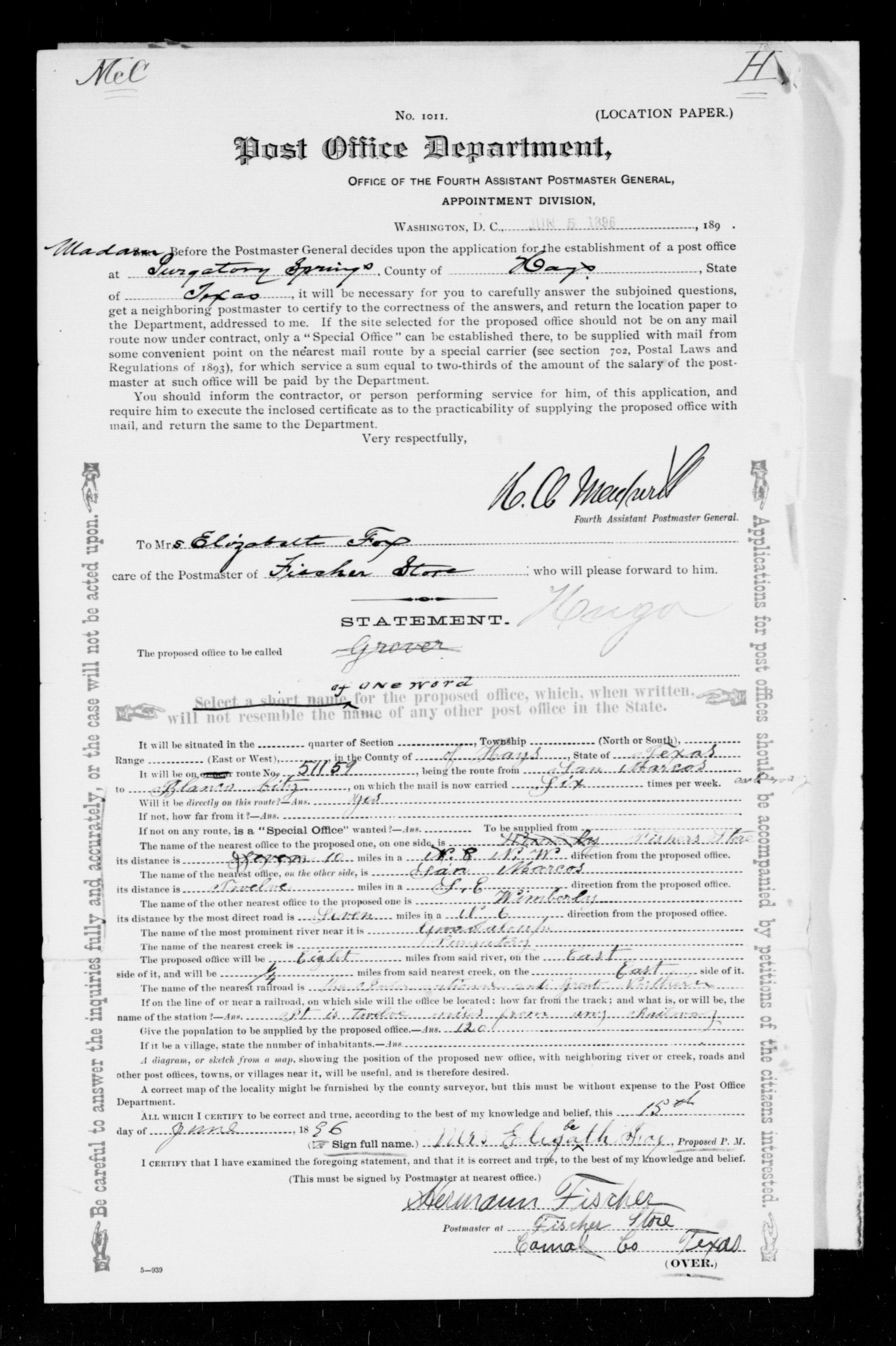
A search of the National Archives shows that the first post office to be located at the settlement of Purgatory Springs was to be named Hugo. This official document dated June 1896 makes it clear that this was to be the first post office here and not a renaming of an existing post office.  The document also shows that the name first proposed was Grover, but that is lined out and Hugo inserted. A search of\ newspapers and the census of the area did not reveal anything or anybody that would suggest a connection to the name Grover. The wording of the document also states that this is the first post office for the area, thus disputing the earlier viewpoints that there was a first post office named Purgatory Springs and then later renamed Hugo.  Apparently there was no earlier post office named Purgatory Springs.   The Hugo post office was established in 1896 with Samantha Fox as the proposed Postmaster.  The document also indicates that the site of the post office was 1/4 mile to the west of Purgatory Creek, the creek which flowed from Purgatory Springs.  The Post Office served 120 people.  The site was reportedly in a store, as is so often done, but the location of the store has not been determined.

Once the area received its post office, the settlement became known as Hugo, with the origin of the name still unknown. As was typical, the settlement adopted the name of Hugo from the name of the Post Office. Thus everything in the area was renamed including the school, the site which is known, and the cemetery, that site being known. On maps there is even a mountain named Hugo Mountain, to the north of the Highway 32 near its junction with Purgatory Road.

The origin of the name of Hugo remains speculative at this time.  Oral family history would indicate that the name was chosen in honor of an ancestral person dating back many centuries in Ireland.  A search of the newspapers of the area for the years immediately around 1896 shows many news articles in the newspapers of San Marcos and San Antonio of the death and memorials to Victor Hugo who died exactly ten years earlier in 1885.  The many news articles were in memory of the tenth anniversary of his death.  Wiki has an extensive article on the bio of Victor Hugo.

There you have it, some new facts, and a suggestion for the origin of the name of Hugo to add to the story of Hugo, Texas.  But, who was Samantha Fox?


The document can be found at:

https://s3.amazonaws.com/NARAprodstorage/lz/dc-metro/rg-028/M1126/M1126-577/M1126-577-0268.jpg


Sunday, February 21, 2021

The Polar Blast ushered in by St. Valentine


The weather forecast told it all: “unprecedented” low temperatures, snow, and wind, and for the whole week no less.  News media often use the word unprecedented because its dramatic, but for the reader the word needs a bit of grounding.  Unprecedented requires a time frame and if we make it long enough, surely the weather we were about to get has been experienced in central Texas before, but it would require going back in time for decades.  We personally experienced similar low temperatures in 1989 when living near the Gulf coast, so it was not unprecedented for us.  
Nonetheless, we had to prepare all exposed pipes to prevent breakage, especially the piping associated with the water system for the house.

All was going well the first day into the cold spell.  And then the electricity to the house was cut off. Quickly following that, the wire line phone system went dead.  Except for the bottled gas we use for cooking, the whole house depends on electricity, including the water system and the heating system. Losing electricity was doubly bad for us because much of our two pumphouses depended on 100 watt light bulbs to add just enough heat to keep the pumps from freezing and breaking. So, we waited for the power to be restored---and waited and waited.  At the time there was no information on why the power failed but one can imagine that some nearby power line was down because some freezing rain fell and that would mean  tree limbs could have broken the lines.

The low temperatures of the day for three days hung right around 5 degrees F with the highs never reaching 32 degrees F.  Everything froze and stayed frozen.  The big problem was how to keep the freezing conditions from wrecking the pumps (cast steel does not tolerate much expansion and cracks easily with expanding ice) now that we did not have the benefit of the 100 watt light bulbs.   Since we have learned repeatedly that it is not wise to get rid of a lot of old stuff, we had on hand two Coleman lanterns that still worked even though we had to search for two good sets of mantles.  So, we lit the lanterns and put them in the two pumphouses, refueling them every six hours, 24 hours a day. We were fortunate to have on hand 4 gallons of automotive regular gasoline as fuel for the lanterns.  Getting out of bed in the wee hours of the morning when the house temperature is 50 degrees, getting dressed and refueling the lanterns at ten degrees outside temperature was no enjoyable experience, but then we weren’t sleeping under a bridge or looking for food in the snow-covered woods like some of the other animals.

We coped with the toilet system by breaking the ice on the surface of the irrigation water tank and dipping pails of water out and using that water to refill the toilet tanks.  Not an easy job on slippery slopes, but doable.

The snow fell after the freezing rain ended and we found six inches of snow on the level ground.  Then two days later, another six inches fell, but neither lasted long as the humidity was low, and the ground still had some heat to melt the now.  You ask what difference the humidity makes on the evaporation of snow.  Snow crystals have vapor pressure just like water so snow and ice “dry” just like water, albeit more slowly.  For those of the northern climes, during pre-clothes dryer days, our family always hung the wash on the clothesline in the winter, just as they did in the summer and the clothes first froze, then dried.  Bits of science never hurts.

It was interesting to note the animal tracks in the snow.  The deer never seemed to mind it all, but probably took some time to learn to eat the snow for water, as all the water supplies were frozen.  Their tracks were prevalent.  Each day proved that the Grey Fox made rounds looking for food, but only at night because we never saw the animal, only the tracks. 

Probably the most miserable critter was the Roadrunner, and unfortunately we found one huddled in the sunny corner of the garage, presumed to having frozen to death, probably the first night of near zero temperatures.  When I first spotted the bird, it appeared to be warming in the sunlight, so I assumed it was still alive and would be best to let it warm up slowly while in the sunlight. This photo shows it huddled in a protective corner behind a spool of fence wire.


A few hours later I tested it for life by nudging it and found no response. 

Later, the next day I looked to see if it was still there, but it was gone.   First thinking it was dead and frozen, now I assumed it had died and was found by the fox and eaten, but the puzzle was not over yet as a wide search of the area revealed no feathers. So, I still had to presume that it was dead and served as food for some other animal.

Then I began to be concerned about all the Roadrunners and how they are able to survive these cold temperatures.  Driving out the driveway the next day we spotted two adult roadrunners looking racing along in their normal fashion, fit as a fiddle and thus we concluded that these hardy devils can survive cold weather.

That prompted a search for how Roadrunners cope with cold weather and we found that two southwestern birds, the Poor Will and the Roadrunner are capable of entering a stage of torpor where they can shut down their systems when it gets too cold and and when they run short of food.  They can exist in this very dormant state for days and survive with no ill effects.  As a result of all this information and a strong desire to think the best for our Roadrunner, we concluded it was in a state of torpor when seen by the garage where the photo was taken and lived through it all. And, better yet, maybe it was our bird that we saw the next day as we drove out the driveway.

Noticeably absent were the ever-present raccoons.  They apparently stayed in their dens wherever those happened to be located.

We probably will never know the full extent of damage to wildlife but it seems evident that it will not be significant.

The weather finally returned to normal for this time of the year, and we began to recover.  It took two days for the house to come back to 68 degrees because the electrical grid was still rationing the power, not only by rolling blackouts but by lower voltages.  We saw voltages as low as 115 when normal is about 125.  Low voltages mean any electrical device is only at partial performance levels.   We first noted this when the bread toaster worked, but never to the extent that one could see glowing radiators in the bread slots.  The heat pumps ran but were not pumping much heat and the auxiliary heating units had to make up the shortfall.

The snow is now gone, the ground is mostly bare, and we found that all the outside piping had survived thanks to wrapping everything with old towels and serapes, plus those valuable Coleman lanterns.  Oh, and another point. Sitting in the dark, even with our kerosene lamps, was not enjoyable so we rigged up a 100-watt light bulb to a DC to AC inverter and lit the lamp with the power from the storage battery.  A normal auto storage battery does not hold a lot of power as it ran the 100-watt light bulb for only a few hours, but that was enough time to get in some reading to take our minds off being cold.

All through this ordeal, our only communication link to the so-called outside world was the cellphone. But still, there was little communication on why we had lost electricity and the outlook for restoration.   When temperatures began to moderate and electricity became more reliable, then the information on the utility system began to flow from the governmental authorities.  What we know now is that very little of the transmission system of wires, transformers, and poles were affected by the storm, but the grid managed by the Texas Energy Commission lost more than a third of its electricity due to two significant events (1) the wind generators in the panhandle were shut down due to icing of the blades.  That reduced electrical generation by a whopping 23%.  We must remember, but not brag, about the fact that Texas generates more of its electricity by wind turbines than any other state. (2) some of the natural gas fired steam turbines had to be shut down due to icing of the natural gas.  This is not unusual, although most would not think that natural gas would ice up and clog the lines and injectors of gas turbines. But again, a little bit of science.  Recall that methane can form hydrates when water is present and the methane hydrates turn from gas to solid at temperatures that we encountered.

All told, had we not lost electricity, we would have easily coped with these temperatures, this amount of snow and for this duration. 

Wednesday, February 10, 2021

Birds and their preferences

 For sure, every area of the country has its birds that reside year around and birds that wander through on their way somewhere else to nest and then some in between the two-those that winter somewhere else but nest here.

We recently had the largest, most rowdy flock of robins move through our area; their brief stay outdid every other occurrence in memory.  They were everywhere, and they stayed perhaps for ten days, then left.  Some years, the last five for sure, there were no robins to be seen here.  Their travel guide put them on a different route to their northern nesting areas, but this year our place was a featured stopover.

The interesting part of this story is the apparent preferences the birds show in their eating, nesting and social habits.

The robins are noted earthworm eaters, but we have no earthworms here, at least none so near the surface that they can tug them out in the classical robin fashion.  So,  what do they eat while ganging up on us as they did recently?  Their droppings show a lot of red berry evidence, and the only red berries we have right now in any quantity are prickly pear tuna berries that the deer have not already found.  But those berries are tucked inside the tunas and not easily obtainable by the robin, so these birds were probably feasting on such berries as possum haws.  Strange as it may be, they may find this fruit the only thing to eat in the area as they travel northward.  Bird authorities have found that migrating robins eat small berries until they exhaust the supply, then move on northward. They roost in clusters in trees at night which accounts for the pile of droppings concentrated on the ground below.

And then there is the noted Golden-cheeked warbler.  We talk a lot about how important it is to protect this bird's nesting habitat, but we actually don't sacrifice much to help this bird.  This bird seems to have two dominant preferences, one is the mature Ashe Juniper that produces stringy shreds of bark they use in nest building and the other is seclusion and privacy.  The nest is nearly always made from this stringy bark that the bird rips off the trunk of the mature Ashe Juniper.  So, even when we proclaim that we are protecting the Golden-cheeked warbler, landowners are busy eradicating their land of the Juniper and building dense housing units on the cleared land.  Hey, not so fast, remember what we proclaim about protecting the habitat of the warbler.

Here is an example in a photo credited to Amanda Aurora of a nest being monitored.  Note especially the flat strips of Ashe Juniper bark that rings the nest.

Figure 14.1 Golden-cheeked warbler nest 


We find that these birds are so reclusive that they are heard more than they are seen.  From our records here, we have heard them at least once per year, but have never seen them.  More recently, we spotted a used nest in a small oak tree.  From its construction, it is almost certain to have been that of a Golden-cheeked warbler.  
Figure 14.2 Suspect Golden-cheeked warbler nest


Compare the preference of the GC Warbler to that of, say, the Northern Cardinal or the Grackle, or better yet, the house wren.  The wren is more than likely to build its nest in the bouquet of flowers adorning your front door, so accustomed are they to being around people.  The grackle is also a standout in its ability to live among traffic and parking lots and people.  Here is a poem that won a prize for us in a local contest.  The poem describes the grackles activity in the parking lot of the local supermarket.

Scroungin' the Lot at H-E-B
I comes across this paper, see...
An' I notes this contest 'bout us birds
with all these prizes fer rhymin' words
So I sez to myself with my famous cackle
"this is right up your alley, old G.T. Grackle"
Next I fly to my tree where I keeps my PC
And that's why yer getting this email from me
Now, first all, and we all know it
You had in mind a human poet
But, what if we cut out the middleman
I win all the prizes... an'
settle some debts with my seed eatin' pals
and share the pie with my favorite gals.
If you think there is nothin' in it fer you
Not true, as I notified a crew
Of media types for an interview
Photo ops and a book signin', too.
Bring the loot to the parking lot around three
My office is in the crape myrtle tree
G.T. Grackle
641 East Hopkins
San Marcos, Texas 78666

The pie was delicious, personally delivered by the man himself, Jerry Hall.

______Sightings___________

The Christmas Bird Count has been completed by the volunteers led by Stephen Ramirez and the count was fewer than last year, but that may be true because of fewer volunteer counters.  This introduced factor of the number of spotters may be adjusted by a few of the other parameters of the count, as this year we noticed that the count also listed minutes of counting.  
No matter what, the count shows  33 species, the most prominent ones being cedar waxwings and robins along with the ever present turkey vulture.   


Thursday, February 4, 2021

A Natural Occurrence often Overlooked

 John Muir once said that everything he touched in nature was found to connect to some other part of nature.  In other words, we are living in a natural world where nearly all aspects of life, not just our own, but all life is interconnected and thus interdependent. This means we need to be careful of what we change or disrupt in nature.

This brings to mind a phenomenon that occurs continuously around the world.

Plants and animals have many things in common, but food stands out as one of primary importance.  Animals, of course, can move around and secure their food where it exists, plants on the other hand need to find food where they happen to sprout.  Plants are at a disadvantage because they can be the food of animals whereas the reverse is not so common.  In addition, plants that happen to sprout where there is no food (and water) don’t last long, do not flower and therefore make the decision not to reproduce in the particular area.   Plants that find tough conditions then become the rare species of the area----maybe even extinct.  So be it, Nature is in control for the most part unless we, the animals, interfere with the natural process in which case the outcome is usually an even more rare plant.  Unless, of course, we animals need the plant for food in which case we create the conditions (irrigation, hot houses, cultivation, insect deterrents,  etc.) that allow the plant to grow in profusion.

But, so much for plants, what about the animals that can move about and find favorable conditions.

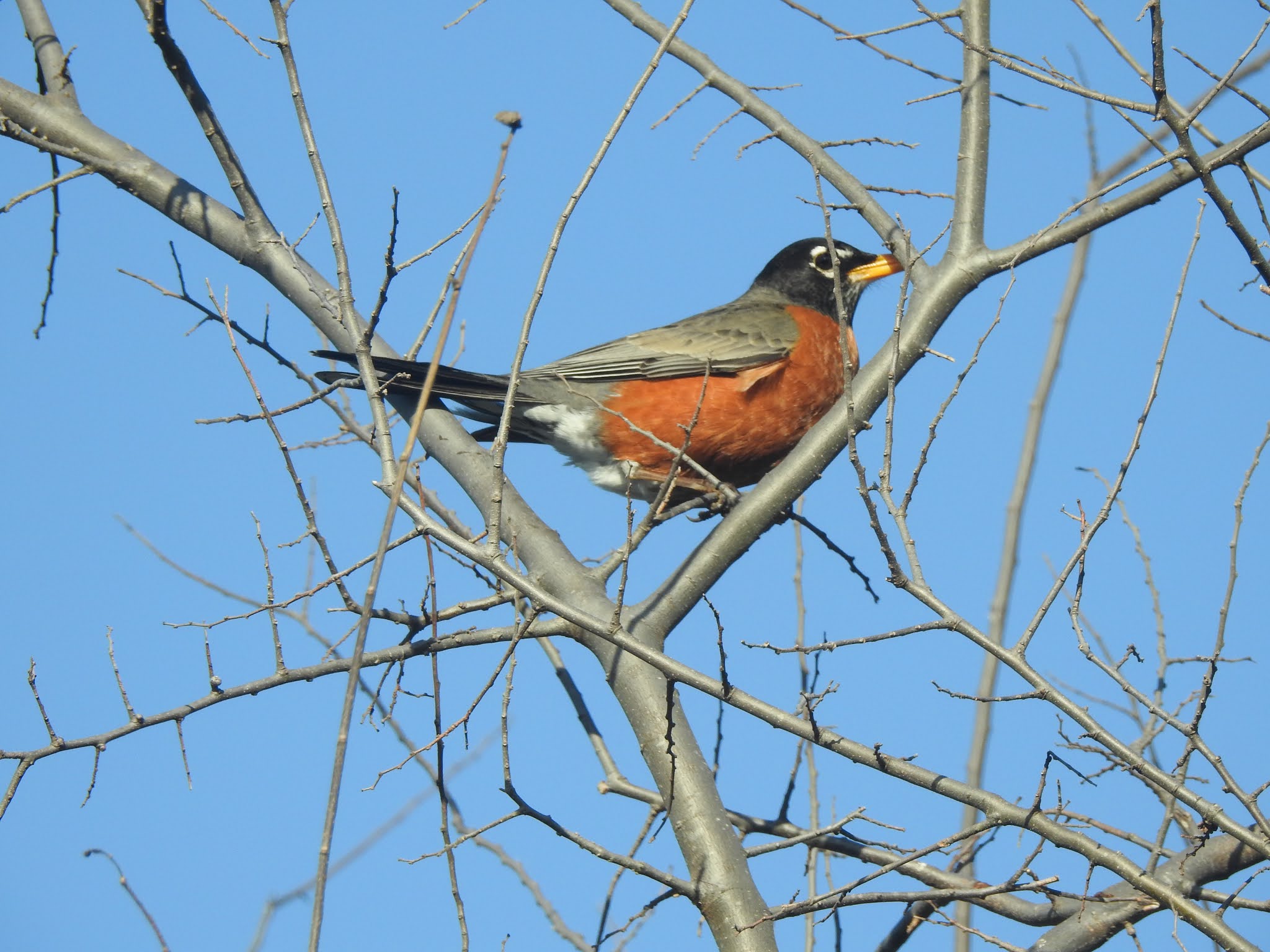
Here is a good example of an animal that moves about for its food.  Twice per year, once in the late fall and the other in the early spring, American Robins (Turdus migratorius) move through the region here in central Texas on the way to their nesting grounds in the northern states, and while passing through they search for food .  They eat bugs, not seeds, and the bugs are classically earthworms. One old robin once said “it’s the early bird that gets the worm” and we know this is true.  The robin is noted for its travels in search of bugs and worms.  At this very moment, flocks of robins are here in central Texas on their way north.  And, they go to the far north, liking not only bugs and worms, but moisture and cool weather that create the environment for their food.  Here in central Texas, especially at this very spot, we seldom see an earth worm, but do have plenty of bugs in the wintertime—right now they appear to have found their food in the screens that cover the gutters of the roof as I can hear them pecking away at the metal screen---that helps us too as it keeps the bugs out of the rainwater collection system, water we use for our drinking water.  So, they have enough food for their short stay.  They will all be gone in a week or less. They have been here for only a few days and will soon be gone on their northward journey.  They never stay here as there too many places both south and north of this location they prefer.  In their breeding season, the summer months, its too hot here.

13.1  American Robin passing through


In our minds, this brings up the story on fish.   Whenever you see a young child fishing, you can count on the child thinking that all water has fish and the fish are equally distributed through the water.   All one should have to do is to bait the hook and cast that into the water and wait.   Depending on whether the fish have found this particular location a good place at which to eat, the wait might be a long time.

It would be an interesting study to determine how much time one needs to fish before learning that fish are to be found where there is food and not necessarily where you choose to cast your lure.  For us, before we began to be more observant of nature, it took many years of fruitless fishing to realize this point.  But the phenomenon of food as the center of concerns exists here with fish too.

Recently a video (youtube) showed a view from a tourist ship moving through the interface of arctic waters and pacific ocean waters.  Observable were many large fish at this interface feasting on the small fish that were visible to them and were flourishing at this fresh water, salt water interface.

Before we pass over it too lightly, isn’t this interface of two waters, fresh and salty a something to note in itself.

13.2 Interfacial water between Arctic and Pacific oceans (youtube)

One often wonders how the fish pass the word to other fish that this is the place to be for food.

Another learned example of the importance of fish feeding at the interface.  My friend and fishing friend David found that fishing the Mississippi River near the end of habitation is often productive for large Seatrout when you can find the interface between salt and fresh water.  If you think about this and look at a map, your natural response is that this area should have no saltwater as it is too far from the salt water of the Gulf of Mexico.

But, not so, salt water has been found near the bottom of the Mississippi River all the way to Baton Rouge.  That is made possible by two factors, one is that the bottom of the riverbed is lower in elevation than the surface of the Gulf and the other is that salt water is “heavier”, that is has a higher specific gravity than does fresh water, allowing the salt water to flow back up the river as the fresh water is flowing to the gulf.  At this interface is food, freshwater food, that the large seatrout find good to eat.

Again, animals go where there is food.  The examples are everywhere.  The backyard birdfeeder, corn for the deer, the list goes on and on.

Now comes the interesting part.

Why do cities exist, especially today?  Of course, the answer is so that people can get "stuff" and to collaborate (for both good and bad reasons).  Focusing on getting stuff, how about food.  Is it more convenient to get food in a city than it is in the countryside?  Sure is, people in rural areas have far less choice and have to travel more distant to get their food.  Imagine a city of 5 million people  and not one garden nor even one producer of beef, chicken or seafood.  People get their food when hundreds of trucks arrive daily to distribution points delivering food from processors across the nation and even from other countries.  People without an income can eat in cities and would find it difficult to procure free food in rural areas.  No doubt about it, cities are like bird feeders. Provide convenient food and people will come.  All a very natural process, but in this case heavy assistance from man himself.

______Sightings_____

Spring is still some many weeks away, but there is some signs that spring will arrive.  The birds that winter here are all in a frenzy for the mating season, the licogiums are up but not blooming, the honey bees are busy on the flowers of the rosemary, the buds have swollen on all the deciduous trees, and so on.

This nice specimen of a buck stepped in front of the lens of the camera and even posed for a second while this picture was taken, then bolted away.  Deer hunting season has closed and I think he made it for another year.

13.3 White tailed deer in Central Texas


Wow! 2024 A year of change

 Looking back over my notes of what happened with the vegetation this year brought back memories of how much of a shift we have seen from pa...